When two medics decided to make Baldur’s Gate, they didn’t have experience with CRPGs. When Mr. Myiamoto directed FZero on SNES he wasn’t a veteran in racing games. When a marketing guy from Ubisoft decided to make a realistic-style JRPG together with a programmer, he didn’t have previous experience in the genre.
Still, many companies publish job offers for specific positions requiring previous experience in the specific genre they are developing. It’s because of the belief that higher skill means faster results, and more important, less risks. This happens a lot on high-quality games and mobile F2P, because these business models became managed in a McKinsian way. And that, kids, is why they are in trouble.
Still, games like PRAGMATA are showing that there are audiences eager to new experiences, with unique blends of mechanics. I don’t know their stories, but I am playing the game and I wouldn’t be surprised if among their team there are designers with no previous experience with 3D action-adventure games. Video games like PRAGMATA are only possible when you are open to a completely different perspective, and when you let people work. I believe it’s hard to find this fit if your job offer filters opportunities out.
Experience within a genre is very important, don’t get me wrong. But the more I work, the more I realize I am full of biases. The more experience I get, the more I push for research and playtesting. New audiences are playing in ways often ignored by a big portion of developers, a sort of tunnel vision you have when you make always the same thing over and over.
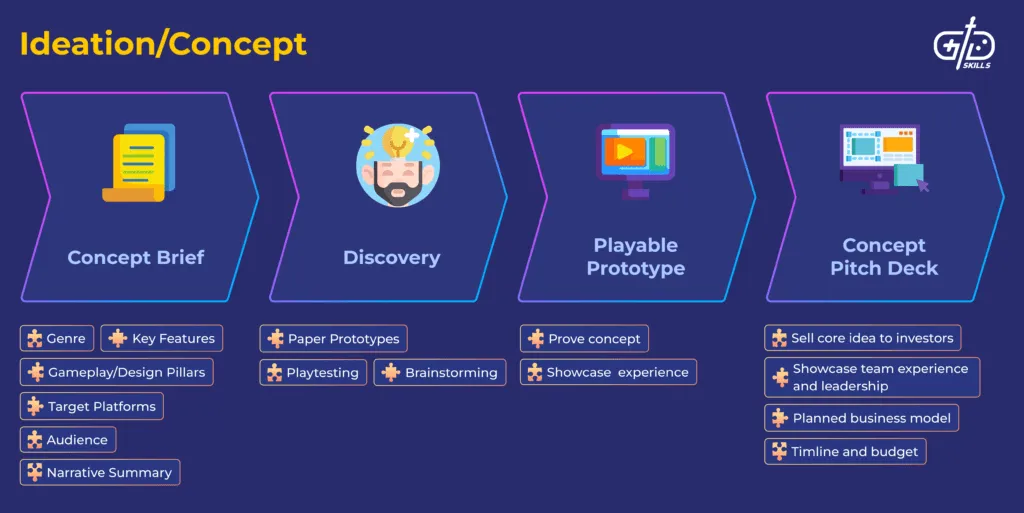
This is one of the reasons that led me to be a freelancer, also if it comes with a price as everything good in our life. Probably the worst one is when a client wants me to tell them the hour using their own clock. They close to proposal, because they don’t really understand (and they actively ignore) the opportunities of ideation stage.
I read the last email that the new CEO of XBox sent to her employees. It is honestly an inspiring take on what’s next for XBOX, I am positive about this person. Maybe the fact she is not a games veteran is good for her actual position. Or maybe I am just a dreamer, I don’t know.
There is one use case that I believe they can tackle pretty “easily”, and position themselves like the platform for everyone they want to become. There are successful f2p midcore titles that occupy too much space on the smartphone. Often they require the latest models to run at the higher quality. I believe that the f2p player doesn’t care of having a copy of what he is playing.
If XBOX manages to become the platform from which you can play the “Genshin Impacts” of the future in cloud on streaming, and maybe engage with mods and UGC for your fav games, there is the chance from them to become THE platform of the future. A sort of Roblox for Mobile f2p games. Of course, there are lots of limitation that may come from Apple and Google. Still, if they manage to do this right, they can really disrupt the market in my opinion.
These days I am playing Clair Obscur: Expedition 33 pretty intensively (when other 40y-old-man-duties permit) these days. And I am also completing my bootcamp on videogames design and conceptualization. A class I gave was based on the 3 main loops of a game, and today I want to apply this knowledge to the 2025 GOTY.
Moment-to-moment (second-to-second)
This first loop is the central one, and it describes what the player does the most. You can say it describes the core dynamic, somehow. In case of Expedition33:
Action: Reactive turn-base combat
Challenge: groups of nevrons (enemies)
Reward: skill points, loot
WHY to repeat this loot: the game is divided in zones within an open world, the Player wants to complete the zone to unlock the next.
Core loop
The core loop is what the Player does the most during the game and gives meaning to the moment-to-moment loop. We can say that it considers the game session as a whole.
Action: Improve team stats
Challenge: complete zone sections
Reward: Advance with the story
WHY to repeat this loot: as any good JRPG it’s about the map! You want to play to unlock new venues and discover new places into the map.
Metagame loop
This loop describes what keeps the Players engaged, what makes them think “I need to return back into the game because I want to…”. Describes the features and mechanics that make me think into the game when I am not playing it. In the case of Expedition33:
Action: defeat bosses
Challenge: what will happen in the story?
Reward: plot twists and secrets discoveries
WHY to repeat this loot: the game is one great adventure story!
Of the many applications of AI in games, I am more interested in those that can unlock new form of experiences. First thing that comes to mind is narrative, of course, but since as a developer you are paying for hosting a server with an LLM I think you need to focus more on the return of the investment on that infrastructure.
One idea is to have new forms of special offers related with the fact that you can or cannot engage with certain systems within a game. Maybe you played heavily during the last event, but you have no time this week. You can say it, and the system can find special solutions for you. Just one example.
Almost every veteran I know—myself included—started by modding, not just “creating.” My journey began with Q-Basic to tweak Gorillas, then modifying voices in Worms, creating custom avatars for Baldur’s Gate, and hacking Diablo hash codes.
The best designers were often protagonists of the modding scene, diving into forums to figure out how to add value to the games they loved.
We’ve seen this cycle before. Tech giants often launch “revolutionary” gaming projects to fuel corporate career leaps, only to abandon them when the next trend arrives. But the real issue is the demand for shortcuts. Some entrepreneurs will try to use Genie3 to chase quick profits with flashy trailers, and some might even succeed in the short term.
Long-term success belongs to those who actually expand the horizons of gaming.
Reaching new audiences and solving the distribution puzzle requires more than a “genie.” It requires deep knowledge. While technocrats push “prompting and scrolling,” the smartest players are busy mastering history, philosophy, and art.
My advice? If you want to break into the market, stop looking for shortcuts. Work hard to engage your audience and start by modding what already exists. Read history books, and myths. Rack your brains, expose your work, and take risks.
You are far more likely to find success through craftsmanship than by playing a “word slot machine” and hoping for a believable game.
I was watching the last Deconstructor of Fun podcast, shooter monthly, on Highguard.
I downloaded the game days ago, completed the tutorial and played three matches. I am not really into hero shooters, but I have to admit that I also had the sensation, as these expert say, that the game was not properly play tested. Which is a common issue in the industry that leads to many games to fail miserably. You need to engage with your future clients, especially with service games. You cannot simply launch early access anymore, early access in current market is perceived as a full launch, especially if you game has been announced in “pompa magna” at The Game Awards by Jeff Keighley in person.
Regarding the market segmentation
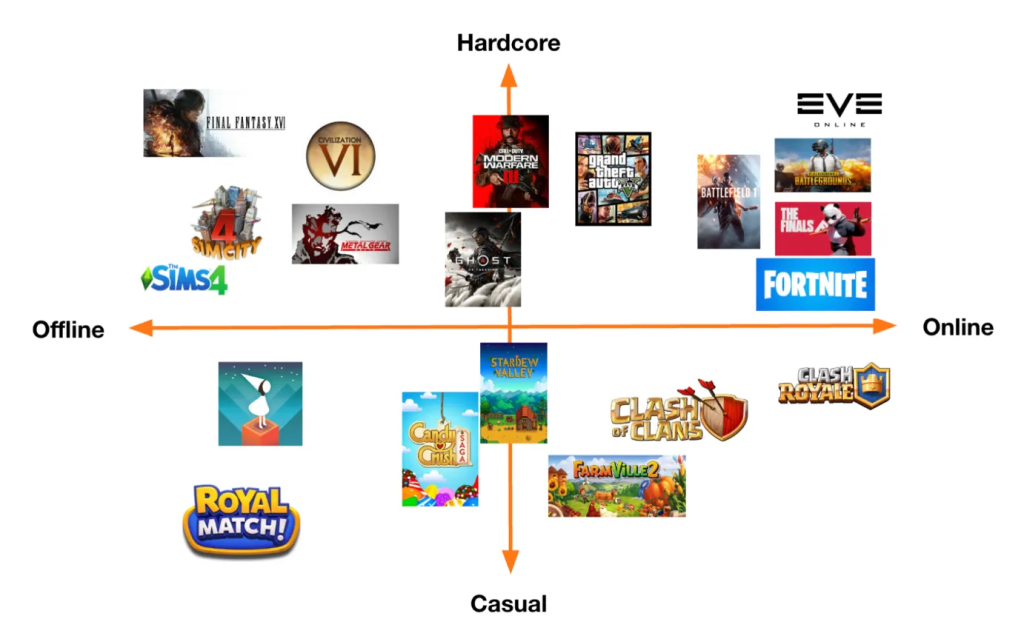
The experts seem to agree (but not fully) on the fact that there are just two kind of profitable shooter genres: tactical and battle royale. I am not sure about that, I prefer this Owen Mahoney’s segmentation:
Owen Mahoney’s view of the industry
I believe that shooter as a genre fits in at least 2 quadrants: online and offline hardcore. Nicholas Lovell also has his view on the industry in general.
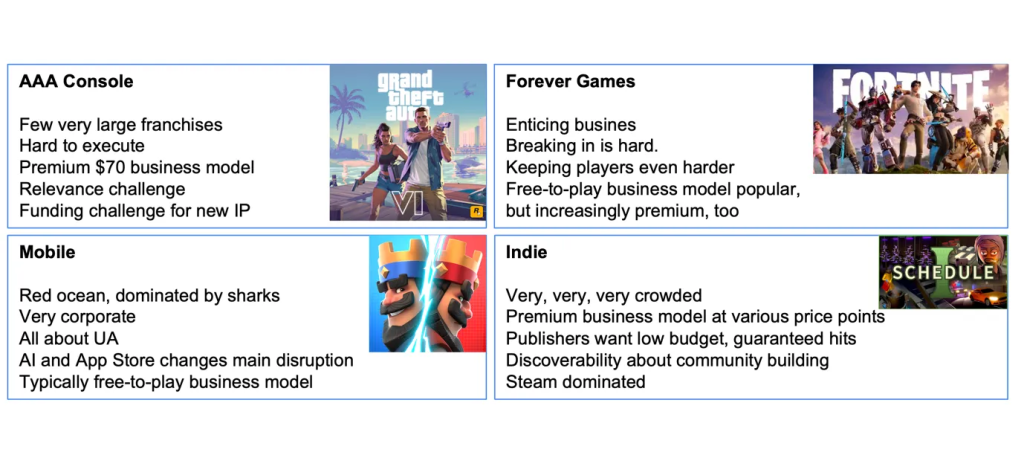
Nicholas Lovell’s view on the industry
And we know there are AAA fps, forever fps like Fortninte, mobile FPS, and also indies who build on top of boomer shooters. Finally, there is Christopher Dring view of the industry:
Under this lens, I see games like STALKER being fps with stories. Fortnite and so on, are for socializing, but also competition/sport. COD and Battlefield as well. Boomer shooters are for passing the time, especially indies like this one.
I believe that the market is more complex and varied than the one pictured by Phillip Black in the DoF shooter monthly podcast.
What I do believe about the game modes
In the podcast, they insisted that the right number of people should be 5vs5 or 3vs3vs3, and I agree with them. But I believe that are also other problems with general game pacing:
Mining crystal is not the best during a shooter session, in my humble opinion. I know it’s a basic in Fortnite, but there you can then build things instantly. Here, instead, is to buy stuff from a vendor.
The vendor itself is slow and boring, can be put in another place
Upgrading/reparing walls is not so exciting, too.
First idea I would try to pitch and eventually design is to buy weapons and repair walls when you die. You die and while you wait, your “soul” can repair stuff. I know, maybe you prefer to watch what is happening, but that can be an extra cam or something while you fix things.
Another thing I noticed is that the most exciting part is when you raid or you need to defend from a raid. Still, I had the feeling that the attackers, the raiders, were stronger than the defenders. Maybe it’s just psychological, but I would like to try something asymmetrical, like 3vs5 (5 defenders).
Running on the horse while shooting is also cool, I remember that from RDR2, which lead designer works for Highguard. Maybe there can be the moment of earning crystals instead of mining.
3 ideas I would pitch:
Buy weapons and manage base on death
Asymmetrical raids
Earn crystals while killing people from the horse
Maybe these would create more exciting/unique moments for Highguard.
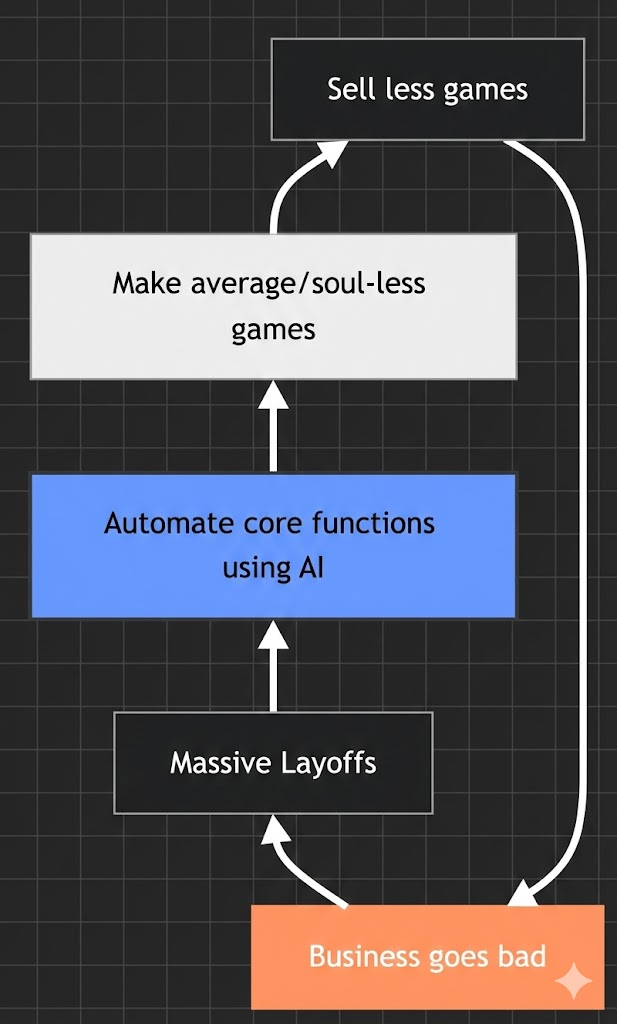
The recent news regarding Ubisoft isn’t just another headline about industry layoffs; it’s a “leading indicator” of a systemic crash. When the numbers don’t add up, the corporate playbook is predictably uninspired: cut the talent, automate the core, and pray the spreadsheet balances itself out.
But creativity isn’t an assembly line, Ubisoft might be the “canary in the coal mine” for an industry chasing its own tail. This isn’t just a trend; it’s a form of “drowning.” When inefficiency (ROI) drops too low, leadership grabs whatever is in reach—AI, NFT initiatives, or massive restructuring—often without even knowing what questions to ask their experts. They are borrowing against a future they don’t understand, hoping that money alone can catch the wind.
The “Glass Ceiling” of the French Elite
A company is only as brave as its leadership, and here we find a significant bottleneck. Ubisoft’s executive team is roughly 90% French, educated at the same elite business schools (ESSEC, ISG), with tenures spanning 30 years.
While these credentials are impressive on paper, they’ve created a cultural monoculture. This “upper-middle-class business elite” is now tasked with innovating for a global, diverse audience they are increasingly disconnected from. When leadership hasn’t seen the inside of another studio in three decades, they stop leading and start rehashing.
The AI Gamble: Partner or “Slop” Generator?
The debate around AI in development is often polarized. Someone argues that AAA gaming is “dead” without AI to reduce the staggering $200m+ budgets. I don’t disagree that budgets are exploding, but I disagree that AI is the silver bullet for quality.
AI isn’t the root of the problem, but it’s a risky “solution”. Relying on a technology that hasn’t yet delivered on its creative promises to save your strategy is a bet, not a plan. If you use AI to generate “slop,” you might save on costs, but you’ll lose the player.
From Rational Design to Brand Decay
Ubisoft once had a superpower: Rational Game Design. It was a method that allowed them to optimize the creation of epic adventures while maintaining a clear vision. But as they chased whales, “Games as a Service,” and unsustainable growth, they lost the creative DNA that made them special.
A software (and AI is just that) cannot solve a brand crisis. AI can’t fix the fact that Ubisoft has distanced itself from player fantasies and instinct—things that aren’t taught in prestigious business schools.
The Opportunity in the Chaos
The failure of long-term vision in these managers is an opening. The collapse of the old guard creates space for those who actually understand imagination and positioning.
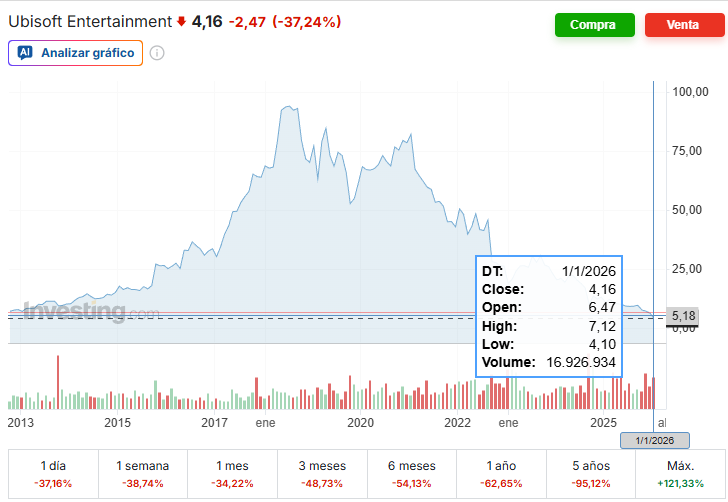
Ubisoft’s stock may be back to 1998 levels, but the talent is still out there. The question is: will they be allowed to lead, or will they be replaced by an algorithm until there’s nothing left to automate?
We use cookies on our website to give you the most relevant experience by remembering your preferences and repeat visits. By clicking “Accept”, you consent to the use of ALL the cookies.
This website uses cookies to improve your experience while you navigate through the website. Out of these, the cookies that are categorized as necessary are stored on your browser as they are essential for the working of basic functionalities of the website. We also use third-party cookies that help us analyze and understand how you use this website. These cookies will be stored in your browser only with your consent. You also have the option to opt-out of these cookies. But opting out of some of these cookies may affect your browsing experience.
Necessary cookies are absolutely essential for the website to function properly. These cookies ensure basic functionalities and security features of the website, anonymously.
Cookie
Duration
Description
cookielawinfo-checkbox-analytics
11 months
This cookie is set by GDPR Cookie Consent plugin. The cookie is used to store the user consent for the cookies in the category "Analytics".
cookielawinfo-checkbox-functional
11 months
The cookie is set by GDPR cookie consent to record the user consent for the cookies in the category "Functional".
cookielawinfo-checkbox-necessary
11 months
This cookie is set by GDPR Cookie Consent plugin. The cookies is used to store the user consent for the cookies in the category "Necessary".
cookielawinfo-checkbox-others
11 months
This cookie is set by GDPR Cookie Consent plugin. The cookie is used to store the user consent for the cookies in the category "Other.
cookielawinfo-checkbox-performance
11 months
This cookie is set by GDPR Cookie Consent plugin. The cookie is used to store the user consent for the cookies in the category "Performance".
viewed_cookie_policy
11 months
The cookie is set by the GDPR Cookie Consent plugin and is used to store whether or not user has consented to the use of cookies. It does not store any personal data.
Functional cookies help to perform certain functionalities like sharing the content of the website on social media platforms, collect feedbacks, and other third-party features.
Performance cookies are used to understand and analyze the key performance indexes of the website which helps in delivering a better user experience for the visitors.
Analytical cookies are used to understand how visitors interact with the website. These cookies help provide information on metrics the number of visitors, bounce rate, traffic source, etc.
Advertisement cookies are used to provide visitors with relevant ads and marketing campaigns. These cookies track visitors across websites and collect information to provide customized ads.