Skip to content

Tag: research

La Coupe du Joueur

Cet article a été écrit à l’origine en italien par Paolo Gambardella. Il a été traduit par un agent d’intelligence artificielle et peut contenir des inexactitudes.

Matthew Ball est devenu le Chief Strategy Officer de XBOX. Dans une récente interview au Summer GameFest 2026, il a déclaré : on sait ce qu’on veut faire, mais on n’est pas encore prêts à l’annoncer au monde.

Je respecte la transparence. Mais le problème que je vois concerne l’ensemble de l’industrie. Les jeux modernes continuent d’être conçus avec une attente implicite : que le joueur ait l’envie, le temps et la patience de traverser une expérience linéaire du début à la fin. Une aventure, un RPG, un narrative game. On vous assoit devant une œuvre à vivre comme un film de 60+ heures. C’est le contrat social.

Je comprends. Final Fantasy VII, The Legend of Zelda, GTA — c’était des expériences dans lesquelles on habitait. Mais qui sont les joueurs d’aujourd’hui ? Pas moi à 13 ans. Ce sont des gamins qui ont grandi sur Roblox, Minecraft, TikTok. Aucune de ces plateformes n’exige de commencer depuis le début pour avoir du sens. Les expériences sont modulaires, relançables, fragmentées.

Roblox n’a pas de fin. Minecraft n’a pas d’histoire principale. TikTok n’a pas non plus d’épisode 1. Ce sont des features architecturales qui reflètent la façon dont les nouvelles générations consomment l’expérience numérique.

La coupe du joueur

J’ai eu une idée simple et peut-être un peu radicale. Et si on concevait un jeu long — un RPG, une aventure — non pas pour être raccourci, mais pour être monté par le joueur lui-même ?

La règle de base : il ne s’agit pas de supprimer du contenu. Il s’agit de donner au joueur les outils pour assembler sa propre expérience.

Caractéristiques du système

Build paths différenciés. Un guerrier et un mage dans la même aventure devraient avoir des parcours différents. Imaginez donc la même histoire, mais filtrée à travers les compétences du personnage. Vous choisissez un personnage et jouez une phase selon ses caractéristiques. Puis vous passez à la suivante, ou vous rejouez la même section avec un autre spécialiste.

Entry points narratifs. Comme dans une série TV avec des épisodes autoconclusifs, chaque session devrait avoir un début et une fin reconnaissables. Le joueur qui revient après trois semaines n’a pas à tout reprendre de zéro mentalement : il peut entrer par un point d’accès conçu à cet effet, avec un bref récap contextualisé.

Rythme variable, pas difficulté variable. Au début de chaque session, le jeu vous demande implicitement : vous avez 20 minutes ou trois heures ? Le flux s’adapte. C’est respecter le temps réel du joueur.

Skip intelligent sans pénalité. Si vous avez déjà complété une quête similaire, ou si la phase est ennuyeuse, le système vous permet de résumer et de passer (sans perdre de récompenses, dans l’idéal). Le choix vous appartient toujours. Le jeu ne vous punit pas de l’avoir fait.

La coupe comme agency. La vérité, c’est ça : dans les jeux, la liberté réside dans ce que vous décidez de ne pas faire. Les jeux cinématographiques courent le risque de se réduire à des marqueurs de carte, des checklists, des indicateurs de complétion, et ainsi de suite. Tout conçu pour s’assurer que vous ne ratez rien.

Qu’est-ce que ce système résoudrait ?

La peur de l’industrie, c’est : moins de contenu = valeur perçue moindre = moins d’achats. Mais regardez Roblox. Chaque expérience dure 15 à 30 minutes, et la plateforme est « infinie ». L’architecture modulaire multiplie la valeur. Un RPG de 80 heures qui respecte vos rythmes vaut plus qu’un RPG de 80 heures qui vous fait culpabiliser quand vous vous arrêtez.

Matthew Ball a refusé de répondre à beaucoup de questions. Mais celle que le présentateur ne lui a pas posée, c’est celle-ci : êtes-vous en train de repenser le format du produit, ou seulement la plateforme ?

Parce que si les jeux continuent d’attendre un joueur qui s’assoit pour 40 heures d’affilée, vous ne perdrez pas les nouvelles générations à cause de Roblox. Vous les perdrez parce que vous n’avez pas changé de langage. Roblox, c’est juste la langue qu’ils parlent déjà.
Ocarina of Time : leçon magistrale sur la conception d’une tragédie

Cet article a été écrit à l’origine en italien par Paolo Gambardella. Il a été traduit par un agent d’intelligence artificielle et peut contenir des inexactitudes.

Il y a un article de Renan Fontes sur Goomba Stomp qui analyse The Legend of Zelda: Ocarina of Time comme une tragédie classique. Link perd son enfance pour sauver un monde auquel il ne peut plus revenir, et même quand Zelda le renvoie dans le passé, c’est la confirmation définitive de cette perte.

Ça vaut le coup d’être lu. Je l’ai fait à l’occasion de l’annonce du remake de ce grand classique.

Le mécanisme tragique

Le cœur de la thèse de Fontes est simple : Link est un orphelin de guerre, déjà séparé des Kokiris avant même que l’histoire ne commence. L’Épée du Courage le punit de son impatience avec sept ans de sommeil. En se réveillant adulte dans un Hyrule dévasté, il est devenu quelqu’un d’autre.

Dans le dénouement, Zelda renvoie Link dans le passé, mais Navi s’en va exactement à ce moment-là. Même si tu pouvais redevenir enfant, toi, tu ne serais plus le même. Le temps vécu ne s’efface pas.

Cette sensation ne vient pas du récit écrit en lui-même, mais de la façon dont le jeu a été construit autour d’une identité émotionnelle cohérente, et de la façon dont les moments marquants ont été distribués avec soin.

Peak-End : les moments qui restent

La psychologie du peak-end nous dit que les gens ne se souviennent pas d’une expérience comme de la moyenne de chaque seconde vécue. Ils se souviennent des pics émotionnels et de la fin. Le reste sédimente, mais ne détermine pas le jugement.

Dans OoT, le pic, c’est probablement le départ de Navi. C’est le silence dans le Temple du Temps quand le monde reprend forme. C’est Saria qui dit au revoir sans savoir que c’est un adieu définitif.

Un jeu quelconque aurait placé le pic émotionnel dans le combat contre le boss. OoT le place dans la perte silencieuse. Le final (Link enfant dans la cour du château, Zelda qui le regarde de loin) ne referme rien. Il laisse une plaie ouverte. Cette plaie que les joueurs portent avec eux pendant des décennies. La même qui, personnellement, m’a changé en profondeur.

Leçon : le pic le plus puissant ne coïncide souvent pas avec le climax mécanique. Si tu veux qu’une expérience soit mémorisée d’une certaine façon, conçois le souvenir, plutôt que l’événement.

La promesse émotionnelle

OoT a une identité émotionnelle précise : mélancolie héroïque. Le sentiment que grandir coûte quelque chose d’irrécupérable, et que le courage ne t’épargne pas de le payer.

Chaque élément du jeu est chargé de cette atmosphère. La musique (Saria’s Song, le Bolero of Fire, la Song of Time) anticipe l’action et la commente. Les temples ressemblent à des endroits abandonnés par quelqu’un qui aimait encore y être. Hyrule Field la nuit est grande et silencieuse comme une promesse qui pourrait ne pas tenir.

Quand un jeu sait quelle est sa promesse émotionnelle, chaque choix devient cohérent. Les couleurs, le silence dans les dialogues, la distance entre les personnages sont des vecteurs de la même sensation.

Leçon : en parallèle de la conception des mécaniques ou des systèmes, ça vaut la peine de nommer précisément l’émotion que tu veux laisser derrière toi. Je recommande quelque chose de spécifique. Ça peut donner lieu à des conversations inconfortables avec l’équipe ou la hiérarchie. Mais c’est important.

Player Need Satisfaction : pourquoi la perte fait mal

La Self-Determination Theory divise les besoins psychologiques fondamentaux en trois domaines : l’autonomie (je sens que j’agis), la compétence (je sens que je progresse), l’appartenance (je sens que je fais partie de quelque chose).

OoT est une tragédie aussi parce qu’il les satisfait tous les trois, avant de les retirer juste avant le générique de fin.

Tu as l’autonomie : tu choisis où aller, quand revenir, comment utiliser les outils. Tu as la compétence : tu deviens adulte, tu bats des ennemis impossibles, tu maîtrises des magies. Tu as l’appartenance : Saria, Navi, Malon, les sages ; un réseau de liens construit pièce par pièce.

Puis le jeu démonte tout.

  • Saria est piégée dans la forêt pour toujours
  • Navi s’en va sans explication
  • Zelda te renvoie en arrière, mais la version de toi qui a vécu ces sept ans ne peut pas revenir.

Leçon : la perte dans un jeu fait mal en proportion de ce que le joueur avait investi dans la construction de quelque chose. Si tu veux qu’un final tragique ait du poids, les besoins psychologiques doivent avoir été satisfaits avant d’être niés.

Conclusion

Fontes a écrit une analyse narrative. Mais en dessous, il y a quelque chose de plus intéressant : OoT fonctionne comme une tragédie parce que les choix de design et les choix narratifs pointent dans la même direction. C’est de la cohérence. Et je suis heureux que ma fille puisse revivre dans une version mise à jour cette grande expérience.

Lire l’article original sur Goomba Stomp

Ne vous laissez pas distraire

Cet article a été écrit à l’origine en italien par Paolo Gambardella. Il a été traduit par un agent d’intelligence artificielle et peut contenir des inexactitudes.

Cette semaine avait lieu le Sony State of Play, et le nouveau God of War y a été présenté. Le jeu met en scène la femme de Kratos comme protagoniste, accompagnée d’un cube comme compagnon — loin de ce à quoi on pourrait s’attendre. Après l’événement, je scrollais sur LinkedIn, et les “experts” avaient tous leur mot à dire. Le personnage est raté. Le cube ne tient pas la route. Changer le sexe du protagoniste n’a jamais marché pour d’autres franchises.

Regarder la réaction d’une personne qui a vraiment travaillé sur le jeu vaut cent fois mieux que tous ces posts LinkedIn réunis. Honnêtement, je commence à en avoir marre des gens qui exploitent cette capacité des algorithmes à propulser les posts polémiques. Surtout quand ces personnes ne font pas de jeux vidéo, elles ne sont pas dans les tranchées. Je préfère entendre la passion de ceux qui bossent vraiment sur des jeux.

Autre chose que je veux souligner : Santa Monica Studios a largement prouvé qu’ils étaient capables de faire des jeux à succès. On devrait tous respecter l’expérience et reconnaître que ceux qui en savent plus que nous ont probablement raison. Je suis en train d’arrêter de suivre les podcasts et les chaînes qui ne font que polémiques, parce qu’ils distraient de ce qui compte vraiment.

Freshness is safer in ideation stage

When two medics decided to make Baldur’s Gate, they didn’t have experience with CRPGs. When Mr. Myiamoto directed FZero on SNES he wasn’t a veteran in racing games. When a marketing guy from Ubisoft decided to make a realistic-style JRPG together with a programmer, he didn’t have previous experience in the genre.

Still, many companies publish job offers for specific positions requiring previous experience in the specific genre they are developing. It’s because of the belief that higher skill means faster results, and more important, less risks. This happens a lot on high-quality games and mobile F2P, because these business models became managed in a McKinsian way. And that, kids, is why they are in trouble.

Still, games like PRAGMATA are showing that there are audiences eager to new experiences, with unique blends of mechanics. I don’t know their stories, but I am playing the game and I wouldn’t be surprised if among their team there are designers with no previous experience with 3D action-adventure games. Video games like PRAGMATA are only possible when you are open to a completely different perspective, and when you let people work. I believe it’s hard to find this fit if your job offer filters opportunities out.

Experience within a genre is very important, don’t get me wrong. But the more I work, the more I realize I am full of biases. The more experience I get, the more I push for research and playtesting. New audiences are playing in ways often ignored by a big portion of developers, a sort of tunnel vision you have when you make always the same thing over and over.

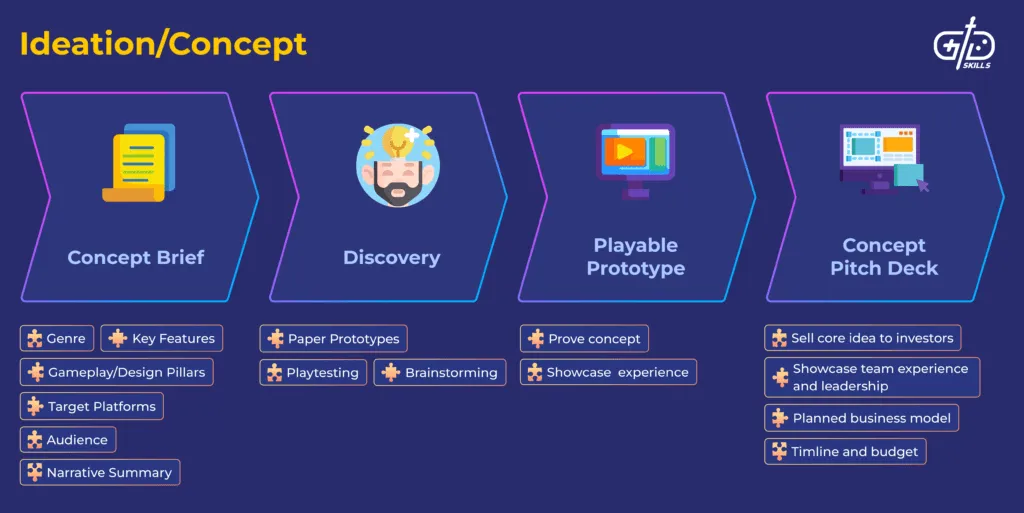
read more: https://gamedesignskills.com/game-development/stages-of-game-development-process/

This is one of the reasons that led me to be a freelancer, also if it comes with a price as everything good in our life. Probably the worst one is when a client wants me to tell them the hour using their own clock. They close to proposal, because they don’t really understand (and they actively ignore) the opportunities of ideation stage.

A potential use case for Microsoft

I read the last email that the new CEO of XBox sent to her employees. It is honestly an inspiring take on what’s next for XBOX, I am positive about this person. Maybe the fact she is not a games veteran is good for her actual position. Or maybe I am just a dreamer, I don’t know.

There is one use case that I believe they can tackle pretty “easily”, and position themselves like the platform for everyone they want to become. There are successful f2p midcore titles that occupy too much space on the smartphone. Often they require the latest models to run at the higher quality. I believe that the f2p player doesn’t care of having a copy of what he is playing.

If XBOX manages to become the platform from which you can play the “Genshin Impacts” of the future in cloud on streaming, and maybe engage with mods and UGC for your fav games, there is the chance from them to become THE platform of the future. A sort of Roblox for Mobile f2p games. Of course, there are lots of limitation that may come from Apple and Google. Still, if they manage to do this right, they can really disrupt the market in my opinion.

Three loops of Expedition 33

These days I am playing Clair Obscur: Expedition 33 pretty intensively (when other 40y-old-man-duties permit) these days. And I am also completing my bootcamp on videogames design and conceptualization. A class I gave was based on the 3 main loops of a game, and today I want to apply this knowledge to the 2025 GOTY.

Moment-to-moment (second-to-second)

This first loop is the central one, and it describes what the player does the most. You can say it describes the core dynamic, somehow. In case of Expedition33:

  • Action: Reactive turn-base combat
  • Challenge: groups of nevrons (enemies)
  • Reward: skill points, loot

WHY to repeat this loot: the game is divided in zones within an open world, the Player wants to complete the zone to unlock the next.

Core loop

The core loop is what the Player does the most during the game and gives meaning to the moment-to-moment loop. We can say that it considers the game session as a whole.

  • Action: Improve team stats
  • Challenge: complete zone sections
  • Reward: Advance with the story

WHY to repeat this loot: as any good JRPG it’s about the map! You want to play to unlock new venues and discover new places into the map.

Metagame loop

This loop describes what keeps the Players engaged, what makes them think “I need to return back into the game because I want to…”. Describes the features and mechanics that make me think into the game when I am not playing it. In the case of Expedition33:

  • Action: defeat bosses
  • Challenge: what will happen in the story?
  • Reward: plot twists and secrets discoveries

WHY to repeat this loot: the game is one great adventure story!

A simple idea for AI in games

Of the many applications of AI in games, I am more interested in those that can unlock new form of experiences. First thing that comes to mind is narrative, of course, but since as a developer you are paying for hosting a server with an LLM I think you need to focus more on the return of the investment on that infrastructure.

One idea is to have new forms of special offers related with the fact that you can or cannot engage with certain systems within a game. Maybe you played heavily during the last event, but you have no time this week. You can say it, and the system can find special solutions for you. Just one example.

In the blacksmith’s house, a wooden skewer

The recent stock market fluctuations following the arrival of AI tech that promises to generate interactive worlds from simple prompts speak volumes about the current lack of video game literacy.

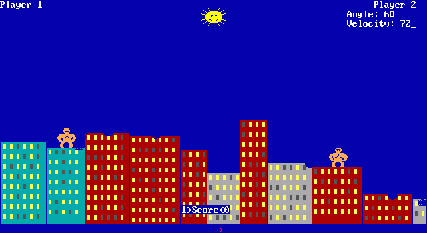
Almost every veteran I know—myself included—started by modding, not just “creating.” My journey began with Q-Basic to tweak Gorillas, then modifying voices in Worms, creating custom avatars for Baldur’s Gate, and hacking Diablo hash codes.

https://en.wikipedia.org/wiki/Gorillas_(video_game)

The best designers were often protagonists of the modding scene, diving into forums to figure out how to add value to the games they loved.

We’ve seen this cycle before. Tech giants often launch “revolutionary” gaming projects to fuel corporate career leaps, only to abandon them when the next trend arrives. But the real issue is the demand for shortcuts. Some entrepreneurs will try to use Genie3 to chase quick profits with flashy trailers, and some might even succeed in the short term.

Long-term success belongs to those who actually expand the horizons of gaming.

Reaching new audiences and solving the distribution puzzle requires more than a “genie.” It requires deep knowledge. While technocrats push “prompting and scrolling,” the smartest players are busy mastering history, philosophy, and art.

My advice? If you want to break into the market, stop looking for shortcuts. Work hard to engage your audience and start by modding what already exists. Read history books, and myths. Rack your brains, expose your work, and take risks.

You are far more likely to find success through craftsmanship than by playing a “word slot machine” and hoping for a believable game.

My take on Highguard

I was watching the last Deconstructor of Fun podcast, shooter monthly, on Highguard.

I downloaded the game days ago, completed the tutorial and played three matches. I am not really into hero shooters, but I have to admit that I also had the sensation, as these expert say, that the game was not properly play tested. Which is a common issue in the industry that leads to many games to fail miserably. You need to engage with your future clients, especially with service games. You cannot simply launch early access anymore, early access in current market is perceived as a full launch, especially if you game has been announced in “pompa magna” at The Game Awards by Jeff Keighley in person.

Regarding the market segmentation

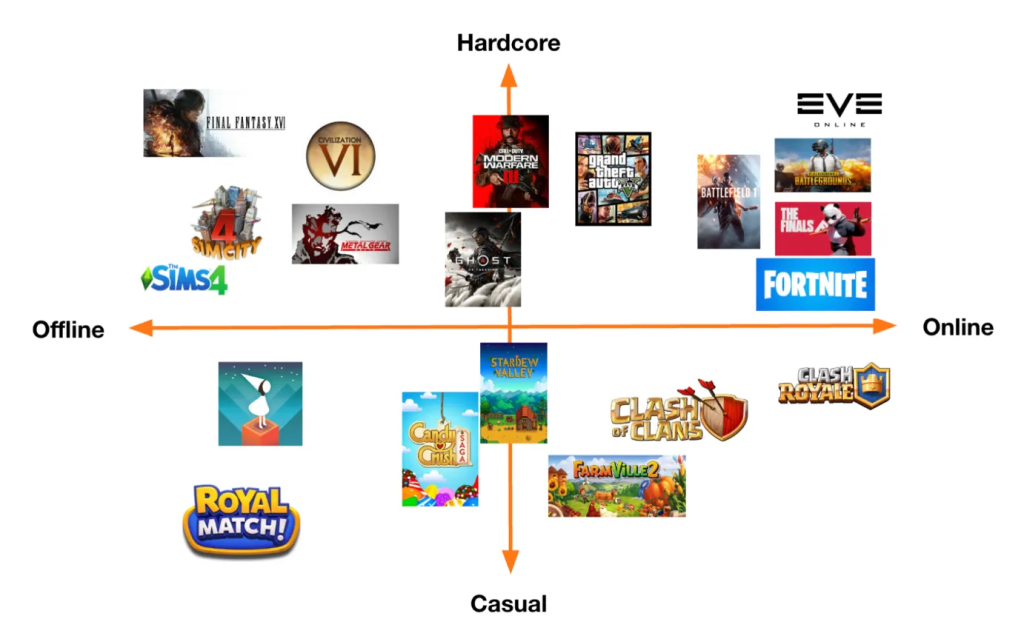
The experts seem to agree (but not fully) on the fact that there are just two kind of profitable shooter genres: tactical and battle royale. I am not sure about that, I prefer this Owen Mahoney’s segmentation:

Owen Mahoney’s view of the industry

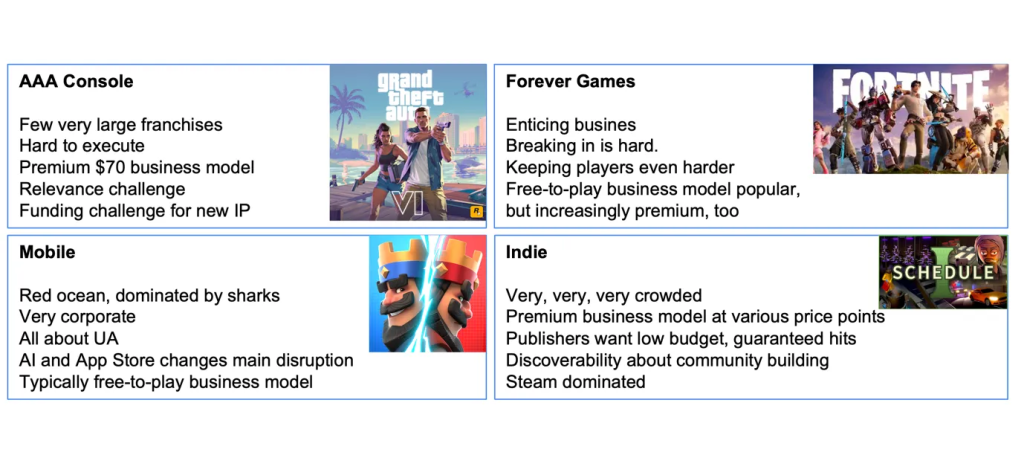
I believe that shooter as a genre fits in at least 2 quadrants: online and offline hardcore. Nicholas Lovell also has his view on the industry in general.

Nicholas Lovell’s view on the industry

And we know there are AAA fps, forever fps like Fortninte, mobile FPS, and also indies who build on top of boomer shooters. Finally, there is Christopher Dring view of the industry:

watch here: https://www.thegamebusiness.com/p/there-is-no-such-thing-as-a-video

Under this lens, I see games like STALKER being fps with stories. Fortnite and so on, are for socializing, but also competition/sport. COD and Battlefield as well. Boomer shooters are for passing the time, especially indies like this one.

I believe that the market is more complex and varied than the one pictured by Phillip Black in the DoF shooter monthly podcast.

What I do believe about the game modes

In the podcast, they insisted that the right number of people should be 5vs5 or 3vs3vs3, and I agree with them. But I believe that are also other problems with general game pacing:

  • Mining crystal is not the best during a shooter session, in my humble opinion. I know it’s a basic in Fortnite, but there you can then build things instantly. Here, instead, is to buy stuff from a vendor.
  • The vendor itself is slow and boring, can be put in another place
  • Upgrading/reparing walls is not so exciting, too.

First idea I would try to pitch and eventually design is to buy weapons and repair walls when you die. You die and while you wait, your “soul” can repair stuff. I know, maybe you prefer to watch what is happening, but that can be an extra cam or something while you fix things.

Another thing I noticed is that the most exciting part is when you raid or you need to defend from a raid. Still, I had the feeling that the attackers, the raiders, were stronger than the defenders. Maybe it’s just psychological, but I would like to try something asymmetrical, like 3vs5 (5 defenders).

Running on the horse while shooting is also cool, I remember that from RDR2, which lead designer works for Highguard. Maybe there can be the moment of earning crystals instead of mining.

3 ideas I would pitch:

  1. Buy weapons and manage base on death
  2. Asymmetrical raids
  3. Earn crystals while killing people from the horse

Maybe these would create more exciting/unique moments for Highguard.

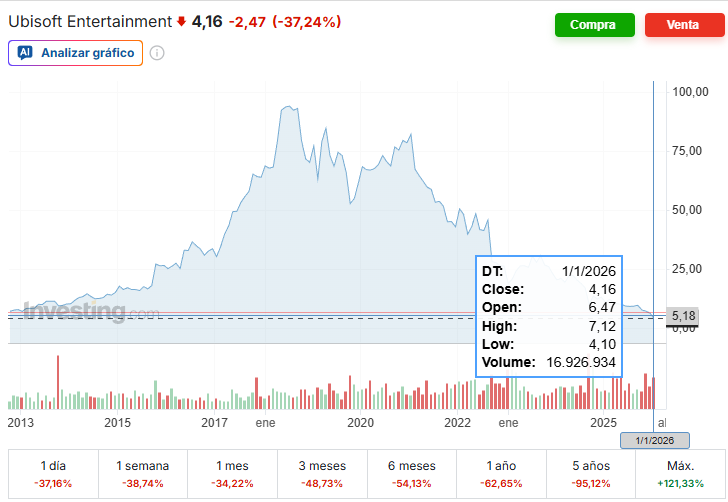
Ubisoft and the “Efficiency Trap”: Why Algorithmic Logic Can’t Save a Lost Vision

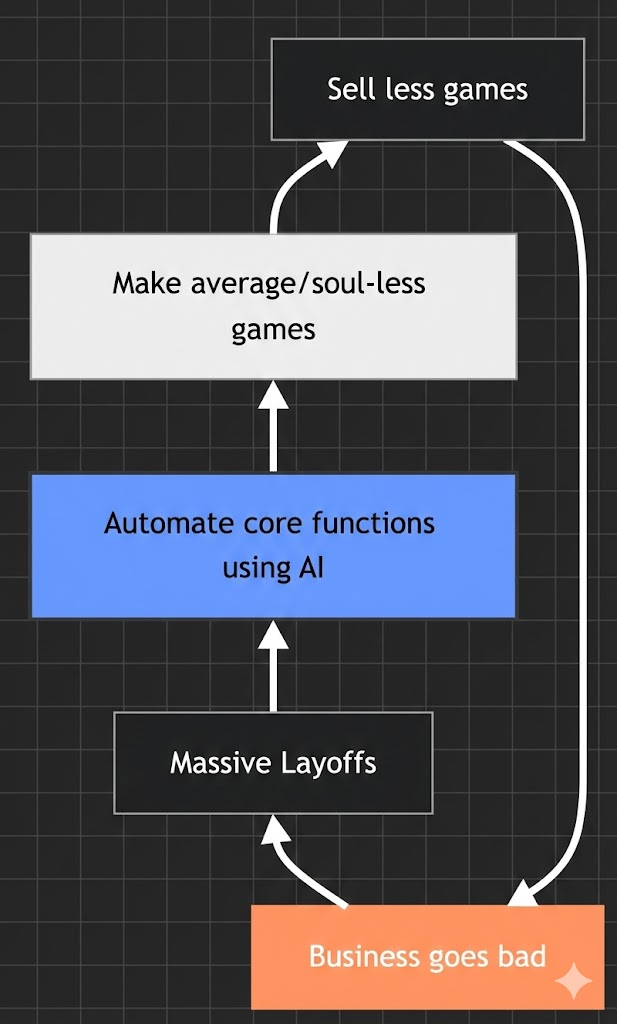
The recent news regarding Ubisoft isn’t just another headline about industry layoffs; it’s a “leading indicator” of a systemic crash. When the numbers don’t add up, the corporate playbook is predictably uninspired: cut the talent, automate the core, and pray the spreadsheet balances itself out.

But creativity isn’t an assembly line, Ubisoft might be the “canary in the coal mine” for an industry chasing its own tail. This isn’t just a trend; it’s a form of “drowning.” When inefficiency (ROI) drops too low, leadership grabs whatever is in reach—AI, NFT initiatives, or massive restructuring—often without even knowing what questions to ask their experts. They are borrowing against a future they don’t understand, hoping that money alone can catch the wind.

The “Glass Ceiling” of the French Elite

A company is only as brave as its leadership, and here we find a significant bottleneck. Ubisoft’s executive team is roughly 90% French, educated at the same elite business schools (ESSEC, ISG), with tenures spanning 30 years.

While these credentials are impressive on paper, they’ve created a cultural monoculture. This “upper-middle-class business elite” is now tasked with innovating for a global, diverse audience they are increasingly disconnected from. When leadership hasn’t seen the inside of another studio in three decades, they stop leading and start rehashing.

The AI Gamble: Partner or “Slop” Generator?

The debate around AI in development is often polarized. Someone argues that AAA gaming is “dead” without AI to reduce the staggering $200m+ budgets. I don’t disagree that budgets are exploding, but I disagree that AI is the silver bullet for quality.

AI isn’t the root of the problem, but it’s a risky “solution”. Relying on a technology that hasn’t yet delivered on its creative promises to save your strategy is a bet, not a plan. If you use AI to generate “slop,” you might save on costs, but you’ll lose the player.

From Rational Design to Brand Decay

Ubisoft once had a superpower: Rational Game Design. It was a method that allowed them to optimize the creation of epic adventures while maintaining a clear vision. But as they chased whales, “Games as a Service,” and unsustainable growth, they lost the creative DNA that made them special.

A software (and AI is just that) cannot solve a brand crisis. AI can’t fix the fact that Ubisoft has distanced itself from player fantasies and instinct—things that aren’t taught in prestigious business schools.

The Opportunity in the Chaos

The failure of long-term vision in these managers is an opening. The collapse of the old guard creates space for those who actually understand imagination and positioning.

Ubisoft’s stock may be back to 1998 levels, but the talent is still out there. The question is: will they be allowed to lead, or will they be replaced by an algorithm until there’s nothing left to automate?