Skip to content

Paolo's Blog Posts

Two Days, Two AIs, and a Princess Turned into a Melon

This post was originally written in Italian by Paolo Gambardella. It has been translated by an AI agent and may contain inaccuracies.

Last week a colleague showed me an interesting video: a game dev getting ChatGPT’s Astra and Claude’s Fable 5.1 to work together inside Unreal Engine, to build a Souls-like boss fight.

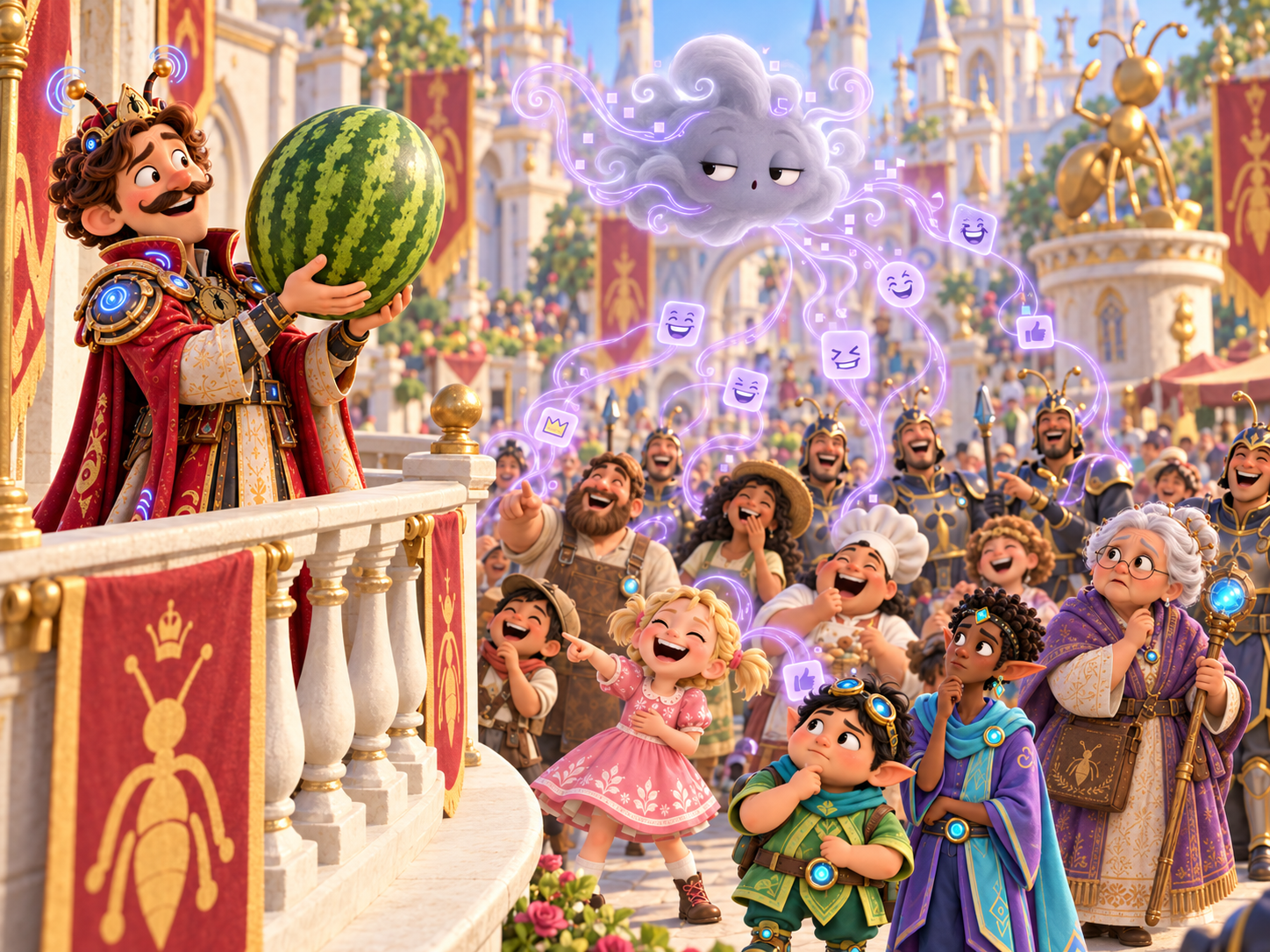
The video itself is about game development, but what struck me was seeing two different AIs working on the same material rather than just one. It reminded me of a story I’d had in my head for a while — “Princess Melon”: I’ve been telling it to my daughter Maria Laura at bedtime since she was born, and over the past month I’ve actually sat down and written it up properly in my spare time. So I thought: why not try the same thing myself, with Claude and ChatGPT, but to finally put a face to its characters?

I spent two days getting the two services to talk to each other: one would propose a character, the other would refine or build on it, until we landed on a consistent cast across all the illustrations — from King Ant to the Little Mist, who feeds on the gossip of people who judge without looking. The process helped me understand who these characters really are, and gave me a much clearer picture of the story itself. When I showed Maria Laura the princess and the friends I tell her about every night, her jaw dropped: for the first time she could see them, not just hear about them.

This morning at the gym I was already thinking about the next step: getting in touch with a professional illustrator to give the book a proper, original look — and maybe, who knows, self-publishing my first fairy tale.

There’s a small irony in all of this. “Princess Melon” is about a Little Mist who thrives on “apparently…” and people who laugh before they’ve even bothered to look for themselves. When I read the comments from the usual modern-day luddites, quick to pass judgement on AI instead of actually trying it, I feel like I’ve somehow wandered into my own fairy tale.

Princess Melon presented to the kingdom

The Business I Chose

This post was originally written in Italian by Paolo Gambardella. It has been translated by an AI agent and may contain inaccuracies.

Yesterday I watched this interview with the CEO of Bulkhead, the studio behind Wardogs, an online multiplayer first-person shooter.

I knew the reaction would come instantly, and that this person’s words were perfect fodder for easy clicks and LinkedIn hot takes against crunch.

Today, a writer friend sends me this piece by another writer.

The business I chose

Nobody forced me into game development. My real passion is thinking about what kind of experience to bring to the medium. The part I enjoy most is discovering new cultures and finding brilliant people to talk and argue with about creative things. My dream is to put my name on a few games that actually leave a mark.

I don’t make games to get rich, and I don’t make them alone — though I had to try it on my own to figure that out. I make games because that’s the choice I made, pure love for it, if you like. Since I spend most of my waking hours at work, it matters to me to try and build something genuinely grand, rather than just tend a small, tidy little patch.

And when I work for others, I always look for projects that excite me. I don’t work just to pay the bills — I try to work on things I actually care about. And that sometimes comes at a cost: a mind that never quite switches off, extra hours, time taken away from my family.

The same was true for the family I grew up in. My mother, a paediatrician, worked far more hours than she was ever required to. My father, a lawyer, would pull all-nighters to draft briefs. My brother is a judge and he too has to do gruelling shifts with no extra pay. My family taught me that crunch doesn’t really exist as a concept — there are just things that need doing, and those things take time.

Recently I chose to move from mobile free-to-play to PC and console games, and that comes with a serious amount of extra hours. This is what I chose, and I know the consequences. We talk about our rights an awful lot, and about our responsibilities hardly at all.

The Pleasure of Walking

This post was originally written in Italian by Paolo Gambardella. It has been translated by an AI agent and may contain inaccuracies.

Lately it feels like mistakes aren’t just piling up — they’re compounding exponentially. New technologies let us get from point A to point B sometimes almost instantly. But that very thing makes us miss out on opportunities that could turn out to be essential.

Imagine that this weekend you decide to visit a museum in your city. Imagine you have a helicopter at your disposal that picks you up from home and takes you straight there. A helicopter ride is fun (I assume — I’ve never been on one), so let’s say the price you pay is falling asleep for the journey. The upside is that you arrive at your destination immediately. But you lose everything else along the way: if you’d walked, you might have bumped into an old friend en route. Or, who knows, stumbled across a café doing a great breakfast. Or spotted a sign announcing the opening of another cultural centre and decided to head there instead. Sure, walking is more tiring, and slower — but it’s full of possibilities.

Right, well — in game design today you can generate a feature spec almost instantly. Your boss tells you to work on a feature, gives you a week, and within two hours you’ve already got a solid base to work from. All thanks to algorithms built essentially on probability, running on enormously powerful hardware, capable of producing structured, reasonably coherent documentation in next to no time. Far less time than you or I would need, that’s for sure.

The problem is what gets lost along the way: the chance to discover other things, to pick up new ideas and angles. But your boss gave you a week and you’re delivering in two days, so your OKR is probably going to look great — even if what you’re not doing is actually discovering anything new.

So where does that leave us? My own preference is pretty clear. For me, a true professional needs to take the time to do things properly — creativity needs constraints, yes, but it also needs time.

How to Stand Out Online

This post was originally written in Italian by Paolo Gambardella. It has been translated by an AI agent and may contain inaccuracies.

There’s a worrying trend that has quite literally exploded over the past few months, at least in my social feeds: posting drafts and half-finished work.

I see established professionals posting rough gameplay examples, presumably to catch the eye of a potential client or employer. I see junior people posting screenshots from 3D authoring tools or game engines, probably to demonstrate their skills.

Noise. Nothing but noise.

I understand the anxiety around wanting to carve out a place in the industry, and I’m all for the drive to get things done — but the problem is what we’re actually showing.

  • If your goal is to develop your indie game, think about serving an audience rather than collecting reactions on LinkedIn
  • If you’re looking for a job, nobody’s going to hire you just because you can open a piece of software.

The reality of the industry

I was reading yesterday this very interesting post by an industry leader — one of the most clear-eyed takes I’ve seen in months. The reality is that we’re in a moment of consolidation (not a crash, as some people like to say), where the investor narrative can’t promise growth anymore. There’s an enormous amount of talent out there looking for work right now, which makes it genuinely hard to stand out.

This naturally leads people to think that standing out and differentiating yourself is what matters. And in a way, that’s true — but I don’t think speed is the key factor here. Posting half-finished work does get your voice out there sooner, yes. But it also shows your scrappy, unpolished side.

So how do you actually stand out?

I don’t have a magic formula, but I’ve been in the industry for years and built my own position from scratch, so I do know a thing or two. The most important thing is the relationships you build with other people — anything you can do to build them better is worth doing.

If you’re an indie developer looking to get visibility for your project, you need to do everything you can to connect with your early adopters as soon as possible. Find out where they are, talk to them, genuinely try to understand how they play, what they buy and why. If you’re putting together a video to grab attention, do it with the right level of polish.

If you’re a professional without much experience, rather than showing things that frankly anyone can do (look, here’s my axe on ArtStation!), put in the work to figure out what makes you unique, and show that in the best way you can. Nobody cares about the how — they care about the end result and why you believe it’s strong.

If you’re an experienced professional, there’s no point showing off that you built a new prototype in a few minutes. Instead, focus on helping people understand why working with you is a good idea. Nurture the relationships you already have, teach what you genuinely know — videos work well for this. Help people see that you’ve learned to think deeply about certain things.

Less slop, less spam, and more real connections and genuine knowledge-sharing!

The Ocarina is Immortal

This post was originally written in Italian by Paolo Gambardella. It has been translated by an AI agent and may contain inaccuracies.

The big moment has finally arrived: my all-time favourite game has been announced as a remake.

This game belongs to a different era — one where we all looked to the future with curiosity. The opposite of today, when the future feels more like a threat. After Super Mario 64 wrote the grammar of 3D, the new Zelda arrived: an epic novel written in that same language.

The innovations were countless, from the enemy lock-on system to an inventory you could browse and use directly from the gamepad. But the most important one was that it was no longer simply a game built around the fantasy of fighting with a sword: it had become a story with a deeper meaning about childhood and growing up.

The design choice to add jumping as an action available to the player at any time does shake things up a little, and perhaps opens the door to new secrets built around ledges and elevation — something that was simply off the table before. In return, though, it adds complexity to the controls.

On that note, I wonder how this game will land with the new generations — those who never played the originals on either the N64 or the DS. I’m optimistic. On top of that, within a couple of years Nintendo will have an iron grip on the market, if Sony and Microsoft keep ignoring the needs of their core customers.

I believe in these remakes as a powerful form of cultural preservation, and I’m glad both that I get to replay this title, and that new generations will get to experience it too!

When a Game Changes the Rules While You’re Playing

This post was originally written in Italian by Paolo Gambardella. It has been translated by an AI agent and may contain inaccuracies.

A few weeks ago I took part in a contest inside a fitness game. A acquaintance had told me about it — a friend of a friend. The prize was a trip to the Maldives for two, for whoever topped the leaderboard. To earn points you had to work out every day in front of your phone camera. Each session gave you the right to open a gacha, and the gacha decided how many points you received. With a bit of luck you could shoot straight to the top of the rankings in one go.

There were over a hundred of us. Then the problems started. The system rewarded people who brought in new sign-ups, and fake accounts started sprouting up in clusters, which the developers had to delete by hand. More than anything else, new rules began appearing — rules that hadn’t been announced at the start. One of them said something like: post a video on Instagram and you instantly get a hundred points. I’m not on Instagram. I read that and thought it was rubbish, that my goal had just moved a long way further away through no fault of my own. I quit.

The original idea behind that game wasn’t bad. You work out (which is good for you), you film yourself, you earn something. The way the contest was handled killed it within days.

The contract with players

Yesterday I was reading a piece by a video game economist. He made one simple, sound point: the way a game asks you for money is a kind of contract. You sign it when you start playing. If the other party rewrites the terms halfway through, the contract is broken — and so is the trust. My contest had a different kind of contract, about acquisition rather than monetisation. But the principle is the same.

The rest of that article, in all honesty, convinced me far less. The author described secret experiments run on millions of players, jaw-dropping figures that nobody had ever verified, a theory that supposedly explains everything. The further I read, the more it felt like the convoluted language was there to paper over the cracks in the writer’s argument. I’ll take the contract idea and leave the rest where it is.

A feeling about new models

The industry needs new ways to get noticed and get paid. The models that dominate free-to-play today — especially the 4X games coming out of Asia like Whiteout Survival — work extremely well on the numbers. The engine is social pressure: you join an alliance, others are counting on you, and to avoid letting the team down you keep spending. The problem is who’s actually footing the bill. Very often it’s people with serious dependency issues, and a model built around them isn’t something I’m proud of.

A few years back, during a rough patch at work, I got hooked on Heroes of the Storm. I used to play it with an acquaintance and we had a great time. It worked because it was skill-based: a team that was losing could turn the game around through ability, by capitalising on the other side’s mistakes. That unexpected epic win did me good, at a time when not much else was going right. In 4X games that feeling simply doesn’t exist. What counts there is time and money, and pressing the same button for weeks on end.

A healthier model is possible. In the short term it brings in less, because it deliberately lets go of the players who spend compulsively. Over the long term it’s a different story: player trust, word of mouth, the desire to come back the following year. I don’t have hard evidence for this, and I’m wary of anyone who claims they do. I have a gut feeling, and that’s a different thing.

Choose a model you can actually sustain

There’s one last piece, and it concerns those of us who make games. A sophisticated monetisation model requires people who know how to run it: balancing economies, moderating communities, keeping servers up, producing content without let-up. If those people aren’t on the team, the ambitious model won’t deliver more revenue. It’ll just deliver more ways to get things wrong.

Better to choose something simple and do it well. And to treat the people playing as someone you’ve made a pact with, not as a target to keep hitting until they give in.
Learn to Tell Your Story

This post was originally written in Italian by Paolo Gambardella. It has been translated by an AI agent and may contain inaccuracies.

Every six months a new piece of technology comes out and people start getting excited, declaring on one hand that we’re done for, that we’ll all end up washing dishes; and on the other that we’ll never have to work again and life will be wonderful for everyone. All of it accompanied by the same case studies every time, heavily inspired by the worlds of video games and science fiction.

I don’t fall for it anymore, thank God.

There is nothing that can replace the human ability to communicate with other people. This includes:

  • playing music for other people
  • telling stories to other people
  • informing other people
  • listening to other people

Imagine for a moment that we had a programme capable of creating a complete game. Production, programming, art direction, design, quality assurance, sound design — the lot. You’d still need people who could walk into a room and make others feel something. A conductor, capable of telling compelling stories, creating memorable experiences, entertaining. No programme can do that, because the moment something like that becomes automated, it loses its novelty.

I therefore think this is the time to be more serious about things, not to give up. Your mind, your physical abilities, and the way you read a context will carry more and more weight — precisely because they are human and unique.

This is also the area I’ve invested nearly 10 years in through teaching, and the reason this blog is still going.

Have a great week — now get to work!

Is Physics Making a Comeback in Gaming?

This post was originally written in Italian by Paolo Gambardella. It has been translated by an AI agent and may contain inaccuracies.

A few weeks ago, a LinkedIn contact proudly showed off their vinyl shelf. They mentioned they also have Spotify Premium. But the records they truly love — they want to hold them, not just stream them.

For years the narrative in entertainment has been straightforward: physical is dead, streaming and digital are the future. But recent data tells a different story.

The American vinyl market has crossed the billion-dollar mark for the first time, marking its nineteenth consecutive year of growth (RIAA, 2025 Year-End Music Industry Revenue Report). Something similar is happening in film: while standard DVDs continue to decline, 4K UHD Blu-ray sales have risen 12%, a sign that the most passionate audiences want to own their content in uncompressed quality, without depending on a platform-tied licence (Digital Entertainment Group data, as reported by FlatpanelsHD).

What about video games?

Here, platform holders are moving in the opposite direction. Disc drives sold as optional accessories, a constant push towards GaaS, ecosystems designed to go ever more digital. I understand the short-term logic: digital margins are higher, distribution costs less, player data is easier to collect. But optimising for short-term margin risks alienating the most loyal core audience — the very same people who, in music and film, are today driving the physical revival.

It’s true that in volume, digital still leads aggregate sales, especially when you lump together mass-market multiplayer titles and premium single-player experiences. But high-end single-player games are emotional investments. Players don’t just consume them — they collect them. I know people who keep the cases of the games that shaped them on their living room shelf, just like my friend keeps his records on his.

On that note, have a listen to this gorgeous Ukrainian lullaby from the new Stalker 2: Cost of Hope DLC:

Why digital is still winning, for now

Geopolitical pressures on supply chains and component costs currently give digital distribution a real cost advantage, and that’s the main reason platform holders are pushing in that direction. But when supply chains stabilise and fatigue around digital licensing — that feeling of “you don’t actually own what you buy” — keeps growing, I think physical will find its moment of revival in gaming too, perhaps on a smaller scale than before, but still meaningful.

Chasing digital uniformity to chase a trend risks losing sight of a simple principle that vinyl and Blu-ray have been quietly proving for years: premium content creates premium collectors.

My gut feeling is that platform holders are abandoning their most loyal fans too soon, all to run after a passing industry trend.

Design and Marketing: A Common Language

This post was originally written in Italian by Paolo Gambardella. It has been translated by an AI agent and may contain inaccuracies.

There’s a saying from Cilento (a region in southern Italy) that goes: “when strength fades, arrogance grows.”

I took part in a meeting about the creative vision for a project, and I put forward some “unique selling points” — elements that could make it stand out. I flagged the ones that, to me, were already floating around in the air, and suggested a few more. That was my way of opening up the discussion with the team. My role wasn’t a managerial one, but I needed to get a conversation going and hear what my directors had to say, to get a better feel for the project.

My proposal was shot down before it even got off the ground: a colleague — a designer — told me that “unique selling point” is a marketing term and has no place in game design. Everyone else in the room backed him up, and the discussion died right there. It felt like a classic case of pointing at the moon and someone staring at your finger: I’m trying to show something — which might be interesting or might not — and instead people take issue with the act of showing itself. This is what happens when you’ve been doing the same thing for years and start believing you’ve already figured it all out. But in the world of video games, where everything depends on so many human and contextual factors, nobody ever truly knows anything, deep down.

Beyond the frustration of the moment — and perhaps I wasn’t great at anticipating how that might land — what bothers me more is seeing how many designers fail to recognise the value game design brings to the business. Treating marketing as something lesser, something disconnected from the real work, a mere sales tool and nothing more — that’s just ignorance, as far as I’m concerned. Especially in 2026, when technology lets us cover more ground than ever before, there are elements of marketing that absolutely need to be folded into game design.

Reducing marketing to the act of selling alone is a pretty basic mistake. Marketing takes time — it’s about building relationships and trust. Game design can’t afford to detach itself from that process. Plenty of modern studios, before they’ve even released a single demo, are already setting up Discord servers. Building community, they call it (even if what’s being built isn’t really a community in the true sense — but that’s a separate conversation). Game designers are active in these spaces, engaging with people to understand how to improve their game. That is marketing, when all’s said and done.

When we talk about “unique selling points,” yes, the concept of selling is right there in the phrase — but the phrasing itself implies an intention rather than an immediate action. Getting to that sale means passing through stages where game design is absolutely critical. Thinking about why a player, three to seven years from now, should buy our game — rather than just doing whatever feels right in the moment — is maturity. It’s professionalism. It’s craft.

Have a great week, everyone!

Eagles Dressed as Pigeons

This post was originally written in Italian by Paolo Gambardella. It has been translated by an AI agent and may contain inaccuracies.

Sometimes we romanticise work to the point of ignoring that moment — which always comes — when we start running on autopilot. We begin measuring our value by the time we put into something, without thinking about the actual outcome or what we’re really delivering to players.

I’ve often found myself in situations where colleagues were clocking loads of extra hours just for the sake of it, or because they’d been pulled into this endless loop. Which inevitably leads to poor project estimates, treating things as feasible when they simply wouldn’t be without the overtime — overtime that, for the most part, adds no real value to the game.

I can’t change those attitudes, though I’ve tried. But I don’t fall into that trap either — I don’t do unnecessary extra hours, especially unpaid ones.

Disagree and commit

These days I’d rather focus on my own work than get into debates, because I’ve noticed people get defensive pretty quickly.

On one hand, I work on what I’ve been assigned, always trying to deliver on time and with something extra thrown in. On the other, I keep proposing improvements on whatever initial vision I’m given. They’re rarely accepted, but the exercise helps me think through the product — and it also signals what I’m capable of.

  • A client’s game is not my game
  • If a client asks me to design a half-baked feature, I first design it exactly as they’ve described
  • Then I offer what I’d consider an improvement, without pushing it. If the client says no, it’s no. Again — not my game.

Show, don’t argue

In a lot of organisations — bigger companies especially, where people go through incredibly elaborate hiring processes and are expected to show up with an impressive track record — verbal disagreements are very often read as personal attacks. Particularly in remote settings, without face-to-face contact, I’ve found that either I’m rubbish at arguing my corner, or people are just too proud to budge.

If I want a design change, I never raise it in the meeting. For me, meetings are a tool for one thing only: showing you want to work as a team, and giving people credit. What I’d rather do is present the requested version alongside a quick prototype of the improved one.

Eagles don’t crunch

I’m like an eagle — I fly high, and occasionally I dive to solve a concrete problem. A lot of clients want me to be a pigeon: fly low, peck around, make a mess here and there.

I have the experience to work efficiently. I don’t need to put in more hours than necessary. I’d rather focus on delivering high-quality work within my contracted hours. I always back other people’s ideas, however odd, but when my day is done, I switch off.

And if they’re paying me eagle rates to do pigeon work — fine by me. Less responsibility.