Skip to content

Tag: research

The Player’s Cut

This post was originally written in Italian by Paolo Gambardella. It has been translated by an AI agent and may contain inaccuracies.

Matthew Ball has become Chief Strategy Officer at Xbox. In a recent interview at Summer Game Fest 2026, he said: we know what we want to do, but we’re not ready to tell the world yet.

I respect the transparency. But the problem I see goes beyond Xbox — it’s the whole industry. Modern games keep being designed around an implicit assumption: that the player has the desire, the time, and the patience to move through a linear experience from beginning to end. An adventure game, an RPG, a narrative game. You sit down in front of a work that’s meant to be experienced like a 60+ hour film. That’s the unspoken contract.

I get it. Final Fantasy VII, The Legend of Zelda, GTA — these were experiences you lived inside. But who are today’s players? Not me at 13. They’re people who grew up on Roblox, Minecraft, TikTok. None of those platforms require you to start from the beginning to make sense of them. The experiences are modular, replayable, fragmented.

Roblox has no ending. Minecraft has no main storyline. TikTok doesn’t have an episode one. These are architectural features that reflect how new generations consume digital experiences.

The player cut

I had a simple idea — maybe a slightly radical one. What if we designed a long game — an RPG, an adventure — not to be shortened, but to be edited by the player themselves?

The basic principle: it’s not about removing content. It’s about giving the player the tools to cut their own version of the experience.

System features

Differentiated build paths. A warrior and a mage in the same adventure should have different routes through it. Imagine the same story, but filtered through your character’s abilities. Pick a character and play a phase based on their particular strengths. Then move on to the next, or replay the same section with a different specialist.

Narrative entry points. Like a TV series with self-contained episodes, each session should have a recognisable beginning and end. A player coming back after three weeks shouldn’t have to piece everything back together mentally — they can re-enter from a designed access point, with a short, contextualised recap.

Variable pacing, not variable difficulty. At the start of each session, the game implicitly asks: do you have 20 minutes or three hours? The flow adapts accordingly. It’s about respecting the player’s real time.

Smart skipping with no penalties. If you’ve already completed a similar quest, or if a section is just dragging, the system lets you summarise and skip it — without losing rewards, ideally. The choice is always yours. The game doesn’t punish you for making it.

The cut as agency. Here’s the truth: in games, freedom lives in what you choose not to do. Cinematic games risk collapsing into map markers, checklists, completion trackers, and so on. All designed to make sure you don’t miss anything.

What would this system actually solve?

The industry’s fear is: less content = less perceived value = fewer sales. But look at Roblox. Every single experience lasts 15–30 minutes, and the platform feels “infinite”. Modular architecture multiplies value. An 80-hour RPG that respects your rhythms is worth more than an 80-hour RPG that makes you feel guilty every time you stop playing.

Matthew Ball declined to answer a lot of questions. But the one the host never asked him is this: are you rethinking the product format, or just the platform?

Because if games keep assuming a player who’ll sit down for 40 hours straight, you won’t lose the next generation to Roblox. You’ll lose them because you didn’t change the language. Roblox is just the language they already speak.
Ocarina of Time: A Masterclass in Designing a Tragedy

This post was originally written in Italian by Paolo Gambardella. It has been translated by an AI agent and may contain inaccuracies.

There’s an article by Renan Fontes on Goomba Stomp that analyses The Legend of Zelda: Ocarina of Time as a classical tragedy. Link loses his childhood to save a world he can never return to, and even when Zelda sends him back in time, that act is the final confirmation of the loss.

It’s worth a read. I came back to it when the remake of this all-time classic was announced.

The tragic mechanism

The core of Fontes’s argument is straightforward: Link is a war orphan, already separated from the Kokiri before the story even begins. The Sword of Courage punishes his impatience with seven years of sleep. Waking up as an adult in a ravaged Hyrule, he has become someone else.

At the end, Zelda sends Link back to the past — but Navi leaves at exactly that moment. Even if you could go back to being a child, you would no longer be the same. You can’t unlive time.

That feeling doesn’t come from the writing itself, but from how the game was built around a coherent emotional identity, and from how the memorable peaks were distributed with care.

Peak-End: the moments that stay with you

Peak-end psychology tells us that people don’t remember an experience as the average of every moment they lived through. They remember the emotional peaks and the ending. Everything else settles into the background, but doesn’t shape the overall judgement.

In OoT, the peak is probably Navi’s departure. It’s the silence in the Temple of Time as the world takes shape again. It’s Saria saying goodbye without knowing it’s a final goodbye.

A mediocre game would have put the emotional peak in the boss fight. OoT puts it in a quiet loss. The ending — young Link in the castle courtyard, Zelda watching from a distance — resolves nothing. It leaves a wound open. A wound players carry with them for decades. The same one that, for me personally, changed something fundamental inside.

Lesson: the most powerful peak often doesn’t coincide with the mechanical climax. If you want an experience to be remembered in a particular way, design the memory, not just the event.

The emotional promise

OoT has a precise emotional identity: heroic melancholy. The feeling that growing up costs you something you can never get back, and that courage won’t save you from paying that price.

Every element of the game is charged with that atmosphere. The music (Saria’s Song, the Bolero of Fire, the Song of Time) anticipates the action and then comments on it. The temples feel like places abandoned by someone who once loved being there. Hyrule Field at night is as vast and silent as a promise that might not hold.

When a game knows what its emotional promise is, every decision becomes coherent. The colours, the silences in the dialogue, the distance between characters — all of them are carrying the same feeling.

Lesson: alongside designing mechanics or systems, it’s worth naming precisely the emotion you want to leave behind. Something specific. This can lead to uncomfortable conversations with the team or with management. But it matters.

Player Need Satisfaction: why the loss hurts

Self-Determination Theory breaks down fundamental psychological needs into three areas: autonomy (I feel like I’m acting), competence (I feel like I’m improving), relatedness (I feel like I belong).

OoT is a tragedy in part because it satisfies all three — and then takes them away before the credits roll.

You have autonomy: you choose where to go, when to return, how to use your tools. You have competence: you grow up, defeat impossible enemies, master magic. You have relatedness: Saria, Navi, Malon, the sages — a web of connections built piece by piece.

Then the game pulls it all apart.

  • Saria is trapped in the forest forever
  • Navi leaves without explanation
  • Zelda sends you back, but the version of you who lived through those seven years can’t come with you.

Lesson: loss in a game hurts in proportion to how much the player has invested in building something. If you want a tragic ending to land with real weight, the psychological needs have to be fulfilled before they’re taken away.

Conclusion

Fontes wrote a narrative analysis. But underneath it there’s something more interesting: OoT works as a tragedy because the design choices and the narrative choices are pointing in the same direction. That’s coherence. And I’m glad my daughter will get to experience this remarkable game in its updated form.

Read the original article on Goomba Stomp

Don’t Get Distracted

This post was originally written in Italian by Paolo Gambardella. It has been translated by an AI agent and may contain inaccuracies.

This week there was the Sony State of Play, and the new God of War was announced. The game features Kratos’s wife as the protagonist, with a cube as her companion — not quite what you’d expect. After the event I was scrolling through LinkedIn, and all the “experts” had their take. The character is wrong. The cube makes no sense. Swapping the protagonist’s gender has never worked for other franchises.

Watching the reaction of someone who actually worked on the game is worth more than a hundred LinkedIn posts put together. Honestly, I’m a bit tired of people exploiting the algorithm’s tendency to push outrage content. Especially when those people don’t make video games — they’re not in the trenches. I’d rather hear the passion of someone who actually works on games for a living.

The other thing I want to point out is that Santa Monica Studio has a more than proven track record of making successful games. We should all respect expertise and acknowledge that people who know more than us are probably right. I’m in the process of unfollowing podcasts and channels that thrive on controversy, because they distract from what actually matters.

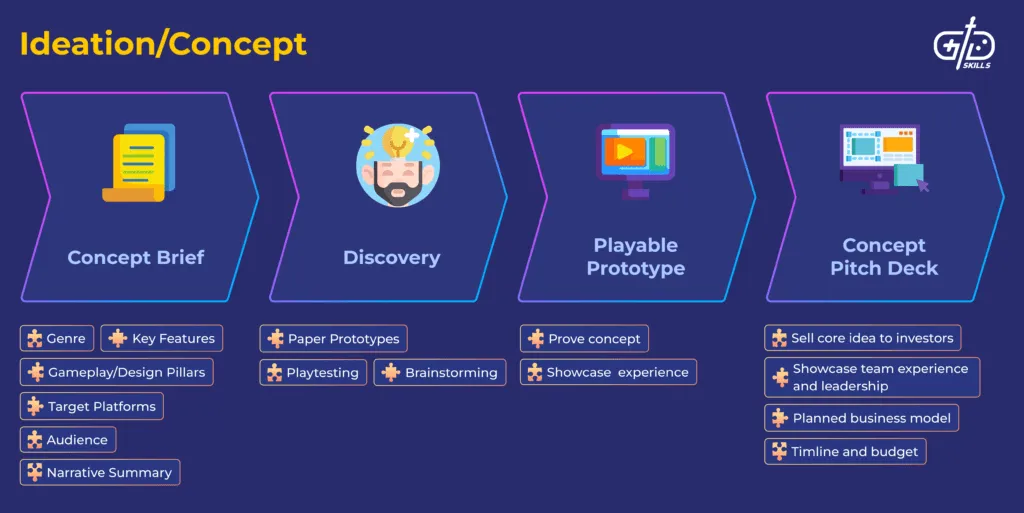
Freshness is safer in ideation stage

When two medics decided to make Baldur’s Gate, they didn’t have experience with CRPGs. When Mr. Myiamoto directed FZero on SNES he wasn’t a veteran in racing games. When a marketing guy from Ubisoft decided to make a realistic-style JRPG together with a programmer, he didn’t have previous experience in the genre.

Still, many companies publish job offers for specific positions requiring previous experience in the specific genre they are developing. It’s because of the belief that higher skill means faster results, and more important, less risks. This happens a lot on high-quality games and mobile F2P, because these business models became managed in a McKinsian way. And that, kids, is why they are in trouble.

Still, games like PRAGMATA are showing that there are audiences eager to new experiences, with unique blends of mechanics. I don’t know their stories, but I am playing the game and I wouldn’t be surprised if among their team there are designers with no previous experience with 3D action-adventure games. Video games like PRAGMATA are only possible when you are open to a completely different perspective, and when you let people work. I believe it’s hard to find this fit if your job offer filters opportunities out.

Experience within a genre is very important, don’t get me wrong. But the more I work, the more I realize I am full of biases. The more experience I get, the more I push for research and playtesting. New audiences are playing in ways often ignored by a big portion of developers, a sort of tunnel vision you have when you make always the same thing over and over.

read more: https://gamedesignskills.com/game-development/stages-of-game-development-process/

This is one of the reasons that led me to be a freelancer, also if it comes with a price as everything good in our life. Probably the worst one is when a client wants me to tell them the hour using their own clock. They close to proposal, because they don’t really understand (and they actively ignore) the opportunities of ideation stage.

A potential use case for Microsoft

I read the last email that the new CEO of XBox sent to her employees. It is honestly an inspiring take on what’s next for XBOX, I am positive about this person. Maybe the fact she is not a games veteran is good for her actual position. Or maybe I am just a dreamer, I don’t know.

There is one use case that I believe they can tackle pretty “easily”, and position themselves like the platform for everyone they want to become. There are successful f2p midcore titles that occupy too much space on the smartphone. Often they require the latest models to run at the higher quality. I believe that the f2p player doesn’t care of having a copy of what he is playing.

If XBOX manages to become the platform from which you can play the “Genshin Impacts” of the future in cloud on streaming, and maybe engage with mods and UGC for your fav games, there is the chance from them to become THE platform of the future. A sort of Roblox for Mobile f2p games. Of course, there are lots of limitation that may come from Apple and Google. Still, if they manage to do this right, they can really disrupt the market in my opinion.

Three loops of Expedition 33

These days I am playing Clair Obscur: Expedition 33 pretty intensively (when other 40y-old-man-duties permit) these days. And I am also completing my bootcamp on videogames design and conceptualization. A class I gave was based on the 3 main loops of a game, and today I want to apply this knowledge to the 2025 GOTY.

Moment-to-moment (second-to-second)

This first loop is the central one, and it describes what the player does the most. You can say it describes the core dynamic, somehow. In case of Expedition33:

  • Action: Reactive turn-base combat
  • Challenge: groups of nevrons (enemies)
  • Reward: skill points, loot

WHY to repeat this loot: the game is divided in zones within an open world, the Player wants to complete the zone to unlock the next.

Core loop

The core loop is what the Player does the most during the game and gives meaning to the moment-to-moment loop. We can say that it considers the game session as a whole.

  • Action: Improve team stats
  • Challenge: complete zone sections
  • Reward: Advance with the story

WHY to repeat this loot: as any good JRPG it’s about the map! You want to play to unlock new venues and discover new places into the map.

Metagame loop

This loop describes what keeps the Players engaged, what makes them think “I need to return back into the game because I want to…”. Describes the features and mechanics that make me think into the game when I am not playing it. In the case of Expedition33:

  • Action: defeat bosses
  • Challenge: what will happen in the story?
  • Reward: plot twists and secrets discoveries

WHY to repeat this loot: the game is one great adventure story!

A simple idea for AI in games

Of the many applications of AI in games, I am more interested in those that can unlock new form of experiences. First thing that comes to mind is narrative, of course, but since as a developer you are paying for hosting a server with an LLM I think you need to focus more on the return of the investment on that infrastructure.

One idea is to have new forms of special offers related with the fact that you can or cannot engage with certain systems within a game. Maybe you played heavily during the last event, but you have no time this week. You can say it, and the system can find special solutions for you. Just one example.

In the blacksmith’s house, a wooden skewer

The recent stock market fluctuations following the arrival of AI tech that promises to generate interactive worlds from simple prompts speak volumes about the current lack of video game literacy.

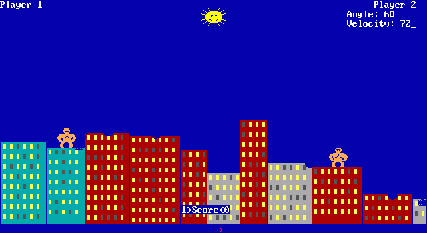
Almost every veteran I know—myself included—started by modding, not just “creating.” My journey began with Q-Basic to tweak Gorillas, then modifying voices in Worms, creating custom avatars for Baldur’s Gate, and hacking Diablo hash codes.

https://en.wikipedia.org/wiki/Gorillas_(video_game)

The best designers were often protagonists of the modding scene, diving into forums to figure out how to add value to the games they loved.

We’ve seen this cycle before. Tech giants often launch “revolutionary” gaming projects to fuel corporate career leaps, only to abandon them when the next trend arrives. But the real issue is the demand for shortcuts. Some entrepreneurs will try to use Genie3 to chase quick profits with flashy trailers, and some might even succeed in the short term.

Long-term success belongs to those who actually expand the horizons of gaming.

Reaching new audiences and solving the distribution puzzle requires more than a “genie.” It requires deep knowledge. While technocrats push “prompting and scrolling,” the smartest players are busy mastering history, philosophy, and art.

My advice? If you want to break into the market, stop looking for shortcuts. Work hard to engage your audience and start by modding what already exists. Read history books, and myths. Rack your brains, expose your work, and take risks.

You are far more likely to find success through craftsmanship than by playing a “word slot machine” and hoping for a believable game.

My take on Highguard

I was watching the last Deconstructor of Fun podcast, shooter monthly, on Highguard.

I downloaded the game days ago, completed the tutorial and played three matches. I am not really into hero shooters, but I have to admit that I also had the sensation, as these expert say, that the game was not properly play tested. Which is a common issue in the industry that leads to many games to fail miserably. You need to engage with your future clients, especially with service games. You cannot simply launch early access anymore, early access in current market is perceived as a full launch, especially if you game has been announced in “pompa magna” at The Game Awards by Jeff Keighley in person.

Regarding the market segmentation

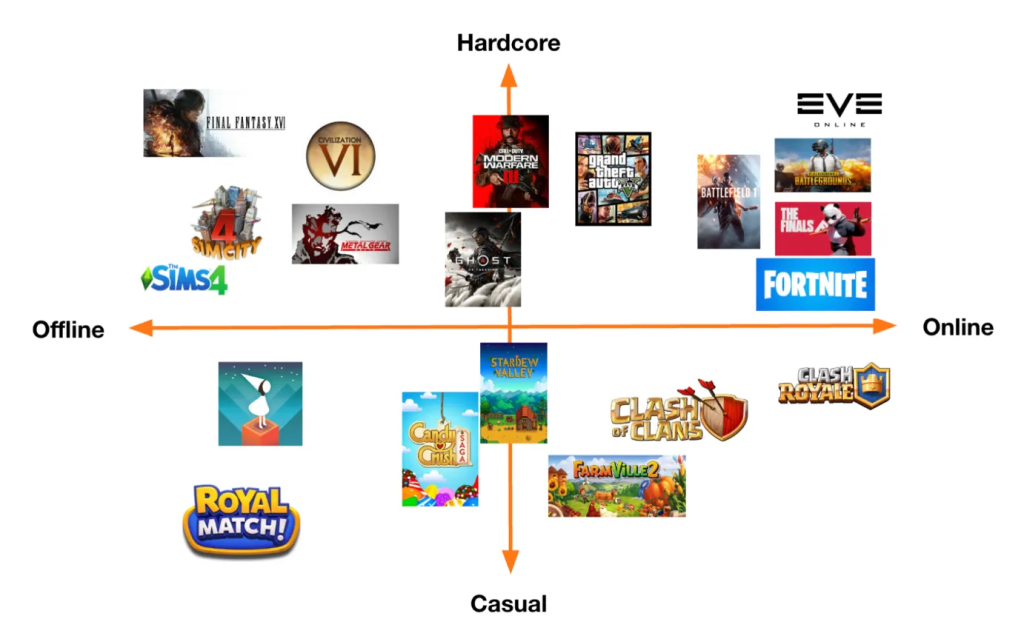
The experts seem to agree (but not fully) on the fact that there are just two kind of profitable shooter genres: tactical and battle royale. I am not sure about that, I prefer this Owen Mahoney’s segmentation:

Owen Mahoney’s view of the industry

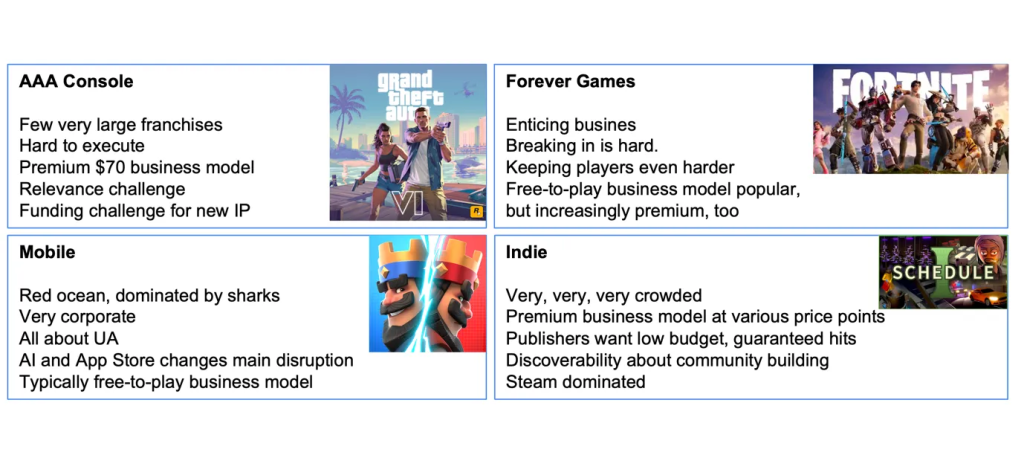
I believe that shooter as a genre fits in at least 2 quadrants: online and offline hardcore. Nicholas Lovell also has his view on the industry in general.

Nicholas Lovell’s view on the industry

And we know there are AAA fps, forever fps like Fortninte, mobile FPS, and also indies who build on top of boomer shooters. Finally, there is Christopher Dring view of the industry:

watch here: https://www.thegamebusiness.com/p/there-is-no-such-thing-as-a-video

Under this lens, I see games like STALKER being fps with stories. Fortnite and so on, are for socializing, but also competition/sport. COD and Battlefield as well. Boomer shooters are for passing the time, especially indies like this one.

I believe that the market is more complex and varied than the one pictured by Phillip Black in the DoF shooter monthly podcast.

What I do believe about the game modes

In the podcast, they insisted that the right number of people should be 5vs5 or 3vs3vs3, and I agree with them. But I believe that are also other problems with general game pacing:

  • Mining crystal is not the best during a shooter session, in my humble opinion. I know it’s a basic in Fortnite, but there you can then build things instantly. Here, instead, is to buy stuff from a vendor.
  • The vendor itself is slow and boring, can be put in another place
  • Upgrading/reparing walls is not so exciting, too.

First idea I would try to pitch and eventually design is to buy weapons and repair walls when you die. You die and while you wait, your “soul” can repair stuff. I know, maybe you prefer to watch what is happening, but that can be an extra cam or something while you fix things.

Another thing I noticed is that the most exciting part is when you raid or you need to defend from a raid. Still, I had the feeling that the attackers, the raiders, were stronger than the defenders. Maybe it’s just psychological, but I would like to try something asymmetrical, like 3vs5 (5 defenders).

Running on the horse while shooting is also cool, I remember that from RDR2, which lead designer works for Highguard. Maybe there can be the moment of earning crystals instead of mining.

3 ideas I would pitch:

  1. Buy weapons and manage base on death
  2. Asymmetrical raids
  3. Earn crystals while killing people from the horse

Maybe these would create more exciting/unique moments for Highguard.

Ubisoft and the “Efficiency Trap”: Why Algorithmic Logic Can’t Save a Lost Vision

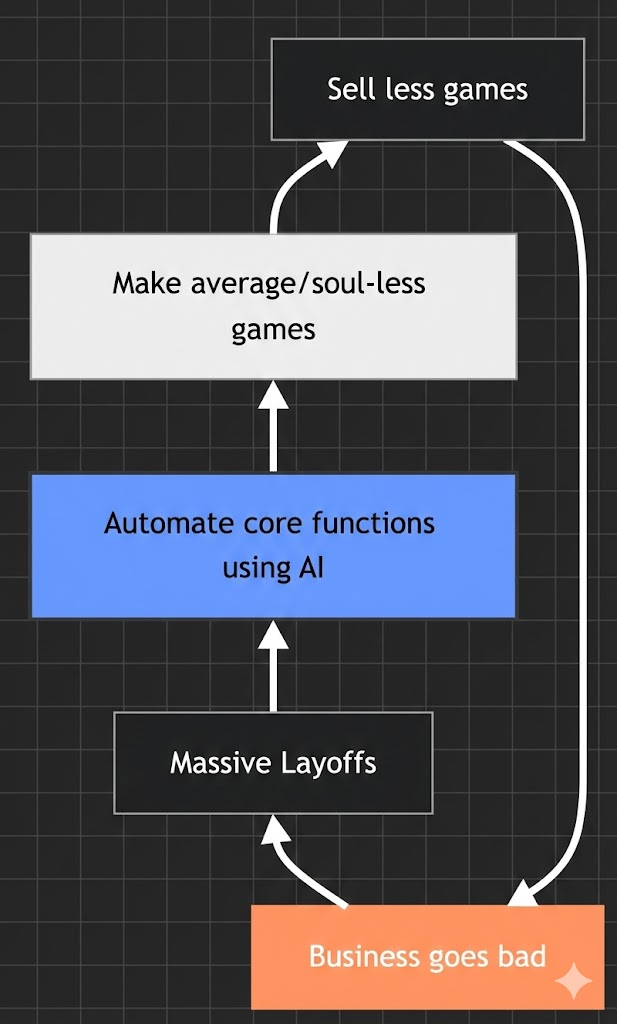
The recent news regarding Ubisoft isn’t just another headline about industry layoffs; it’s a “leading indicator” of a systemic crash. When the numbers don’t add up, the corporate playbook is predictably uninspired: cut the talent, automate the core, and pray the spreadsheet balances itself out.

But creativity isn’t an assembly line, Ubisoft might be the “canary in the coal mine” for an industry chasing its own tail. This isn’t just a trend; it’s a form of “drowning.” When inefficiency (ROI) drops too low, leadership grabs whatever is in reach—AI, NFT initiatives, or massive restructuring—often without even knowing what questions to ask their experts. They are borrowing against a future they don’t understand, hoping that money alone can catch the wind.

The “Glass Ceiling” of the French Elite

A company is only as brave as its leadership, and here we find a significant bottleneck. Ubisoft’s executive team is roughly 90% French, educated at the same elite business schools (ESSEC, ISG), with tenures spanning 30 years.

While these credentials are impressive on paper, they’ve created a cultural monoculture. This “upper-middle-class business elite” is now tasked with innovating for a global, diverse audience they are increasingly disconnected from. When leadership hasn’t seen the inside of another studio in three decades, they stop leading and start rehashing.

The AI Gamble: Partner or “Slop” Generator?

The debate around AI in development is often polarized. Someone argues that AAA gaming is “dead” without AI to reduce the staggering $200m+ budgets. I don’t disagree that budgets are exploding, but I disagree that AI is the silver bullet for quality.

AI isn’t the root of the problem, but it’s a risky “solution”. Relying on a technology that hasn’t yet delivered on its creative promises to save your strategy is a bet, not a plan. If you use AI to generate “slop,” you might save on costs, but you’ll lose the player.

From Rational Design to Brand Decay

Ubisoft once had a superpower: Rational Game Design. It was a method that allowed them to optimize the creation of epic adventures while maintaining a clear vision. But as they chased whales, “Games as a Service,” and unsustainable growth, they lost the creative DNA that made them special.

A software (and AI is just that) cannot solve a brand crisis. AI can’t fix the fact that Ubisoft has distanced itself from player fantasies and instinct—things that aren’t taught in prestigious business schools.

The Opportunity in the Chaos

The failure of long-term vision in these managers is an opening. The collapse of the old guard creates space for those who actually understand imagination and positioning.

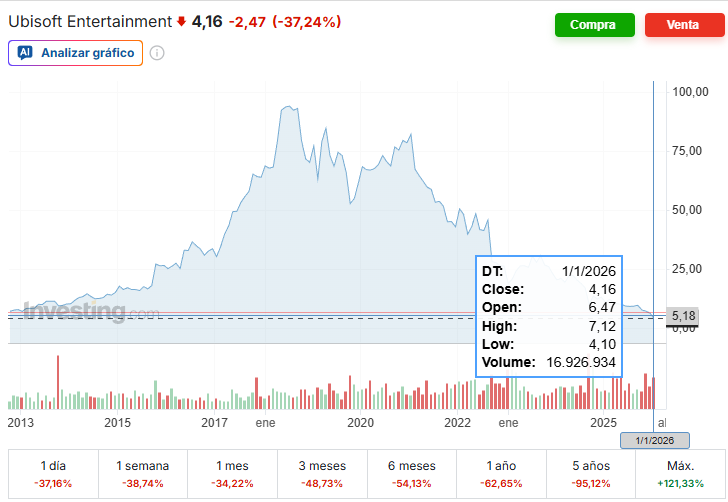
Ubisoft’s stock may be back to 1998 levels, but the talent is still out there. The question is: will they be allowed to lead, or will they be replaced by an algorithm until there’s nothing left to automate?