A good way of thinking in GDD is to write down more details of what’s already in a build of some sort. With this I mean that if you design pages and pages of documentation regarding something not concrete, you are at risk of delivering something disconnected from reality.
Frame the problem, develop prototypes, align, and only after write down specs. That’s the way. You need less talk and more rock.
Of the many applications of AI in games, I am more interested in those that can unlock new form of experiences. First thing that comes to mind is narrative, of course, but since as a developer you are paying for hosting a server with an LLM I think you need to focus more on the return of the investment on that infrastructure.
One idea is to have new forms of special offers related with the fact that you can or cannot engage with certain systems within a game. Maybe you played heavily during the last event, but you have no time this week. You can say it, and the system can find special solutions for you. Just one example.
This week I watched a couple of videos on PRAGMATA, a game coming out tomorrow on major high-quality platforms. Reviewers seem to agree that it’s a game made with courage, that reminds of the good side of PS3 era.
I just watched Street Fighter Movie trailer, and honestly: just the music (What’s Going On?) unlocks so many memories. A movie to watch, definitely.
The trend of this year is clear, companies and Hollywood invested the last year in legacy IP and CAPCOM is heading this in the games industry. Whether if they are creating new IPs, or making art with the strong IPs they have, they are clearly playing on nostalgia for their positioning.
I am playing Clair Obscur: Expedition 33, and I cannot avoid to notice that there are flaws mainly under the gameplay/UX perspective. Also the GOTY is not immune to imperfections, and that’s actually one of the main reason why Players play games. We love imperfect things!
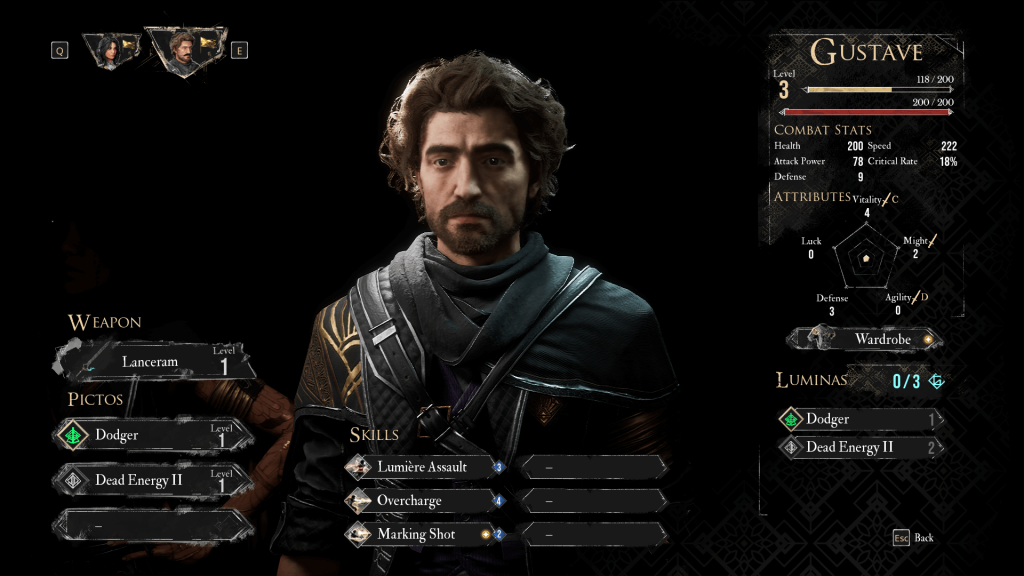
From this screen you can set up everything for selected character(s)
There is a system which is very interesting, it permits you to create different builds for your team. It opens when you decide to see the detail of one of the members of your team.
Weapons
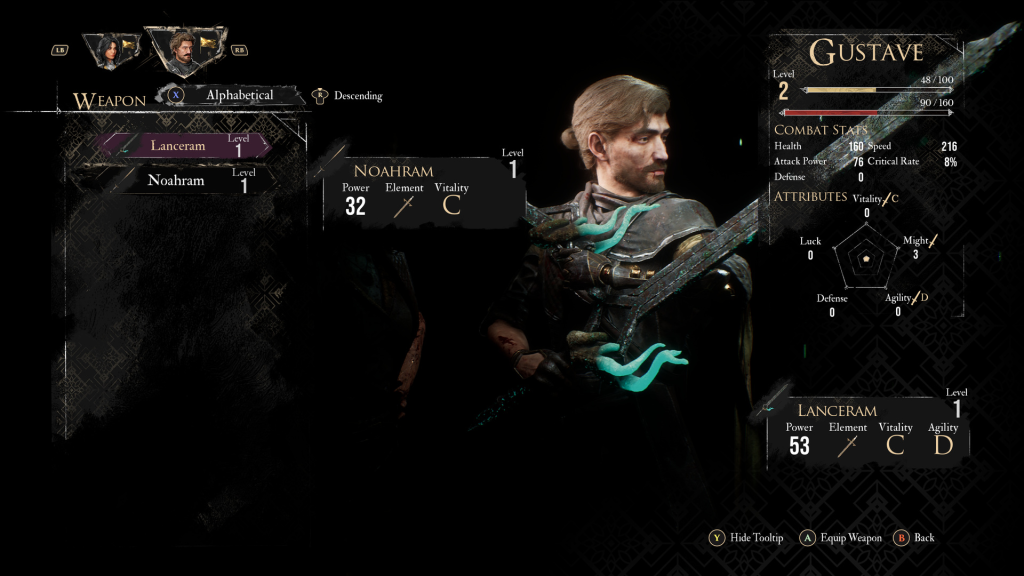
This is how the weapon screen at the start of a game
Each character has a set of weapons available. You can find weapons mainly by beating specific monsters (in the game they are called: Nevrons) like bosses or mini-bosses. These weapons are related with damage, but also with 1-2 stats each.
Weapons may offer extra benefits, and they can be leveled up at the camp. They are readable, and also different: you can see the weapon currently equipped in battle.
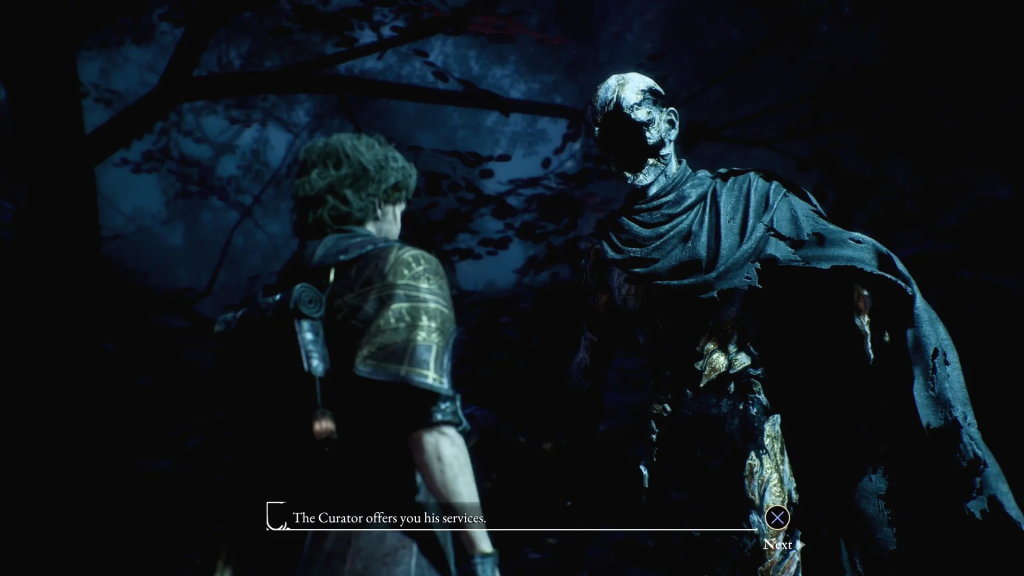
This creepy guy lets you upgrade your weapons at the camp
The struggle with weapons is that you cannot predict where they can arrive, how powerful they can become. So it’s hard to decide to invest in a specific one, especially sooner in the game.
This weapon looks cool, should I upgrade it or keep resources for later?
Pictos
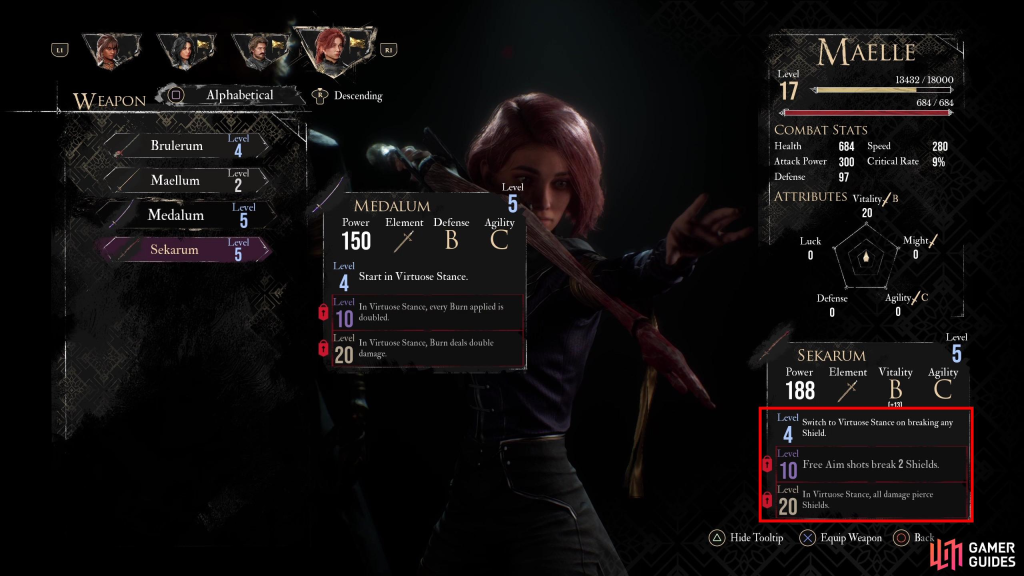
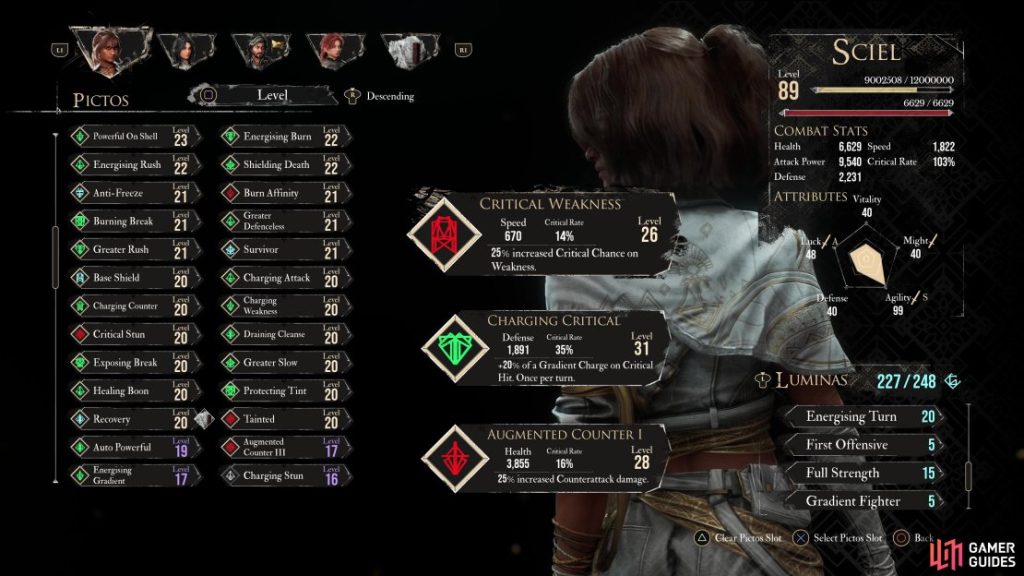
During the game, you collect Pictos, which are things you can put in 3 slots per character to get extra benefits on stats and effects in battle. In theory, you can study the advantages you have in certain stats and decide accordingly which Picto to equip to your character.
your slots are the ones in the middle. On the left, all the pictos you collected
In practice, you are overwhelmed by them, and it’s hard to make a choice of which to equip, in my opinion. Also because the stats they influence are not directly the main ones, but secondary/calculated. So you should be very knowledgeable about the game systems to understand properly this one. Also, when a Picto is equipped on one of your member, you cannot use it with another.
Luminas and Lumina Points
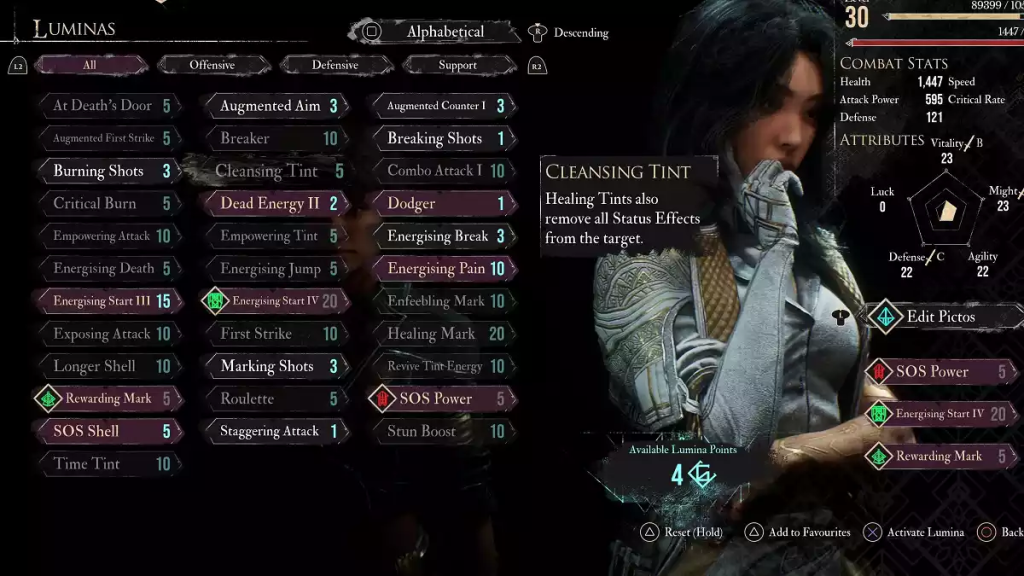
In order to solve the Picto issues and to encourage you to swap them continuously, Sanfall Interactive designed Luminas: using Pictos more than 3 times (in more than 3 battles) unlocks the possibility to use their special effect only using another resource, called Lumina Points.
This system is complex and hidden in the menus, I am sure that most players will ignore them completely and focus on mastering the dodge/parry mechanics in combat. I believe that the UX doesn’t serve well the system, which is already very complex to be fully understandable. Maybe in the future, with the integration of more systems to provide real-time guidance to the Players, these things will be easier to grasp.
Many years ago, I lost my job ad a dream company and I decided to become the best game designer I could possibly be. Part of this is still within me, also if many things changed. One for all, I understood that teams/clients do not need, nor want, the best in class.
If you are reliable, honest, candid, and humble, generally speaking you will be better welcomed into games teams. I notice, especially among junior game designers, the will to be better than others or more knowledgeable. You can easily end up being perceived as superb, like that.
The best way to do your job is to give the best of your “more or less”, without delivering too much. You will lose less energies and your job will be recognized in any case.
In this age of slop and significative increment of information and leisure that people receive, positioning will be always more critical. One of the mistakes clients make is to think in positioning like something belonging to the game. But positioning it’s in players’ minds, the game is just a medium.
If you see the recent successes you will notice how they well extremely clear in terms of positioning in the minds of people:
Resident Evil Requiem: the original and unique horror game
Crimson Desert: the open world for fun, not story or stat-oriented players
Pixel Flow: high intensity puzzle game, where you should master the speed of the belt
Game design should help in this. In fact, it’s impossible solely using marketing to identify the right patterns to spot a new genre where you position yourself. People in their mind have like 2-3 slots maximum per category. So what’s your?
How to help your team position the game
Every single time a new game starts, you discuss around its genre. The game genre is a shared language among everybody involved. You can say “I want to make a racing game” as a developer, but you can also declare “I don’t like souls-like games” as a player. The genre is a good point of start.
In mobile f2p a common philosophy (because it’s a service business) it to think like “let’s take the players from this other mobile game”. So you are playing to steal somehow players from your competitors. I think it has advantages and disadvantages. The positive thing is that you will become laser focused in offering a bigger/better game that already existed, basing on your own resources and expertise. The disadvantage is that you may ignore the context of your competitor and end up competing with a giant that will crush you. I think in all the companies that are trying to make a Brawl Stars but better. Good luck with that!
Another philosophy is to create your own genre. You spot motivations, study the use cases, determine possible gaps, and innovate accordingly. This is my favorite method, but it holds risks. Because you need real taste and true engagement with the community. You need to really will to also put out fast things that may not work. It’s not for everybody. As a consultant, for instance, I cannot propose that to all my clients.
Conclusions
There are no silver bullets, that’s clear. Otherwise they would have been already taken by others. You need to be really aware of your situation (or the situation of your employer), to decide the best path. Nobody said it was easy, but one thing is important: game design in the AI era is required to care about the game position. Otherwise it will be meaningless.
I use Claude to make my prototypes within Unreal Engine. I don’t have anything embedded in the engine itself, I have the program installed and go back and forth to implement what the LLM suggests me.
It works pretty good, I have to say. On one end, it forces me to structure well the problem to solve; Claude helps with everything, from research to properly framing. I am faster in creating my own JIRA tasks and message my colleagues in a proper and clear way. Then, I use blueprint and I have to say that the results (from a prototype perspective) are pretty satisfying. Also, at the end of each chat I tell it to create a report for its knowledge base, so that in future should be better and better. At least, I hope so.
There is a challenge though: switching back and forth from Claude to the engine to implement what the LLM says is tiring and I end up my days with headache. It’s like having someone giving you suggestions constantly. I know there is a way to integrate everything into the engine, but it’s still experimental and I don’t want to risk on a shared code.
There is no secret formula to make a successful game, otherwise it would have been discovered already. It’s true, though, that success cases generally involve the right doses of inspiration and pragmatism.
The inspiration is needed to create something novel, something unique, something people wants. When I see games starting from charts and SensorTower reports I already know they are doomed. Games should start from something intimate to someone, and inspiring. It can be a childish fantasy, there is absolutely no need to be a tormented artist.
For instance, think in Royal Match the match-3 game from Turkey: they clearly started from the fantasy of breaking expensive dishes and pots in a royal mansion. Something that many of us had when children, visiting historical places with our family or schools. You need something like that, if you don’t have that do not throw away your money and find it first.
Pragmatism is needed because you need to be very aware of what the market actually wants. In this way, we would have avoided the $80B investment in “the Metaverse” by Meta, for instance. Lots of effort, creative energies involved to try to find the Grail, and for what? It is clear that people doesn’t want VR devices covering their faces. Also Activision/Blizzard, recently presenting a MOBA game for mobile phone with Overwatch IP, for Western audience. People here do not want to play MOBAs, why are you greenlighting something like that?
You need to be inspired by some fantasy and read the room before of starting a new expensive venture, things that I would like to see more here in Europe.
Last year I found a great client; good team, excellent leadership, profitable company. The project was (well, is) ambitious and novel. I felt part of the leadership team, I contributed to the development of their MVP. And then, a more expert designer joined and I was out. I had an interesting chat with my client, and he explained me exactly why the decision. It made sense, I learnt a lot. Still, it hurt because everything worth in life hurts a little.
Now that it’s one month since I joined GSC Game World, I already feel there is something very different in the way of managing high-quality projects compared with mobile f2p. Mobile needs pragmatism: you are chasing big numbers because you are investing huge amounts of money to give a highly technological product in the hand of distract people for free with the hope to engage their attention. High quality games, on the other end, are for people who decide to light a console up to be immersed into an experience they paid for.
And this leads to a fundamental difference: (product) management is what leads mobile, while creative direction is what leads high quality games. Of course, I am passionate and prepared designer and I can tackle any challenge, plus I have a certain age and experience so I can be a great leader. But mobile games are managed in a McKinsey-an style, and companies chase perfection. And the best way to avoid the risk of not having it is to hire people with a real pedigree (which I don’t have). On the other end, PC/Console single player high quality games (open world, FPS, survival) look for people capable of prototyping and realize the creative vision being away of design pillars, vision, and so on.
Two different worlds that I am sure can learn from each other. I know I will bring learnings from premium to mobile, and viceversa.
One month ago I have started a new full time gig at GSC Game World. It’s been years of doing extra work to learn the technologies and methods of high-quality games, finally the stars aligned and I got my opportunity. I am excited by this new venture, and I am rearranging forces to keep my consulting services on, thanks to the help of a game design assistant who I recently selected among my students.
I want to say just two things on this; the first is that it would have been impossible to get this new job without the existence of remote working. And it would have been impossible both for me and for the company that hired me. I know that a lot of people believes that we need to be in the same place to make a good job, I am not a guru so I don’t know. I only know that GSC Game World has become more international thanks to the advent of remote work.
Second thing is that I could hire an assistant thanks to the existence of LLM platforms, specifically Claude in my case. Having collaborators and assistants means communication, alignment, management, and lots of other things. I need to measure well my words, and provide concrete schedules. All of this constitutes an overhead that would have been simply impossible to tackle without the help of some automation of sort. Also on the other end, I am able to frame and solve the right problems faster and deliver both with my employer and my clients.
My services are becoming more sophisticated, and I hope to share with you important learnings on this channel. Stay tuned.
We use cookies on our website to give you the most relevant experience by remembering your preferences and repeat visits. By clicking “Accept”, you consent to the use of ALL the cookies.
This website uses cookies to improve your experience while you navigate through the website. Out of these, the cookies that are categorized as necessary are stored on your browser as they are essential for the working of basic functionalities of the website. We also use third-party cookies that help us analyze and understand how you use this website. These cookies will be stored in your browser only with your consent. You also have the option to opt-out of these cookies. But opting out of some of these cookies may affect your browsing experience.
Necessary cookies are absolutely essential for the website to function properly. These cookies ensure basic functionalities and security features of the website, anonymously.
Cookie
Duration
Description
cookielawinfo-checkbox-analytics
11 months
This cookie is set by GDPR Cookie Consent plugin. The cookie is used to store the user consent for the cookies in the category "Analytics".
cookielawinfo-checkbox-functional
11 months
The cookie is set by GDPR cookie consent to record the user consent for the cookies in the category "Functional".
cookielawinfo-checkbox-necessary
11 months
This cookie is set by GDPR Cookie Consent plugin. The cookies is used to store the user consent for the cookies in the category "Necessary".
cookielawinfo-checkbox-others
11 months
This cookie is set by GDPR Cookie Consent plugin. The cookie is used to store the user consent for the cookies in the category "Other.
cookielawinfo-checkbox-performance
11 months
This cookie is set by GDPR Cookie Consent plugin. The cookie is used to store the user consent for the cookies in the category "Performance".
viewed_cookie_policy
11 months
The cookie is set by the GDPR Cookie Consent plugin and is used to store whether or not user has consented to the use of cookies. It does not store any personal data.
Functional cookies help to perform certain functionalities like sharing the content of the website on social media platforms, collect feedbacks, and other third-party features.
Performance cookies are used to understand and analyze the key performance indexes of the website which helps in delivering a better user experience for the visitors.
Analytical cookies are used to understand how visitors interact with the website. These cookies help provide information on metrics the number of visitors, bounce rate, traffic source, etc.
Advertisement cookies are used to provide visitors with relevant ads and marketing campaigns. These cookies track visitors across websites and collect information to provide customized ads.