Skip to content

Tag: inspiration

Is Physics Making a Comeback in Gaming?

This post was originally written in Italian by Paolo Gambardella. It has been translated by an AI agent and may contain inaccuracies.

A few weeks ago, a LinkedIn contact proudly showed off their vinyl shelf. They mentioned they also have Spotify Premium. But the records they truly love — they want to hold them, not just stream them.

For years the narrative in entertainment has been straightforward: physical is dead, streaming and digital are the future. But recent data tells a different story.

The American vinyl market has crossed the billion-dollar mark for the first time, marking its nineteenth consecutive year of growth (RIAA, 2025 Year-End Music Industry Revenue Report). Something similar is happening in film: while standard DVDs continue to decline, 4K UHD Blu-ray sales have risen 12%, a sign that the most passionate audiences want to own their content in uncompressed quality, without depending on a platform-tied licence (Digital Entertainment Group data, as reported by FlatpanelsHD).

What about video games?

Here, platform holders are moving in the opposite direction. Disc drives sold as optional accessories, a constant push towards GaaS, ecosystems designed to go ever more digital. I understand the short-term logic: digital margins are higher, distribution costs less, player data is easier to collect. But optimising for short-term margin risks alienating the most loyal core audience — the very same people who, in music and film, are today driving the physical revival.

It’s true that in volume, digital still leads aggregate sales, especially when you lump together mass-market multiplayer titles and premium single-player experiences. But high-end single-player games are emotional investments. Players don’t just consume them — they collect them. I know people who keep the cases of the games that shaped them on their living room shelf, just like my friend keeps his records on his.

On that note, have a listen to this gorgeous Ukrainian lullaby from the new Stalker 2: Cost of Hope DLC:

Why digital is still winning, for now

Geopolitical pressures on supply chains and component costs currently give digital distribution a real cost advantage, and that’s the main reason platform holders are pushing in that direction. But when supply chains stabilise and fatigue around digital licensing — that feeling of “you don’t actually own what you buy” — keeps growing, I think physical will find its moment of revival in gaming too, perhaps on a smaller scale than before, but still meaningful.

Chasing digital uniformity to chase a trend risks losing sight of a simple principle that vinyl and Blu-ray have been quietly proving for years: premium content creates premium collectors.

My gut feeling is that platform holders are abandoning their most loyal fans too soon, all to run after a passing industry trend.

Design and Marketing: A Common Language

This post was originally written in Italian by Paolo Gambardella. It has been translated by an AI agent and may contain inaccuracies.

There’s a saying from Cilento (a region in southern Italy) that goes: “when strength fades, arrogance grows.”

I took part in a meeting about the creative vision for a project, and I put forward some “unique selling points” — elements that could make it stand out. I flagged the ones that, to me, were already floating around in the air, and suggested a few more. That was my way of opening up the discussion with the team. My role wasn’t a managerial one, but I needed to get a conversation going and hear what my directors had to say, to get a better feel for the project.

My proposal was shot down before it even got off the ground: a colleague — a designer — told me that “unique selling point” is a marketing term and has no place in game design. Everyone else in the room backed him up, and the discussion died right there. It felt like a classic case of pointing at the moon and someone staring at your finger: I’m trying to show something — which might be interesting or might not — and instead people take issue with the act of showing itself. This is what happens when you’ve been doing the same thing for years and start believing you’ve already figured it all out. But in the world of video games, where everything depends on so many human and contextual factors, nobody ever truly knows anything, deep down.

Beyond the frustration of the moment — and perhaps I wasn’t great at anticipating how that might land — what bothers me more is seeing how many designers fail to recognise the value game design brings to the business. Treating marketing as something lesser, something disconnected from the real work, a mere sales tool and nothing more — that’s just ignorance, as far as I’m concerned. Especially in 2026, when technology lets us cover more ground than ever before, there are elements of marketing that absolutely need to be folded into game design.

Reducing marketing to the act of selling alone is a pretty basic mistake. Marketing takes time — it’s about building relationships and trust. Game design can’t afford to detach itself from that process. Plenty of modern studios, before they’ve even released a single demo, are already setting up Discord servers. Building community, they call it (even if what’s being built isn’t really a community in the true sense — but that’s a separate conversation). Game designers are active in these spaces, engaging with people to understand how to improve their game. That is marketing, when all’s said and done.

When we talk about “unique selling points,” yes, the concept of selling is right there in the phrase — but the phrasing itself implies an intention rather than an immediate action. Getting to that sale means passing through stages where game design is absolutely critical. Thinking about why a player, three to seven years from now, should buy our game — rather than just doing whatever feels right in the moment — is maturity. It’s professionalism. It’s craft.

Have a great week, everyone!

Learning to Use Platforms

This post was originally written in Italian by Paolo Gambardella. It has been translated by an AI agent and may contain inaccuracies.

Yesterday I went out for dinner with my family at a restaurant. I asked for details about a dish, the waitress gave them to me, I ordered it. When it arrived, several of the things she’d described were missing. I pointed it out, she went to speak to the chef, who sent back the message: “that’s how the dish comes.”

I’m unlikely to go back. And for a moment I thought about leaving a negative review on Google Maps. I went to look the place up, read through the existing reviews, and found plenty of positive ones and just as many negative — the negative ones almost always about the exact same thing as my experience.

Adding mine would have just been noise on top of noise. And when you think about it, what we’re really doing when we leave a review like that is feeding a platform and potentially damaging someone who, that evening, had simply made a mistake. I let it go. If someone asks me to recommend a restaurant in future, I just won’t mention that one.

What struck me, thinking it over afterwards, was why that dish had bothered me so much. It wasn’t just the missing elements. It was that the explanation I got — “that’s how it comes” — left me with no sense of control: I couldn’t understand what had happened, I couldn’t avoid it next time, the blame sat entirely outside me and was presented as a fixed house rule. If the chef had said “you’re right, we missed that, let me redo it,” I’d probably have left happy anyway. It’s the same mechanism that makes a player get angry — not so much at losing, but at not understanding why they lost and not knowing what to change next time. Negative reviews, whether for restaurants or games, more often come from that kind of frustration than from the difficulty itself.

And players leave reviews on platforms far more often than a customer leaves a review for a local restaurant. That review, on Steam, has a direct impact on a game’s sales. It’s why platforms in my industry have overtaken even personal recommendations: your opinion, if you write it there, carries real weight (unlike with neighbourhood restaurants, thank goodness).

How do you survive in this kind of situation?

I was watching an interview with a designer who says he doesn’t play other games during development, so as not to be influenced. The interviewer points out that Shigeru Miyamoto has said similar things on several occasions — arriving at his own solutions rather than retracing what already exists.

I work in exactly the opposite way, probably because I don’t make my own games but work for third parties (clients and GSC Game World, at the time of writing). When I start a new design I always look for the unique and distinctive elements by starting from what the competition is already doing. Pareto’s rule applies: 80% familiar territory, 20% novelty. To put it into practice I use a few platforms:

  • I use Gemini and Claude for research
  • I use Steam to study competitors’ capsules and descriptions, and to read reviews
  • I use YouTube as a kind of quick playtesting proxy

A concrete example: if I’m working on a progression system, I’ll first go to Steam and read what players love or hate about similar systems that are already out there (that’s my 80% — what the audience already expects and recognises). Then I look at where all the competitors start to look too much alike, because that’s where there’s room for the 20% of novelty that makes a game stand out without scaring off the people who try it.

It also depends on the kind of work I do: I can’t play the “misunderstood genius” when I’m working for a client — I need to meet their requirements as professionally as possible. But I don’t experience that as a creative compromise. Looking first at what already exists and figuring out what I can adapt, recombine or recalibrate is a genuine working method, not an imposed constraint: more often than not, the smartest move isn’t to invent from scratch, but to find the right lever in what already works.

Platforms, in this sense, help me enormously — speeding up tasks and bringing solid data to help me align with the client. The very same platforms that now dominate the games industry are the ones that provide the most valuable tools for improving what I do. On the other side, though, the most skilled creators use them differently, and go out of their way not to let them have a hold over the creative process when it really matters.

Maybe the answer isn’t to pick one approach over the other, but to know when to use each. Platforms as a research tool when I’m working for someone else and need to understand what the market expects. Silence when I’m working on something of my own and want it to come from an idea, not from a comparison. And in both cases, the lesson from the restaurant stays the same: whether you’re reading reviews or designing a system that will generate them, the right question isn’t “how harsh is the verdict” — it’s “does the player understand why it happened, and do they feel like they can do something about it next time.”

What Became of the Old Values?

This post was originally written in Italian by Paolo Gambardella. It has been translated by an AI agent and may contain inaccuracies.

La crisi che stiamo vivendo nel settore dei videogiochi deriva principalmente dal fatto che il potere si è spostato dai publisher alle piattaforme. Una delle piattaforme contemporanee più rilevanti è Roblox.

Anche se il suo modello di business è discutibile, il 50% dei bambini americani apre Roblox nel corso della settimana. La piattaforma è estremamente accessibile e presente su molteplici dispositivi. Il che mi riporta, a mio avviso, a un momento simile all’inizio degli anni ’90, quando la gente iniziava a chiedersi cosa fosse davvero un videogioco — il momento in cui nacquero Baldur’s Gate e titoli simili, per capirci.

Lo dico sempre ai miei colleghi e clienti: se il tuo gioco esce tra sette anni, il pubblico a cui ti rivolgi in questo momento sta probabilmente giocando su Roblox, Minecraft e Fortnite. Fare previsioni è impossibile, perché i videogiochi toccano corde molto personali e le tendenze vanno e vengono. Un gioco in stile anni ’90 potrebbe tornare di moda nel 2030 — non lo sappiamo.

Eppure noto una tendenza a voler ignorare queste mode, in gran parte perché non corrispondono a quella che consideriamo la nostra idea di come dovrebbe essere un videogioco. Siamo cresciuti con certi valori, quei valori vengono oggi messi seriamente in discussione, e questo porta inevitabilmente a degli attriti. È del tutto umano cercare di evitarli con qualche scusa, perché fare i conti con ostacoli reali fa anche male.

Quindi, per quanto sia vero che Roblox ha permesso la diffusione di un gioco in cui era possibile pagare per derubare bambini dei loro personaggi virtuali e umiliarli, è altrettanto vero che moltissime persone scelgono quella come forma di intrattenimento. La formula del successo, secondo me, sta nel trovare il modo di far convivere i nostri ideali con queste nuove tendenze.

Reflections on Mobile and Premium

This post was originally written in Italian by Paolo Gambardella. It has been translated by an AI agent and may contain inaccuracies.

In 2022 I decided to try switching careers, from mobile to PC/console games. You know the ones — in crisis, not growing, running on increasingly expensive hardware, built by hundreds of well-paid people over seven years on unsustainable business models? Yeah, those. Well, not exactly those — I’m being ironic… but you get the idea.

I actually managed it this year. In March I joined the ranks of GSC Game World, the creators of the legendary S.T.A.L.K.E.R., thanks to a recommendation. “We need people like you,” my friend Adrian told me in August 2025, and seven months later I was in. After years of a career in mobile and now moving to PC and console games, I’m realising just how much I still have to learn about game design. The shift in mindset is sharp.

Mobile and premium

In mobile, speed and execution efficiency are everything, because the business runs fundamentally on performance marketing. Companies pay to acquire users (when a game is free, your time becomes the currency), so the whole game is about retaining them and nudging them towards small payments to keep them hooked.

Premium titles are a completely different story:

  1. First of all, there’s a direction to discover — somehow — together with your team. It’s about creating a memorable experience, built on a fantasy that taps into something players genuinely desire. You can’t run quick experiments the way you do in mobile; instead, you have to think carefully through all the possibilities a feature opens up.
  2. Games like S.T.A.L.K.E.R. already have their audience, a good chunk of whom are very vocal online. The ability to listen to all those voices and turn feedback into concrete design decisions becomes essential. In mobile, it’s more about making changes and watching behavioural data, since the players who spend the most and keep the business afloat — the so-called whales — tend to be pretty quiet.
  3. Everyone has their passion, their ego, and their experience, so working on premium game design means finding the meeting point between personal creative vision, business sustainability, and technical feasibility with the developers. A decision made today could have ripple effects five to seven months down the line. Very different from mobile, where you can iterate much faster and where personal creative vision only goes so far (see: dark patterns that nobody actually likes, but that we all end up using anyway because there’s no real alternative).

Technology and AI

Lately a lot of players have been emerging promising to speed up content production, and the most popular technology is obviously artificial intelligence. However, the critical judgement, vision, and systemic sensitivity needed to build this kind of product make these tools less useful than you’d think. You need to think very strategically, and you also need leadership skills to navigate the different habits and personalities within a team. No algorithm helps you with that. You’re far better off picking up a hobby, exercising, reading history and philosophy to understand what makes people tick.

I’m happy, and that’s what matters. My little business isn’t in crisis, I’m also building an indie game, and I’m in a very creative phase of my life. Most importantly, I’m getting my hands on things that are real — things that actually matter.

Things We Cannot Control

This post was originally written in Italian by Paolo Gambardella. It has been translated by an AI agent and may contain inaccuracies.

Watch this:

Things like this put me in a difficult headspace. On one hand, I feel all those emotions that led me to choose this career path in the first place. On the other, though, there’s this strange sense of sadness. I’m aware that it’s very unlikely I’ll ever put my name on something so memorable that its soundtrack gets played at GDC in that kind of spine-tingling way.

And not for lack of wanting — let’s be clear about that. But there are a number of things I can’t control, which may or may not put me on the right path. I mean, just imagine hearing the music from your game being played, and catching those little yelps of excitement from the audience who loved the experience.

That’s the ultimate goal I’m chasing in everything I do, but it doesn’t depend on me alone. It depends on a huge number of factors, most of which are out of my hands. The most likely outcome, if we’re being honest with ourselves, is that something like that will never happen. My career will never reach those kinds of milestones — if you just look at the numbers.

That’s why I choose to focus on the journey, not the destination. I’m not really the type who goes “I believe in this game, so I’ll develop it on my own if I have to, because it needs to exist.” I’m someone who grew up — in terms of play and culture — in tabletop RPG clubs. In nerd circles, listening to alternative music, never dressing fashionably. Actually having a real disdain for trends. Today I’m different; I’m still that guy, but also a man with his own values, and my goal is to pass those things on to others. I focus more on my relationships with the people I work with, with my team.

Because, sad as it may be, it’s the truth: in all likelihood, I’ll never work on something that becomes truly memorable. But what matters is to keep working with passion on whatever comes my way.

The Taste of Results

This post was originally written in Italian by Paolo Gambardella. It has been translated by an AI agent and may contain inaccuracies.

When we design a new game, we enter a battle between personal taste and results. The taste of whoever truly owns the vision is what shapes even the reading of those results. In my career I’ve never seen a 100% scientific team. I have, however, seen a 100% artistic team — meaning a team focused solely on results.

Results as objectives

One of the most common problems in contemporary game development is using KPIs as objectives. This immediately drains them of meaning — the team fixates on hitting the number and loses sight of the bigger picture. And obviously, that harms not just the artistic side, but the scientific one too.

KPIs are useful for understanding two things:

  1. Whether the direction we’re heading in is the wrong one (but they won’t tell us if it’s the right one)
  2. Whether the changes we’re making to the product are moving things in the right direction (but they won’t tell us if the idea itself is any good)

To find genuinely good, winning ideas, we need to make room for creativity and our artistic side.

Taste as an excuse

The problem I see most often on the other side is using the artistic dimension as an excuse to stop thinking about the player’s final experience, and focus only on our own personal challenge of making content. A game is indeed a work of art, but it’s sold in a fiercely competitive market, in a world where attention spans are razor thin. The only way to survive long-term is to create play experiences that are genuinely worth people’s time. And taste alone isn’t enough for that.

It matters to think about the fantasy we’re offering players — what players can become through our game. To structure that thinking properly, and channel our personal taste in service of it. When we’re working with a team, things get considerably more complicated, because as designers we have to constantly worry about aligning, influencing, and communicating. And that’s not always an easy job, especially with more artistically-minded teams. You have to be honest and make yourself vulnerable, even at the risk of being undermined by colleagues. It’s not a role that suits everyone.

Art, Craft, and Science

For me, the best approach is always to start from something intimate and personal (again, tricky when working in a team), because games are an art form and players want to live through experiences that are aesthetically rich. Aesthetic here meaning the essence of the experience, not just the visual layer. So the base of the pyramid is the artistic one.

Then there’s the second side, which is the engineering and technical side. Depending on what you want to realise on screen, you’ll need specific resources — and if the final quality is low, it drags everything else down with it.

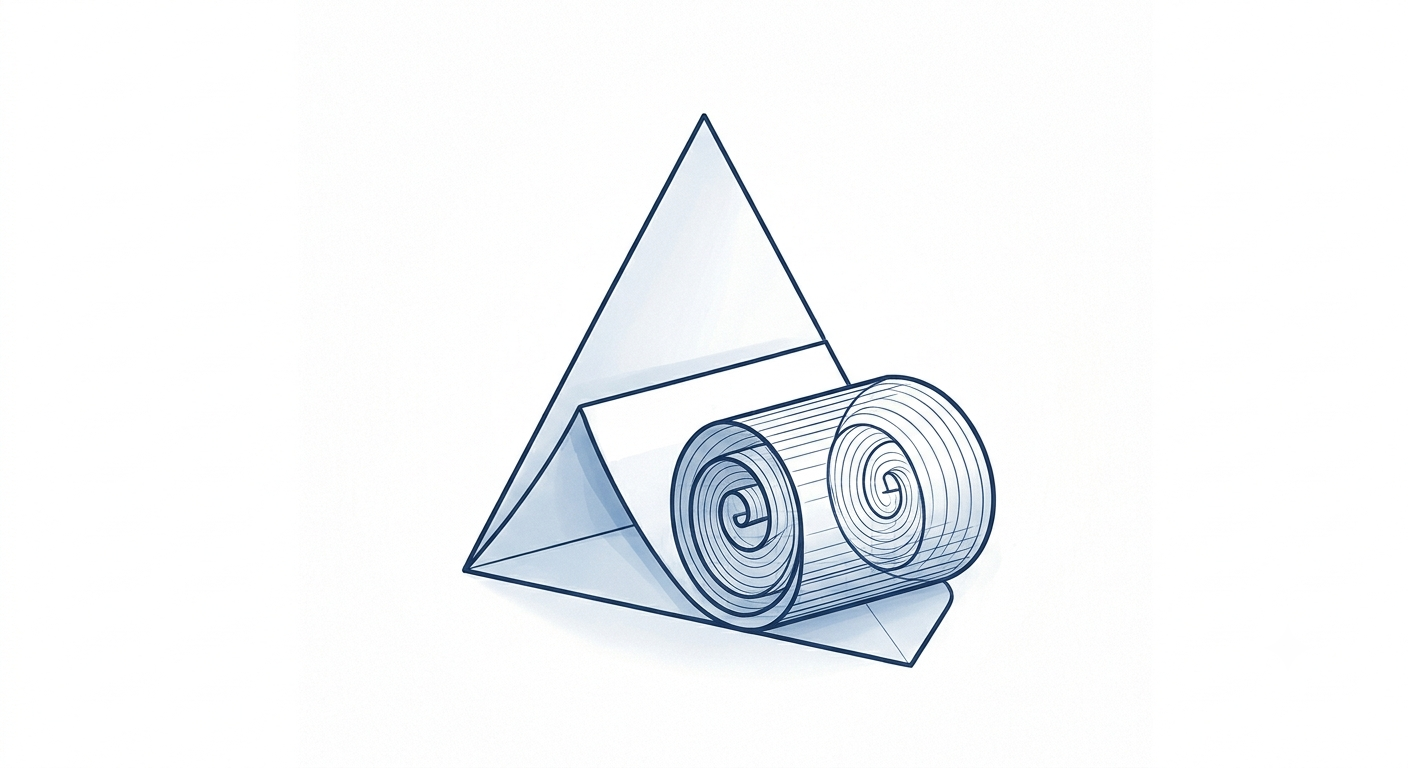
The scientific side helps you understand where not to go, and how you’re currently tracking, but it generally doesn’t offer a diagnosis. For that, you have to go back to the art. If I picture all of this schematically, it’s like a pyramid with a strong base (art), something that coils around itself and can complicate things (craft/technology), and a final point that doesn’t carry too much weight in the end, but is still essential to complete the shape (science). I tried asking Gemini to visualise this concept and it generated this image:

Rolled triangle

A Few Techniques for Better Navigation

This post was originally written in Italian by Paolo Gambardella. It has been translated by an AI agent and may contain inaccuracies.

I’ve been working for a few months now with a new team in a part of the industry that’s completely new to me. I keep thinking back to a post I read a while ago by Owen Mahoney about the 4 industries of video games. My hands-on experience is confirming that the different worlds Mahoney identifies really are different.

Communication is genuinely different

In mobile f2p, as a designer I always have to justify everything with KPIs and metrics — that’s just the deal. In the PC/Console world, though, that kind of thing is generally frowned upon. These are games far more grounded in the creators’ personal taste, which brings another consequence with it: to avoid too much noise and keep the development process from getting muddy, people very often don’t communicate properly. You work in isolation, and you have to trust your teammates completely.

My previous professional experience pushed me to look for solutions to this problem, but I was stopped almost at the first attempt. I took it pretty badly at first — I’ll admit I felt almost useless in that context. But then something shifted: as a designer I don’t have to justify every single thing with numbers, and that is genuinely an improvement.

So all I’m left with is complete trust in my fellow travellers — but one fundamental problem remains: the feeling of being lost. Sharing is limited, documentation is all over the place, and it’s easy to feel disconnected from the bigger picture.

How I’m tackling this challenge

My years of experience, even if not directly in high-end games, are still there, and I’m adopting some techniques to get my bearings. Fair warning: they’re not for everyone — not everyone can make themselves vulnerable and risk coming across as the person who doesn’t know what they’re doing. But for me, the goal (my personal and professional growth, and my connection with the team) outweighs any bruised ego.

The first technique, which I call probing, is to keep putting proposals to the team. I structure them properly, make the best case I can, and table them in a meeting with everyone present. The typical response is that it can’t be done that way, that it’s always been done differently, that the game is not what I’m imagining. And that’s exactly what I’m after: the designers who know the product better than I do finally start sharing what they know. Sometimes they even argue amongst themselves — I just sit there and listen, taking it all in.

The second technique I use is reverse-engineering assets and commits. Following comments and discussions in the code helps me really understand what everyone is actually trying to achieve.

The third technique is mapping the team’s knowledge holders. Domain experts, and sometimes short one-to-one chats to concretely understand how something works. The trick there is to go in with an idea already formed, then ask for confirmation. Something interesting always comes out of it.

Finally, the last thing I spend time on is being a bit of a documentation archaeologist. The information is fragmented and often contradictory, but it’s still something. My goal is always to track down documentation written for external partners, because that’s usually where you’ll find the clearest articulation of the vision.

Change isn’t easy, but it makes you richer

Sometimes I have to sit with feelings of helplessness and incompetence — but for me, that’s exactly where the real personal, spiritual, and professional growth lives. I hope this post can be useful to anyone who finds themselves in the same situation, or something like it.

It’s also really important to make yourself useful: pick up simple tasks that nobody wants to do, so the team understands you’re there to help, not to act as a consultant. There’s a bias against people who come from mobile, like me — no point pretending otherwise. The only way I know to push back against it is to roll your sleeves up and get on with it.

Equal Rules, Opposite Reasons

This post was originally written in Italian by Paolo Gambardella. It has been translated by an AI agent and may contain inaccuracies.

Sensor Tower has published its first report on ad-based monetisation in mobile gaming. I read it in detail (summary article on Deconstructor of Fun). The figure that caught my eye: hybrid games that put in-app purchases first (IAP-first) earn roughly four times as much as those that put advertising first (IAA-first). Purely ad-based games can still reach nine-figure numbers, but they’re the exception, not the rule.

The report leaves one question open: in ad-based games, free rewards earned through ads compete directly with paid rewards from the store. Solving this cannibalisation is, according to the author, the opportunity still left on the table.

The playbook of someone who’s been building economies for 40 years

These reflections on the report reminded me of a talk by Teut Weidemann, recorded at Digital Dragons.

Mr Weidemann argues that a well-designed game economy is the real source of stable revenue — not flash offers or battle passes. And in making that case, without ever mentioning “ethics” or “player trust”, he lays out a set of rules that are, in practice, anti-manipulation (which brings me back to my own post from yesterday):

  • Avoid discounts on premium currency, otherwise you destroy the price anchor and players just wait for a sale instead of buying;
  • don’t do per-user dynamic pricing. Weidemann cites the Zynga case, which ended badly when players compared notes and discovered different prices for the same item;
  • always leave at least one resource that even the wealthiest whale can’t buy. Even players who pay for everything still need to work for something, otherwise they finish the game in a week and walk away bored;
  • don’t tie virtual items to a subscription: a portion of free-to-play players are happy to buy a premium account (more comfort, less grind) but consider buying an item “cheating” — so keep the two things separate.

The tension

Weidemann’s rules look a lot like the ones from Self-Determination Theory that I wrote about yesterday: respect player autonomy, don’t break trust, don’t treat players differently from one another without good reason. His stated motivation is: if you break the price anchor you lose revenue, if the whale has nothing left to work towards they leave, if players find out you’re treating them differently they’ll tear you apart in the reviews. It’s risk management, more than ethics. And as far as I’m concerned, that makes it even more compelling than my own thoughts from yesterday — especially when you’re talking business with people who only speak that language.

Which brings me to the question I find most interesting from a game design perspective: does motivation matter, if the outcome for the player is the same? Mr Weidemann proposes optimising for a long-term function, and that happens to coincide with respecting the player. Now I’m left wondering: maybe in the long run, serving players and exploiting them converge on the same rules — and what diverges are only the economies that are thinking short-term.

Serve, Don’t Manipulate

This post was originally written in Italian by Paolo Gambardella. It has been translated by an AI agent and may contain inaccuracies.

Andrew Kelley, the creator of the Zig programming language, opened a talk with an uncomfortable question: who does the software we write actually serve? The talk is called “Don’t Take the Black Pill” and it was made for an audience of developers, not game designers. But it’s exactly the question we should be asking ourselves every time we design a progression system.

A more honest measure than “fun”

Deci and Ryan’s Self-Determination Theory says that a person is doing well — in a game as in life — when three needs are being met: autonomy (my choices matter), competence (I’m improving, and I can see it), and relatedness (I’m not alone). A system can have spotless retention metrics and still deny all three. There’s a name for that too: coercive retention. The progression is there, but the player comes back because a timer is expiring or a notification dragged them back in, not because they actually wanted to.

Coercionware, outside games too

Kelley calls this category “coercionware”: software whose purpose isn’t to serve the people using it, but to manipulate them. The examples he gives don’t come from games — unsolicited push notifications, A/B tests optimising for the click rather than the experience, recommendation algorithms chasing engagement instead of value. What struck me is that he frames all of this as a design choice, not a side effect. Someone, in a meeting, decided this was fine.

The same problem, different name

In games we call it other things: gacha, limited-time events, season passes that pile on the pressure. But it’s the same mechanism: autonomy is taken away to guarantee a return. I wrote about this last week when talking about dopamine and oxytocin — the relatedness in Self-Determination Theory is, at the end of the day, the same conversation as oxytocin. A player who comes back to spend time in a world or with other people doesn’t need to be held in place by a timer.

A useful habit

There’s a simple habit I use when evaluating a new feature: play devil’s advocate with myself. Assume it fails, and ask why. The list of reasons usually includes things like “it confuses the player” or “it doesn’t convert well enough.” It’s worth adding one more: it fails because it manipulates instead of serves. That question doesn’t come up on its own in a roadmap meeting. You have to ask it deliberately, before you ship.

The next time a feature improves the numbers, the right question isn’t whether it works. It’s whether the player chose it — or got caught in it.