Skip to content

Tag: insight

Start from Personas

When you study game design, you usually focus on documents and prototypes for small games. The first steps that are taught in educational centers are purely technical.

Then you are in the market without the skills that make you a professional designer. Which are not the techniques, but are those oriented toward the video game business.

Normally a team reports to one or more managers who maintain a business vision. Our role as designers is to understand how to realize this business vision. We have to think more about endorsing the product than creating something directly. Players will receive the product packed and polished. Technical skills are important, but our ability to understand the business is critical.

Personas are one of the methods that allow this communication across the whole team. I share with you this workshop that aired last Saturday. The audio is bad, but the content is excellent.

If you want to work for companies as an employee or consultant, you need to come up with frameworks that solve concrete business problems. Thinking about who will really play and how to structure a product for them requires effort and is not intuitive.

Create tools only for good games

As game developers, we often focus on the wrong things which can lead to not achieving our objectives. We might worry about having the wrong team or not having enough time or money, but there is one thing that we don’t talk about enough: production choices.

In f2p, a mistake is to focus on developing development tools without first having a profitable game. For example, if you have a game with characters with their stats, you might develop a tool that allows you to update and set those statistics. But if the game itself doesn’t work, then that tool will have been a wasted effort.

In the past, it was common for developers to create an engine for a series of games. It meant investing a lot of time and money into something that hadn’t been proven to work. The development team would then focus on making the best engine rather than the game itself.

The great masters of game development have always said that the key is to focus on the game itself. The tools should be developed to support the game, not with plans for possible “plan B” games in mind. There are countless examples of games that were unknown or failed, but had great tools behind them.

In short, it’s important to focus on the game itself over the development tools. Only by doing so can we achieve our objectives and make great games.

Connect and open your mind

If you want to stay in this video game industry for a long time, I recommend you connect with many people. I take part in various Discord and Slack groups and this allows me to have a broader view of things. Sometimes simple things happen that make me completely change my paradigm.

During a casual conversation on game design, I discovered this article on how to write good GDDs.

I start with the UX when thinking about a new design. But after discussing it with the writer of this article I have changed my mind. The message of today is this:

I used to think that my client, as game designer, is the Player. But I actually have two clients: the Player and the Product Manager. My duty, during the development of a game, is to provide solutions to the Product Management so that they can deliver value to the Players through the game.

Ethan Levy

He passed me this interesting speech of his from 2018, and I recommend it to everyone.

Respect the art of game design

I met a prospective client the other day who needed simple service. Given a set of published games, derive a design document that specifies everything that should be included in the final game.

The goal of the document was for a programmer to take it and figure out exactly what to do to produce the final game.

I told him his dream is beautiful, but that remains so. Making a game is not an assembly line; the specification documents that other developers need to work with must be produced based on real development needs.

The best way to be successful in video games is to maintain a certain degree of realism and respect for this art that is so difficult to master.

Hiring good leaders

A good leader will have worked with others and can involve these people in other adventures. This is one of the keys to success when a company wants to find a new leader for a department.

I have met various leaders in my career, and I would not work again with all of them. In the selection processes for leaders in which I take part, I do not see enough insistence on this point. A good leader makes the company hire the best talent.

If there’s one thing that’s important to a good leader, it’s the ability to help manage the hiring process.

  • What is this person’s reputation in the local sector?
  • How will they create a meaningful hiring strategy?
  • Are they capable of bring the best people with them?
  • Do companies check these things when they hire a new leader?

Often, some inefficient people get for some reason to be “head of…” at some company. Another company reads their resume and sees they’ve had that position before. The company doesn’t inquire who they have worked with and “cancer” expands into another reality.

A good leader may have held non-leadership positions, but be respected by current and former colleagues. Important is the capability of making an impact in hiring the best talent.

Don’t just look at the resume, you need to consult the people that worked with them!

Reviews are your best friend

Whenever you are starting a new game project or if you are working on LiveOps for an old one, you have a free asset that is very useful: reviews.

Only a small part of Players are willing to leave reviews for your games, especially in free-to-play. Videogames can ask directly in-game to leave a review, but not everyone does so. They do not represent in any case the dominant opinions, but they are useful to spot opportunities for your game.

  • If you read critical reviews and you notice something that repeats a lot, that something can be converted into a unique selling point for your game.
  • If you read positive reviews and you notice something that repeats a lot, that something should be a must-have for your game.

Use Steam or Data.ai to filter out positive and negative reviews. Remember Pareto’s principle. Use always 80% of other games and innovate on the 20%.

  • 80% you should take can be read in positive reviews that repeat
  • 20% of novelty can be read in critical reviews that repeat

Analyze the reviews of the main game you are taking as a competitor, but also of its clones and competitors!

What? There are NO clones of that game? You are probably choosing the wrong competitor and you will hardly manage to have success in its field.

How to use Twine for Player Experience Narrative

Play Lilys Choices in your browser here.

Game writers use Twine to write stories. It’s a great tool and pretty easy to learn. I have learnt during my certification course at The Narrative Department. This week I am prototyping a new feature for Lily’s Garden, so that I decided to use this new tool to test its effectiveness also in terms of feature prototyping.

You can play the Twine prototype here: we have the feature, Lilys Choices.

Final thoughts

  • Twine is a great tool to create a proper Player experience narrative for a new feature.
  • The idea of having an extra resource to start extra Dramas is not new, but it is very important that the dramas end up with a surprise for the Players. Also in terms of concrete rewards!
  • It is important for this kind of games not giving to the Players choices that exclude specific branches. First of all, produce all this content has a cost. Second, some Player may feel frustrated and may want to try the other way around. This thing is not possible in those games.
  • The narrative should be focused on a true fan of the game. At this stage other profiles in the team will probably find risks and flaws to the designs, so be prepared! It is very important to push things forward boldly.

Devlog

How to map and select ideas

This week I decided to prototype a new narrative system for Lily’s Garden using Twine. After deciding the right problem statement, which is:

How can we engage more the Players more interested in the story, rewarding every effort they make to reach better outcomes during the puzzle part?

I passed to generate a lot of ideas on my notebook. Then I filtered out the best of them.

Ideas classification

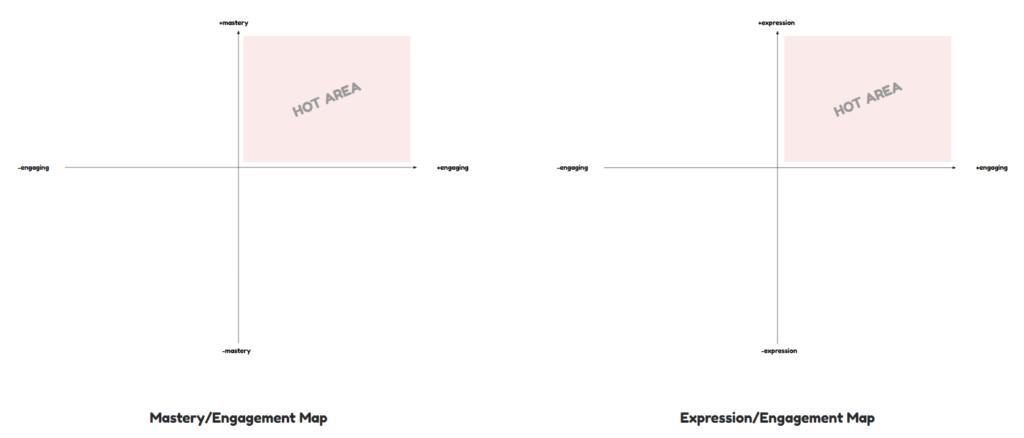
Now it’s time to map the ideas in a proper chart. The X axis will represent the engagement, the metric to improve. Engagement is measured with session length and average sessions per day. Those are the KPIs.

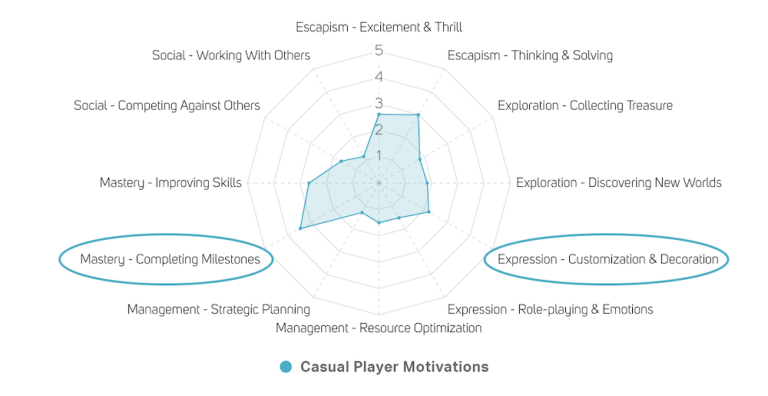
On the Y axis consider the motivation to stay longer and open the game more during the day. This article by The Games Refinery will help us.

The two main motivational drivers for this genre are Mastery and Expression. So that we have two possible charts to map out the outcome of our brainstorming.

I classify the ideas in both those maps and see if we spot something in common. Usually this process is a team process and takes time and discussion. Again, in my case is just a quick exercise.

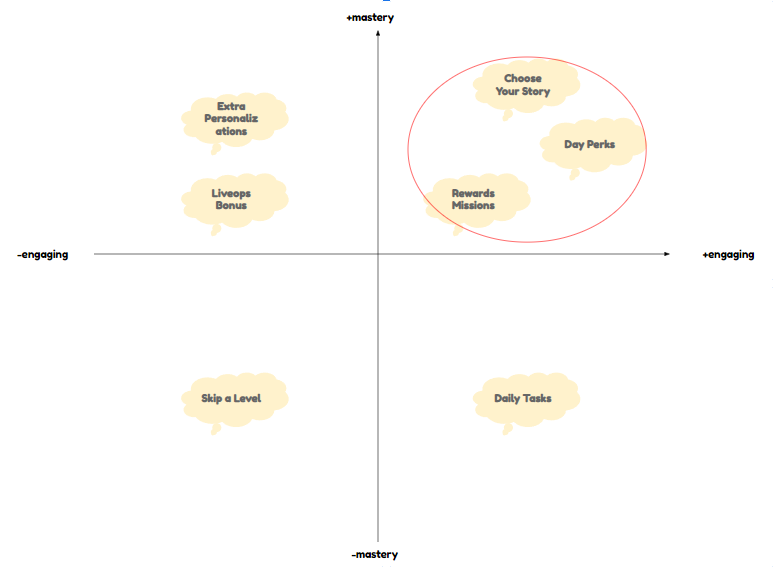
Against mastery we can see that we have 3 possible ideas to build:

  1. Choose your Story: creating and using special tiles/power-ups during the puzzle match, you get points to invest in story branches.
  2. Day Perks: Once a Day ends according to what you used you can get extra rewards (boosters, power-ups, infinite lives, ingots)
  3. Rewards Missions: playing the game and performing positive actions such as buy lives, get extra movements, return every day, you unlock a special currency which can be converted in boosters and power-ups.

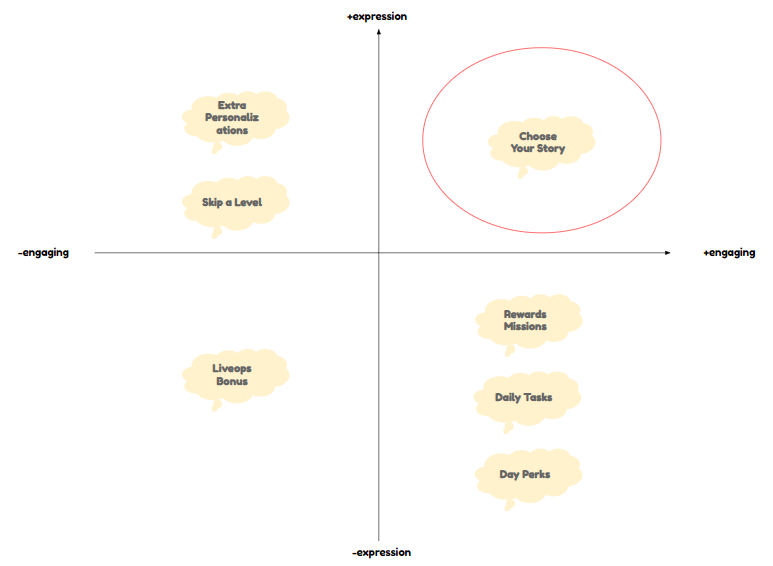
Mapping ideas with expression in mind, a single idea is in the hot spot.

We have then selected our main idea: Choose your Story. Secondary ideas: Day Perks and Rewards Missions. On this base we can build our prototype!

New narratives for mobile casual games

I loved this NoClip documentary on the making of Dishonored.

I believe that in terms of narrative there are a lot of interesting aspects that can be taken from this concept. Take the match-3 with decoration genre for a moment. You earn a star beating a level and you use that star to complete the next task. A cutscene with dialogues is shown and then new tasks are opened. You have to play more levels and see how the story goes on.

What if:

  • we can make the environment speak more about what’s happening
  • we can let the Players explore better and interact with environment discovering where to use the stars to fix things
  • we can deliver the story reacting to the Player’s actions instead than stop it to show a cutscene or a dialogue

The MVP Culture

Over the years I have learned the single thing that product leaders hate most: uncertainty. There is a common myth of epic leaders capable of having a solid vision to spread across their team. It is almost never the case. Usually the game vision is the result of team effort.

During the development of a new game or a feature for an existing game, there are a lot of variables that make the people feel uncomfortable and insecure regarding the return on that investment. Which is why the MVP, minimum viable product, concept has been rented from the startup “fail fast” culture.

You develop the basics of that new implementation and with that you measure the results. In theory, you will eliminate risks.

In practice, instead, often that way of producing things shows a lack of vision and understanding of the market. I saw many times the MVP converting to the final product. The team publishes the MVP of a new features, metrics and analytics seem OK and they pass to the next MVP without putting the right effort to make that feature really awesome. 

This is a short term strategy that never works. Games are a refined craft that require passion for the details. That is where the magic happens.

MVP are useful to:

  • Test the technical context and make proper development estimations
  • Have something practical to show an idea to the upper management
  • Run playtests with some cohort

MVP are NOT the right thing to do if you want to:

  • Run split test with engaged cohorts
  • Prove the growth potential of a new game
  • Estimate the LTV improvement on the long term