This post was originally written in Italian by Paolo Gambardella. It has been translated by an AI agent and may contain inaccuracies.
This past weekend I was completely captivated by the stream of news about video game code decompilations. This came after a week of surprises, in which I discovered I can basically have an idea and see it come to life immediately. On my own, without asking anyone for their time.
Make your own mix
At work I built something that would have been unthinkable three months ago, but for obvious reasons I can’t go into it. In my personal life, I’m studying Catalan and I made a video game for my class, starting from an expression we use a lot: tros de quòniam, which roughly means “a person who’s not the sharpest tool in the shed”. In class we’d done a verb trivia game, so I asked my teacher if I could photograph it. Then, using all the free material available online, ChatGPT helped me structure my own version.
My idea was to keep the dice roll and add objectives to complete — like in mobile puzzle games — which drive much stronger engagement. There are four colours, one for each verb family. Each correct answer is worth ten points multiplied by the dice roll, and filling the bar lets you capture the “trosset” of that colour. Mistakes don’t set you back and there’s no timer, because the goal is to learn.
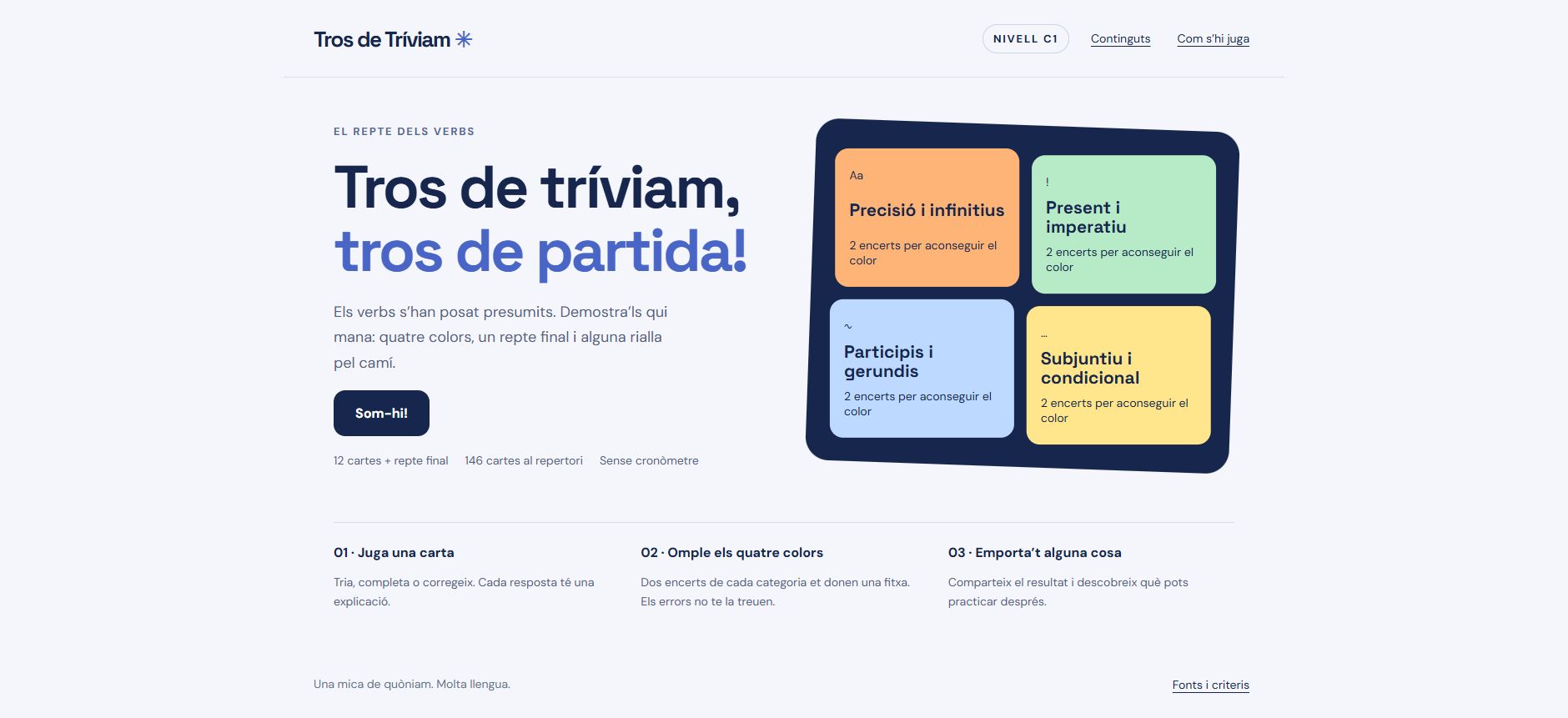
When I think about it, there isn’t a single new element in this game. The class trivia game, the exercises from official sources, the dice, the progress bars from mobile puzzlers — all of it already existed. The creative work was deciding how to fit the pieces together. You can try it here, if you’re studying Catalan.

What I’m seeing now is that people are using Claude to decompile games and mash them together. In the video below, for instance, someone merged EA’s Skate and Modern Warfare 2: the player can switch to third person, hop on a skateboard, and shoot enemies while doing it.
This is absolutely fascinating, and it breathes new life into the many mechanics that repeat from one game to the next.
I can picture a future where belonging to an ecosystem lets players try out whichever combinations appeal to them. You finish Spider-Man and Wolverine, then use each character in the other’s game. New life for what you’ve already bought. Really exciting stuff.
As a game designer, though, the first thing that springs to mind are the problems. Spider-Man is an acrobatic improviser — he hits and bounces between enemies, and his combat is designed with lots of space and spread-out foes. Wolverine’s combat is far more brutal and visceral, all close-quarters. Put Wolverine in Spider-Man’s New York and you immediately wonder how he moves between skyscrapers without webs. Put Spider-Man into Wolverine’s close-range brawls and his acrobatic rhythm has nowhere to breathe. Every game builds its enemies, levels, and camera around its protagonist’s core verbs. The most interesting mix is the one that forces you to rediscover a game you thought you already knew.
Thoughts on creativity
Some people might raise an eyebrow — fairly enough — at this avalanche of novelty arriving within the space of a few weeks. There are genuine ethical issues tied to all of this. For me, though, creativity somehow exists outside the reach of overly conscious logic and deliberation.
In one respect this situation resembles the question of chasing trends, which I struggled with a great deal working in mobile free-to-play. Chasing trends is a fundamentally anti-creative act. Being aware of trends certainly enriches your knowledge, but creativity is a process of discovery rather than an exact science. Those who chase trends always stay on the too-familiar side of things. A good mix starts from something the player already knows and adds just one surprise: familiar enough to get them in the door, fresh enough to keep them there.
In the same way, having these new tools available unlocks an enormous number of opportunities. Here’s a concrete example: before, to run some experiments and show the team I had a worthwhile idea, I’d have to ask the producers to assign me at least one artist and one programmer. Today I don’t need any of that. I’m not spending anyone else’s time, and that gives me a much wider space to explore. I can make five rough prototypes in an afternoon, throw four of them away, and discover things I didn’t even know I needed to ask.
Impossible to ignore
I use tools that are built on the large-scale appropriation of intellectual property, and that’s simply true. But the benefit from a purely creative standpoint is enormous. There are people more talented than me who could do without them — I can’t, and right now I’m not blocked.
My personal limit is to use them only for prototypes. I’ve written a story, La Principessa Melone, which I hope to publish in Italian in December. I illustrated it first with ChatGPT, and it was precisely those images that helped me understand what I was looking for — which then sent me looking for real artists to actually draw it. The prototype helped me figure out what I wanted, while the book itself will be drawn by human hands.
I don’t know how long this will last: there are various ethical and geopolitical questions that could shut down certain services within hours. So I wouldn’t recommend anyone build their strategy around any of this.
But it’s impossible to deny that we’re looking at a dazzling and in some ways incomprehensible situation, because everything is moving incredibly fast. My practical advice: prototype a lot and quickly, and keep anything that really matters out of a service that could be gone tomorrow.