Skip to content

Tag: professional

Has “put genre here” died?

Online discourse regarding the gaming industry is very often monopolized by marketing and business people. Which is normal, since they are “selling” ideas and spreading new and old trends.

What makes me smile often is when I read that a specific genre has died. It is like “hey, everyone! Stop doing this because now people don’t want to play this kind of game anymore.”.

As a designer, anyway, I know that Players look for experiences capable of satisfying fantasies. This has nothing to do with a specific genre. Good games start with an assumption on fantasy. “Be a cat” can be a fantasy (STRAY, an indie game). “Win big at Casino” can be another one (SlotoMania, free to play mobile game). “Dominate your opponent mind” (Chess, classic game).

Starting from fantasy, then you build your actions and mechanics on top. And then you design your economy starting from goals structure. You can eventually add up a setting/world and, finally, the story.

During the process of defining your actions and economy, you should study the market and its trends of course. But I would like to invite you not falling into the trap of riding a trend for the sake of it OR rejecting ideas just because there are not much success cases.

When the market is emptying of a specific genre there are usually a series of reasons. Something that doesn’t work for the most can be a huge opportunity for your reality. Don’t be a follower, write your own story.

A serious doubt

The other day a friend of mine passed me this message:

Never until now have people boasted of not having read a book in their lives, of not caring about anything that might smell slightly of culture or that requires a minimum intelligence.

Today’s illiterate people are the worst because in most cases they have had access to education, they know how to read and write, but they don’t exercise.

Every day there are more and every day the market cares for them more and thinks more about them. The media compete in offering content designed for people who do not read, who do not understand, who ignore culture, who want to be amused or distracted, even with the dirtiest gossip.

The whole world is being created to suit this new majority, friends. Everything is superficial, frivolous, elementary, primary… so that they can understand and digest it.

They are the new ruling class, although it will always be the dominated class, precisely because of their lack of culture. And so it goes for those of us who are not satisfied with so little, for those of us who aspire to a little more depth.”

Jesus Quintero, Journalist, writer and presenter of radio and television programs

I work in mobile free-to-play since 2012. I started my journey in video games in 2007, dreaming of joining Bethesda, Bungie or Nintendo. More in general some company that impacted deeply in my personal life with their titles.

Free-to-play is based on a simple concept: you need a huge amount of people playing your game. For that reason, everything should be very smooth. Frictionless. We ignore conflict for the sake of keeping attention and awareness toward our service. People has to stay, everyday, with you. So that an obstacle may frustrate too much someone, and that person will go away. They will churn.

Many free-to-play games end up becoming an escuse to get people’s attention without offering any spark of culture. Without requiring any mental effort. Just come in, it is easy and rewarding!

Investments go towards those products, because they can scale dramatically. They can become profitable business. People doing game with passion, games that make people think, instead, have to fight every month to survive. To pay salaries and their bills. Maybe a YouTuber will take their game and stream it next week. Will someone simplify it for the people? Few people will invest in them, because they do not promise growth. They promise a message to the World.

My doubt today is: what am I doing?

How to build the next Supercell

I have a secret to build the next Supercell. Really, I have it! Have I ever built a company like Supercell? Of course not, but I mean: we live in the age of suggestions, advices, best practices, influence, likes, follows… So why shouldn’t I write some wise article about how to do things, right?

As any secret, this one is very easy to understand too: stop treating people like children. Easy, right? Let’s see three common ways in which you are treating your people like babies, including before they join your company.

Technical tests and assessments

In some case those are necessary, especially for junior talent or for talent that is switching radically the sector. For instance, passing from free-to-play to AAA. Anyway, if you are hiring a person in his forties please: give me a break!

Our curriculum, carreer and our ex colleagues speak from themselves. We have nothing to demonstrate anymore and we are completely capable of doing the job at a technical level. Do I really need to show you how I structure an economy in a spreadsheet? Do i really need to demonstrate my presentation skills? Do you want me to create a flow and a wireframe? Or worst, a single GDD bible? Please, I do this since probably before you joined that company. Again: give me a break!

Do this instead:

  • Interview for cultural fit
  • Review in detail past experiences
  • Ask for referrals of ex colleagues and employers

When I see a test proposal I just think: “ok, you are not capable of evaluating my kind of profile. Next.”

Show me the next things to do with no context

I remember when I was a little dude asking to my father: “Why should I do that?”.

“Because I say so”, was his answer.

35 years later, history repeats. And I am very tired of that. You give a task and a deadline, with no perspective. I will do that for you the best I can. I swear. But I will never understand anything like this. Why is this important for the project? And how will we demonstrate that in fact it was? When we shoud have some learning? What about the past iteration? How did it go?

Maybe you are too busy to explain well the vision behind any choice. That means that you are not doing the job you should, to me. Because if you are my manager, you should be focused on manage my team and myself. Not the game. Not the code. Not the art.

Put your hands on my work

This is tipically something that you do to game designers. And tipically something that occurs in small-mid sized companies. We spent weeks designing something, researching, getting the problem right, sync with all the people involved. And then you decide to change everything because you have your own idea in mind. You are the founder or the leader of the project and you have the last word.

I could be wrong and you right, of course. Still, you are stealing my opportunity to learn more about the audience and the kind of product we are doing together. I just feel that my solution will never be tested on the field. Your solution maybe can be successful. And probably you will be happy and still will recognize my work. But you stole my opportunity of seeing a design I made going out there.

Stop play with my toys, those are mine!
Push your boundaries

I see a lot of professionals getting a name in the industry working on successful projects. Then they decide to go indie. And they do the exactly same thing they were doing at the mother company, but with less resources. After a while, they return back to some corp. Classic.

One of the things I always suggest to the people I mentor is this: do not remake things you already did before. I am not sure it is the right way of thinking, honestly. It is just mine.

To me, remaking stuff is always a mistake. Maybe the thing you want to remake is an old experiment that failed for some reason. Learn from it and do something else, don’t try to take shortcuts or you will repeat other errors you did for that same experiments that were eclypsed by the major errors.

If a project was successful, instead, it probably was for a bunch of reasons. It wasn’t just your work and effort, but also the timing and the context of that time. If you decide to invest your time and effort for a new project, try always to push your boundaries instead. It is usually a better choice.

Your indie can become the Metaverse

I am actively looking for a new job, while preparing my next step which will be a course on game writing and also a deep study of the Unreal Engine. I am arrived at a point where I consider myself pretty good at free to play, but I am constantly playing indie and AAA games. Why not try do some small indie experiment?

So that I fell in this paradox lately. I see a lot of huge investments and acquisitions towards companies and projects which are basically clones of existing success cases. I see also a bunch of independent people with really good ideas struggling to pay the bills at the end of the month. What the heck is going on? Why those people cannot manage to get investments?

So that the next guess is that maybe they don’t even try to sell something. Every game studio needs something who knows how to sell the idea behind. And suddendly some very old concept, like 3d lowpoly characters in a 3d World becomes the Metaverse. And some people buys that idea.

Show your impact

When you get an interview you can demonstrate your skills in three ways:

  1. Taking a test
  2. Showing a portfolio
  3. Demonstrate the impact of your work

Often, you are required to do more than one thing at the same time. In fact, many companies ask you to take a test. Before, they review your portfolio and later they ask you about the impactful initiatives you lead in your previous jobs.

Impact is, by far, the most interesting thing. Still it’s not really easy to understand the specific impact of your designs. Many times (too many times) your designs are strongly influenced by the context. It may be some specific software constraint or also the green light process at which every initiative is submitted.

Still it is very important to learn how to estimate the right impact of your work. In data driven contexts, like f2p for example, you should also accompain your reasonings with concrete KPIs increment (in % to not break any secrecy).

A VIP idea from Delta Airlines

Design games for the free-to-play mobile business is whale hunting. Unless you are a genious, like Bit Life developers, you will probably do the math. And doing the math, you will notice that you need high spenders to sustain your business.

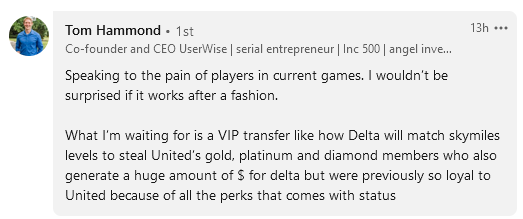
Yesterday I saw this comment on a LinkedIn post:

Shoutout to Tom Hammond for this great idea.

I checked out the original Delta program and now I cannot understand why nobody is doing that.

Scenario

Ana, a Slotomania player, is a Black Diamond level VIP client. She gets an ad from your Mobile Casino Game that promises her VIP level can be matched with a challenge.

  • Installs the game, logs in
  • A pop-up asks her if she already has VIP status in other games, she answers that she does and details that she is a Black Diamond in Slotomania
  • Within 12 hours, a person from Customer Support contacts Ana, asking for more information
  • Ana’s VIP level is matched with the game’s VIP level.

Why?

If someone has a high VIP level in another game, it is most likely a whale. It could be a whales acquisition strategy.

Failing at premises

Successful games are games that manage to meet the right audience willing to invest their money in them to get the kind of fun they expect. And that is nothing new, it’s game design 101. It’s the very first lesson you learn anywhere when you start designing games. You should design a game for some audience.

There are many ways of failing at this. Actually, the vast majority of games fail to deliver this exact point. Which is why video games are a very risky business.

The experience may help you avoid some mistake, and mine has a almost constant issue that I see: failing at premises.

In fact, a lot of times I hear sentences like:

We want to make a game like <CoolGameTitle> but more [casual|hardcore|midcore], just like <NewTrendyGameTitle>.

Senior VP of Product Ownementshipssss (or some fancy title like this)

I don’t know if the syntax I am using is completely clear, I guess it is not. But the truth is that when you want to change a playstyle from a specific audience, that almost for sure leads to disaster. Casual, midcore and hardcore to me are a way of describing the gameplay session time.

It is good that you take your references, but if you are willing to force a significant change in gameplay behavior you are on the wrong way. If you know that a specific successful game has that playtime, you should consider that seriously as a pillar and not as something to change. We can be misled to think that “making things simpler” means “shorter/longer gameplay sessions” and that is almost never the case.

Never say never of course, but that is in my experience one of the false premise that make a game lose the money and efforts you and your team invested in.

The power of asking

I notice a tendency of show off everything on social networks instead than asking for help. Especially from Gen Z, I see that many times they are worried more with their personal brands that with building meaningful relationships. The few of them who ask will receive.

There was a moment in my career in which I found myself alone, without a job and thinking seriously of leaving the industry. Naturally, I started to speak with every friend regarding this. Also with new employers. I worked as waiter and as data scientist, always thinking in making video games someday. I also started a blog in Spanish in order to make myself visible, but there was a single activity which I was committed: asking.

I asked everyone I could for help. Most people will try their best, believe me. Asking is way more useful that put a screenshot of a Unity session on LinkedIn saying “first trials with new video pipeline!”. That is not useful at all, there is no polish in what you’are publishing and it’s only noise. Ask instead something to some expert of your field. Ask them everything you can, on all channels you can. Use comments but also DMs. Ask and insist asking for help. Ask is so powerful!

Love your manager

I want to design games at work. I love to do it and I put all my effort in it. I study everything in detail, I try to understand the problem, the context and also the competitor’s choices. Then I come up with a vision for a new game or feature. And the politics start!

Usually, I work for managers: product managers or producers. Many times they come with a lot of ideas already regarding what to do and what not. So that it’s important to understand well those ideas first, because anything out of those ideas is really hard to get approved.

I would love to not having to deal with politics, not having to defend my work always. Sadly, this is not possible in the company context. So that we should embrace it and love it. Love it by loving our teammates, first. This is very important: do you love your manager?

Love is an act of empathy and humbleness, in this case. You don’t love your manager as you love your wife, of course. Love is to really try to understand your manager and the vision and the background that brought to that vision. Love is to listen the reasons and be able to discard your own brilliant ideas in the name of theirs. Love is wanting your manager to shine, because if the manager has success, the whole team has it.