Skip to content

Tag: professional

Deserving the position

A friend of mine, indie game developer, is trying to join the industry. He managed in a brilliant way getting his first interview. He study their game and made a feature proposal for them.

A few months ago, I sent my CV to the same company and for the same position. I have far more experience than my friend, still they rejected my application. He was smart and proactive. I didn’t, I just applied. He deserves that position!

Today he asked me for a way of preparing for his interview. I suggested him to get informed regarding the main KPIs, key performance indicators. Those are very important when you are giving the core of your service for free.

Then you have to study the company’s game and at least 2 competitors of the same game. Look on Game Refinery and Deconstructor of Fun for more depth on the genre.

This post is for my friend. He deserves the position!

Remote processes

I work remotely for companies since 2016, more or less. I am very specialized in game economies and UX, so that for them is easy to deal with my tasks and responsibilities.

Game development, instead, is never so easy. You cannot rely just on freelancers to build successful products that potentially may last years. You need a core team fully involved every day. And in order to keep it working properly, you need to set up the proper processes. Also the companies that state that they don’t believe in processes, end up setting up (scrappy) processes in the end. To me, it is better to embrace the process as part of the development. In my opinion, processes are very important.

In 2020 everything shifted online. Remote work was forced by the terrible situation of the pandemic. We had no time to prepare, we had to act fast. In a lot of cases, the same exact process employed before was translated to the asynchronous remote work. Some of the most “boring” things were also eliminated. In their place, nothing new was developed. The new process, then, was like Frankenstein.

Nowadays, many are arguing that we need to return to the office because is not the same online. They are right, online is not the same. But, are you sure you did your job, testing and iterating alternative processes?

The reality of giving games for free

You start a new project with your team, and you read that someone is getting rich with a f2p mobile game. There are people, called whales, that are willing to spend thousands of euros each month. You can be rich too! You have a great idea!

Then you find the right investors and you build your team. You study the market well, mitigate all risks and put your product in soft launch, after 2 years of development. Then you struggle with metrics. Day one, day seven, day thirty retention. Average revenue per user, lifetime value.

You spend two years more in development. Investors want to see their return on investment. Your team is tired, many of the original members are gone. And you fail.

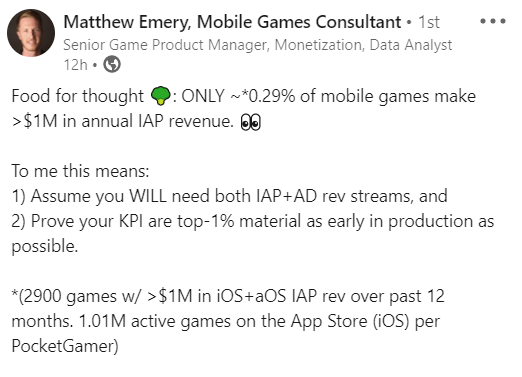
Was you a disaster? No, you are just the regular situation. Read here:

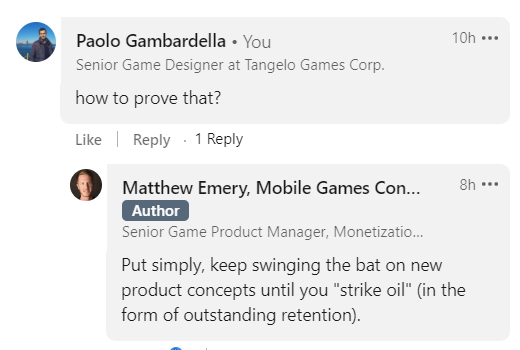
I asked to this expert how to prove your KPIs potential early. He answered me that:

And I tell you: it is NOT easy all of that. First of all because when you are under pressure is super hard to admit that your KPIs are not promising to the investors. You need talented people, and that’s pretty uncommon.

Many of us feel that F2P is dominated by white collar people full of money and addicted “users” that cannot stop play. The reality is super different. The reality is that 99.71% of projects fail. That’s the regular situation.

Everything is clear

You are at your desk, everything is clear in your mind. The new game mode should feature a new energy system which permits to spend energies in change of doing a whole set of special actions in your RPG. You can throw bolts, run away from fights, hit with a sword. All with this energy system.

Then the engineer writes you on Slack: hey, can you check this? You see that nobody understood the vision, so that check your documents. “Look, is all there!”. They didn’t read the comments under the flow, your document was too long to read. The leader of the project says it’s too late. And the leader starts imposing own design, without thinking too much. Discussions starts, but in the end the vision changes.

You update your documents.

Documents that no one, except from you and maybe QA, will read. Satisfied you will shut down your PC. And hope for the best.

Play the build

Game designers play the build. Everyday. At least for a couple of minutes. Then we play other builds too, during our working day.

And then maybe we play again the build. Just to check out all the differences.

Someday this rule is not respected. Sometimes those days are many. Sometimes are in the row.

And when this happens there is the possibility that the game is not so engaging to you, anymore. Ask yourself if it’s time to move on.

When a game designer steps in

There has been a lot of talk lately about the usefulness of video game fairs. This year at the most important fair in Brazil, BIG Festival, game designer Mark Venturelli confirmed their usefulness.

He envisions a show fully sponsored by new brands that have received massive funding to promote their pyramid schemes. Imagine seeing logos of brands that have never created a successful video game or console invade your spaces little by little.

This is where heroes like Mark Venturelli enter the scene. With the excuse of presenting a speech on the future of game design, Mark instead explained why NFTs are a nightmare. Explaining the obvious, but giving a pure game design base, our hero got a standing ovation.

Video here:

Slides in English here:

Friday, I’m in love

I would love to build my own company, after many years serving many projects and teams. I have developed a vision, I feel I can somehow foresee part of the future.

I would like to focus on gameplay first short games. I would probably start from PC games. 3 months development, plus 3 refinements and then 6 months to see the return on investment.

I have everything clear, but I don’t want to stay behind burocracy, contracts and all the things. I guess I will have to, at some point of course. If I want to really put in place all the knowledge I had those years.

Don’t get me wrong, I am not a guru or something like that. I know for sure that I am wrong in so many ways. I just feel that in order to really grow more I need a period building something I really believe in, in a way I feel the best.

As Italian, I am a fan of the stories of Olivetti and other entrepreneurs like him. To me a company needs to improve the society where it is founded, in a meaningful way.

And I think I have this way, I just need to try.

Getting inspiration

We want to create a new game, often times because we played one. So that we got inspired and somehow we want to make our own version of it. Maybe we are working for a company which spotted a market opportunity. So that we start studying the games belonging to that market, try to reproduce the best things.

Games industry is very endogamic. We tend too much to take inspiration from the inside of it. But if we see the best products out there, they take a lot from the outside and bring it to the inside.

Days ago I was talking about the TikTok of puzzle games. That is a way of looking outside. You just study the apps market and think in a better UX for some classic game. It often works like that. If you look at games like Royal Match, they took well known mechanics and the real twist is completely on the UX side.

Another great reference is nature. From nature many game designers created memorable gameplay experiences. Think in Japanese legend Shigeru Myiamoto and the story of how The Legend of Zelda was conceived. If you like to walk and you really start observing you notice that nothing in nature is wrong. Recent game The Ants: Underground Kingdom is another evidence of the power of nature. Especially if you want to get better ideas on gameplay and lore, nature is the way.

Art, toys and objects without purpose are also a great way of getting inspired. The history of videogames is full of examples like that. Think in the indie success GRIS or the mobile game Monument Valley. There is not a superhigh challenge, nor a specific deepness in their economies. The Players can just enjoy the overall game feel.

Remote processes

I am very outspoken and I work mostly remotely since 2017. Way before of the pandemic I was providing my game design services to many companies all across Europe. My specialty is game economy and gameplay design for free-to-play. Companies contacted me for three main things:

  1. To set up the vision for some new project of their.
  2. To review and design a new tutorial for their game.
  3. To add more monetization features to their games.

My main tasks are always been to become aware of a certain context, study a specific market and provide concrete solutions. All of that online, by remote.

I remember back in the days when I had to wait for the producer to call me after the internal meeting. I wasn’t allowed to participate to their daily standup because they were too lazy to set up a camera and connect with me.

Then the pandemic came and this is now the new normal. Now most of my work is online, but the processes are still the offline ones. I mean, I didn’t saw relevant updates to the game development practices. And that’s a problem.

Game development has many moments, good and hard ones. Especially the hard ones, when you need to tell the others your truth about something are getting always more complicated. Sometimes you notice that things are just not working out. So you should take the courage and speak with your boss and colleagues about that. You can do it by writing on a “public” slack channel or by contacting the leaders in private and have a virtual face to face with them. Still, with the remote something is missing. You always have that colleague with stays silent most of the time. And most of the time that colleague is one of the smartest. But they don’t talk, so you will never know. And possibly then they quit for a better job. And you remember that you never asked them directly to express themselves during meetings.

Like this there are a lot of stories. Remote work brought good things to the industry, but one thing is clear: games are not getting published in the expected volume.

We should update our processes at some point.

Best practices

The games industry is estabilishing its processes step by step. Year by year. You work on a new feature and you are constantly studying other games. How is that feature implemented there? Why?

Then you discover an article or a video and you see that there are best practices to do that. Maybe a colleague, maybe your own boss show you the best practice. Often time you discover the best practice AFTER you did your breakdowns, your wireframes, your flows, your brainstorming with your team.

Best practices are the best because there is nothing better, right? They are based on facts. On data. On results. On money.

The temptation with best practices is to just implement those, because someone already figured that out. Why reinvent the wheel?

The risk is design something without even understanding why it should work and how to measure its effectiveness. In the meanwhile, a new trend and best practice popped out. Your design is old, maybe you should iterate on that.

Best practices are those things that, when they are publicly available and well defined online, are already surpassed. So that those are just common practices waiting for a new best.