Skip to content

Tag: professional

My feels and fears

I lost a professional contact the other day due to a personal point of view expressed online. My point of view is not yet formed, but we know the medium well. We often say things that aren’t reasoned enough, that’s how it is nowadays.

This person said that AI art violates the rights and people working in digital art. As far as I know, AI art algorithms try to mimic the learning process of a human artist. A huge amount of human work feeds the machine. Then the algorithm generates art based on the interpretation of a prompt.

It is possible to write prompts quoting famous artists’ names to achieve a very similar style.

This makes me think a lot. I’m impressed by the ability that a tool like Midjourney of inspiration offers me. I’m concerned about the use made of the results of these technologies.

It is abuse, in fact, even for me. I lost contact due to a misunderstanding and it doesn’t matter. Friendship remains, as we say in Italy. Yet, I agree that inspiration is one thing and copying is quite another.

Throughout my career, I’ve always watched artists take inspiration from Pinterest and ArtStation. Someone copied at least some parts. But the result is achieved with effort, which is being torn down today.

I feel these new technologies are like the advent of 3D. I feel that they are something really revolutionary and wonderful.

But I’m afraid that these technologies are abusive in so many ways. Our creativity must be preserved because it is what distinguishes us from animals. We cannot allow something created by us to hurt the souls of people in the name of higher productivity.

It is necessary to regulate.
Improve your imagination

Nothing and no one can take imagination away from us. New technologies can certainly allow a person to multiply productivity. This will inevitably lead entrepreneurs to hire fewer people.

The world before the invention of spreadsheets needed less skilled labor. Elevators were driven by a person. Those jobs are not available anymore. C’est la vie.

The human being will always be irreplaceable in the imagination. Worry about your imagination and let the machines do the repetitive work.

Create tools only for good games

As game developers, we often focus on the wrong things which can lead to not achieving our objectives. We might worry about having the wrong team or not having enough time or money, but there is one thing that we don’t talk about enough: production choices.

In f2p, a mistake is to focus on developing development tools without first having a profitable game. For example, if you have a game with characters with their stats, you might develop a tool that allows you to update and set those statistics. But if the game itself doesn’t work, then that tool will have been a wasted effort.

In the past, it was common for developers to create an engine for a series of games. It meant investing a lot of time and money into something that hadn’t been proven to work. The development team would then focus on making the best engine rather than the game itself.

The great masters of game development have always said that the key is to focus on the game itself. The tools should be developed to support the game, not with plans for possible “plan B” games in mind. There are countless examples of games that were unknown or failed, but had great tools behind them.

In short, it’s important to focus on the game itself over the development tools. Only by doing so can we achieve our objectives and make great games.

Respect the art of game design

I met a prospective client the other day who needed simple service. Given a set of published games, derive a design document that specifies everything that should be included in the final game.

The goal of the document was for a programmer to take it and figure out exactly what to do to produce the final game.

I told him his dream is beautiful, but that remains so. Making a game is not an assembly line; the specification documents that other developers need to work with must be produced based on real development needs.

The best way to be successful in video games is to maintain a certain degree of realism and respect for this art that is so difficult to master.

They said me “no” again

I got in touch with a manager of an important company for a position that was definitely too big for me. Anyway, trying never hurts. I had the opportunity to take part in a selection process. The process included a technical test that I had to deliver in a time frame set by myself. I accepted, even though I had promised myself not to. I carried out the test and also asked for help from people more experienced than me, for feedback. These people helped me, thank you, Susan and Katie.

After two weeks I got the answer. I didn’t pass the test. The answer came accompanied by comprehensive feedback on the reasons. I read the reasons, I would have liked to defend my assessment in a videocall. Yet, re-reading my proof and reading that feedback I find myself agreeing on many points.

Feedback

A constant in my life is that they tell me I don’t get straight to the point and I arrive as confused. I seem too academic and introduce concepts that aren’t always very clear.

Then there are comments about typos, but I’m not a native speaker.

Some questions have been interpreted by me from a different point of view. So my answer came as wrong.

Conclusions

Technical tests serve to prove how a designer structures a problem to derive systems. There are two basic types of thinking in this regard.

  1. There are holistic system thinkers, who look at the big picture to find patterns.
  2. There are those reductionists who start from the details and then get to the big problem.

I am a professional of the first type. In a short time frame, it’s hard for me to get straight to the point. And this is a big problem for technical tests. I have never passed a single technical test in my life. I believe that is because of this. But I’ve always worked, and I must say that my colleagues are always quite satisfied with my work.

I shouldn’t agree to take assessments during the selection process. For me, they are a big commitment. Following, an unnerving wait. And the answer is always no.

Working in a competitive market

Working on a game that will have to enter a very crowded market, the so-called red ocean, involves a certain degree of challenge.

When you enter a market full of competitors on one side it means that there are customers willing to pay. But it means that it is necessary to solve some problems to have a chance of success.

The alternative is to look for virgin markets, blue oceans, but very often this is because some genre in question does not move much interest. We can create a first-person platform for mobile devices since none are in top200 grossing. There aren’t any because people don’t care. Sometimes it’s better to go to already populated markets, especially if we have an idea of ​​what to improve.

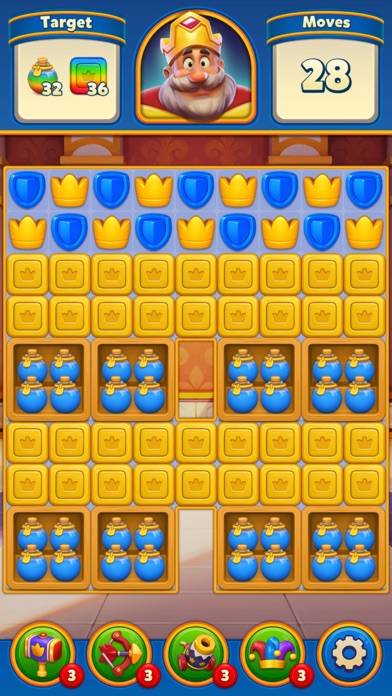
Take the case of Royal Match, a top-notch match-3 that was released when the puzzle market felt overcrowded.

  • The game fixed key UX issues, shortening the load times.
  • They came up with a brilliant system of level design.
  • It implemented the renovation feature very without the need for dialogue.
  • They designed very simple and clear graphics.

The result is an agile, fast game, perfect for mobile. It doesn’t matter that he entered a red ocean market, he made it because he understood his audience well.

Many teams choose to remain followers. They study a market and copy here and there, hoping to secure a piece of the pie. In the process, they don’t even understand the reason for some choices. Years go by, goals are not achieved, and people are fired.

During the job interview, you must inform yourself well about the projects.

My path for the next future

In recent months I’ve been deciding about my professional path. On the one hand, I like working as an advisor for companies. In fact, you learn a lot more this way.

When you work for an important corporation you learn to work in that context. When you work like a warrior-mage level 20, instead, you learn the hard way.

But, it’s a very stressful lifestyle. Sometimes hard times add up with 2-3 clients and it’s not always easy to manage.

So when I get a tempting offer I choose to try to enter the selection process. These are long and tedious, made up of expectations and many uncertainties. Doubts and insecurities come out and block part of the rest too.

This is my rant for today.

Hiring good leaders

A good leader will have worked with others and can involve these people in other adventures. This is one of the keys to success when a company wants to find a new leader for a department.

I have met various leaders in my career, and I would not work again with all of them. In the selection processes for leaders in which I take part, I do not see enough insistence on this point. A good leader makes the company hire the best talent.

If there’s one thing that’s important to a good leader, it’s the ability to help manage the hiring process.

  • What is this person’s reputation in the local sector?
  • How will they create a meaningful hiring strategy?
  • Are they capable of bring the best people with them?
  • Do companies check these things when they hire a new leader?

Often, some inefficient people get for some reason to be “head of…” at some company. Another company reads their resume and sees they’ve had that position before. The company doesn’t inquire who they have worked with and “cancer” expands into another reality.

A good leader may have held non-leadership positions, but be respected by current and former colleagues. Important is the capability of making an impact in hiring the best talent.

Don’t just look at the resume, you need to consult the people that worked with them!

15 years in the Games Industry!

I realized that I am turning 15 in the video game industry this year. Not bad, considering that the average time is 7 years. I have doubled the average, and I am satisfied.

There have been times when I haven’t found a job in my industry and I’ve dedicated myself to something else. I have been a QA tester in a cybersecurity company. I was a data scientist at a robotic automation startup. All these experiences have enriched me.

I am very happy that I was able to stay in the industry. Despite the various blows received, I always got up. Thank God I wasn’t too impressed, although I bear the consequences.

Nowadays my job is part of my identity as a person, and I’m not sure that’s always a good thing. Many people work as game designers, I AM a game designer. People appreciate my designs, they always reveal a passion for the projects I am involved in. I have serious difficulties relating to the lack of professionalism, though.

Personal challenges

When I see a roadmap based on “best practices” without reflecting on “whys” and with no connection with the Players of the game, my blood boils.

I can’t accept the use of KPIs as targets, a huge mistake that is very common in the industry. Direct efforts to improve indicators and your game become a means of justifying investments. Not a means to deliver a great playful experience to people. I understand that we talk about KPIs with investors, it is a way of selling. But transferring these discussions to those who have their hands in development is deleterious.

I always think of all references and edge cases and it is an activity that engages my mind a lot even when I am in front of a book in the evening. And if I see the solution being replaced for no reason, I already know that I will spend a sleepless night out of anger.

My love for game design

I love to define everything in detail. In a self-respecting team, some more visionary people manage everything and make decisions. I like to help these people land ideas down. I like to support them in their decisions.

Someone has to do the dirty work! Prepare documents, wireframes, and flows. Square all the numbers in a spreadsheet. They are long and difficult activities. For some, they are also boring. I love doing them! I’m a game designer, it’s not that they pay me to do it. I do it for love!

My goal for the next 5 years is to improve my relationship with the profession. And my next full-time gig should start me in the World of leadership. I have seen a lot of things, now it’s time to take part in the strategy too!

In the meantime, happy anniversary to me!

How to use Twine for Player Experience Narrative

Play Lilys Choices in your browser here.

Game writers use Twine to write stories. It’s a great tool and pretty easy to learn. I have learnt during my certification course at The Narrative Department. This week I am prototyping a new feature for Lily’s Garden, so that I decided to use this new tool to test its effectiveness also in terms of feature prototyping.

You can play the Twine prototype here: we have the feature, Lilys Choices.

Final thoughts

  • Twine is a great tool to create a proper Player experience narrative for a new feature.
  • The idea of having an extra resource to start extra Dramas is not new, but it is very important that the dramas end up with a surprise for the Players. Also in terms of concrete rewards!
  • It is important for this kind of games not giving to the Players choices that exclude specific branches. First of all, produce all this content has a cost. Second, some Player may feel frustrated and may want to try the other way around. This thing is not possible in those games.
  • The narrative should be focused on a true fan of the game. At this stage other profiles in the team will probably find risks and flaws to the designs, so be prepared! It is very important to push things forward boldly.

Devlog