Skip to content

Tag: professional

We will live more!

Any technology and platform, like all human things, has a beginning, a development, and an end.

Some of the technologies we use today to make games, and the platforms we distribute them on, will be gone in 3-5 years. It’s hard to keep up with time, which is why so many video game creators from the past no longer deal with it.

If our intention is to try to last longer in the industry, we must develop a true love for the profession and also try to avoid situations that can restrict our potential.

  • I’m not a mobile level designer, I’m a game designer
  • I’m not a Unity developer, I’m a game developer
  • I’m not a realistic-style concept artist, I’m a game artist

Specializations are great at the beginning of a career to find your first job. If your personal brand says “casual games economy designer” and it works, that’s fine.

But inside, in our moments of study and passion, we cannot and must not limit ourselves. Trend passes and the company that develops that particular technology doesn’t survive. If we love the main branch of our work, the generalist thing, there is no problem.

We will be able to see the practical benefits even in a completely different environment. We will live more!

Shape up your game development!

I am studying Shape Up these days, a new way of working with remote and asynchronous teams created by 37signals. Game development is software development so I believe that Shape Up can be adapted.

Instead of working on a product backlog, that oftentimes becomes huge and gives guilt (a good feature now can be not a good feature in 3 months), you work on giving form to the ideas. In game design, we call them concept documents. In Shape Up they call them pitches.

Your job as the creator should be to develop your taste and motivate the appetite of the team. Shape Up is based on betting on specific pitches. At every iteration, instead of reordering priorities on the product backlog, you sit at a table and decide on which concept document you will bet on.

Your team is composed of adult people, they should be able to self-organize to complete a project in a 4-6 weeks fixed time frame. Maybe this time window may vary with game development, we have a heavy art pipeline.

The constraint here is the time to complete a project. Other processes require the team to be involved in too many meetings and to estimate the time of each task. With Shape Up you don’t need any of that, so you can just focus on bringing value to the table.

Seems to me more agile than agile!

Raw ideas, good ideas

If an idea is a good idea you will see it very often. From your collaborators, community, and critics.

There is no need to store all the ideas on a list.

Instead of doing that, land ideas down preparing concept documents. Spend time on giving values to good ideas, not on storing every idea.

Concept document structure

  1. Problem (Use case) – What motivates this idea
  2. Appetite (Constraints) – How much do you need to spend developing this idea
  3. Solution (Overview) – bullet point list with core elements needed to properly realize the idea
  4. Rabbit Holes (Risks) – Detect all things that are not central to the concept and can slow down the development
  5. No Gos (What is NOT) – Define well what is NOT included in the idea

At every iteration, you sit at the table and review all the concepts. Then you decide with which you proceed. It’s a bet, you need a taste.

Get rid of product backlogs

Product backlogs kill productivity. They are a list of things to do that grows over time. You spend time looking at them, you may also feel guilty.

Get rid of product backlogs! Some raw ideas that seemed interesting 3 months ago probably are not anymore. Your team is designers, artists, and engineers. They need autonomy to work on concrete, well-shaped ideas. They are not ticket-pickers.

What to do instead? Develop your appetite for ideas, and train your taste.

  • What motivates you?
  • How would you define sweet, salty, bitter, sour and umami?

Find the right partners

My grandfather told me once: Stay with those who are better than you. He intended humanly better, of course, not to those who have more futile stuff.

Understanding who is humanly better than us is an art and often we make mistakes. The important is to strive to stay with the best that we meet on our road.

Partners are the most valuable predictor of success. This is valid in all areas of life. Want a better career? Find the right partner. Starting a business? Find the right partners. Looking for a job? Find the right partners. Launching a new game? Find the right partners.

When you hire a freelancer, you are the client of a 1-person business. At the start, we have to test each other from both sides.

  • Will this person be the right one to delegate this job?
  • Will this new client pay me on time?

Oftentimes, after a couple of weeks, we may become partners. The company found someone to produce faster. And the freelancer found a business from which to learn to spot and solve more problems. This helps us to be faster with future clients, too. In fact, we see every week different kinds of situations and challenges. Many sources of data and very different readings of those. Wide picture.

Treat freelas like partners!

My suggestion then, is to treat your freelancers not simply like service providers. The best clients I have ask me “How are you doing?” “How do you feel?”. Speak to us also of other struggles you have, maybe we can help. This creates bounds. This fosters a partnership. This creates value.

Maybe you do not need our service anymore at some point. Our job is done. We can still be a partner, though. You can recommend us to other businesses, for instance. Write to us the updates on your product. “Hey, I am coming to this conference next month, what about you?”.

Be a good partner first, and you will find the right partners. Gigs, businesses, and jobs come and go. What the people think of us stays for a long time.

Support their autonomy

Working on player retention is always a challenge. You must be careful with all the levers you touch. By concentrating on one you can inadvertently change another.

As a general rule, I always recommend thinking in the long term. Very often to improve player retention on the first days, we offer just external motivators. Daily bonus, shop bonus, special offer, weekly tournament.

Anything that controls players’ autonomy is to the detriment of their intrinsic motivation.

  • “Come in every day for 7 days and you’ll get this”,
  • “Hey, check the shop now”
  • “Watch this ad, double your coins”

Especially that part of Players that enjoys our game, can see their internal motivation shrink. This translates into lower long-term retention (60, 90 days).

There are games with low short-term retention compared to the average. Those manage to retain players in the long term because those who stay motivated.

Why do match-3s work well in the long term?

  1. They offer a very intuitive mechanic: combine 3 or more elements of the same type in line to match
  2. Every match counts because it can unlock a cascade
  3. Players can create power-ups: special tiles that help them towards their goals.

Feeling that you can create power-ups with your ability is great for intrinsic motivation. There are many elements that support the autonomy of Players.

If we add rewards and bonuses for playing a match-3, we will see that D1 retention increases. But the intrinsic motivation of our PRO Players, true fans, can decrease.

If we add mechanics to support and encourage player autonomy, in the short term things can get complicated. This can mean lower D1-D3 retention. But in the long term, we could have a more stable curve.

It is much easier to think about rewards, deadlines (tournaments), and bonuses. But the art of game design is a Swiss army knife that offers many tools. If you see that in your pipeline there are only new bonuses and tournaments to develop, ask yourself: “how will that affect the long term retention?”.

Designing tools

We always talk about target audiences, game loops, and meta mechanics. Much of a game designer’s job is to help design the tools needed to generate content. Be they the levels, dialogues, cutscenes, source-sink systems, etc.

The first piece of advice is that the work speeds up a lot for the first versions of a feature if we think of a single path. Too many variables to control slow down the development of the first iteration. Better to go direct with a concrete version with concrete numbers.

The second piece of advice is to prepare tools that serve the game you are creating. Thinking too far ahead, perhaps about future games, makes you lose the main focus. The focus must be on creating the best game possible. Leave the vision of the big picture to the product managers, and focus on the design of the game in question.

The last tip is to think modularly. A useful tool must be designed so that it can be unplugged whenever you want and inserted into other projects that could use it. Communicate with the engineers this intention and design a versatile and modular tool.

I love balancing

I’m here working for a good client balancing the resources of the game I’m helping design. A great way of closing my week!

Balancing offers a very interesting challenge to my mind. It’s about establishing intentions and predicting player behavior.

Balancing is not putting everything in balance. If everything is flat and there are no cliffs, everything also becomes monotonous. It’s about understanding and working on players’ intrinsic motivation to perform certain activities. Balancing does this through strategic introduction, gating, and withdrawal of game resources.

It’s a practical and concrete activity. Sometimes I have to change numbers on a spreadsheet. Other times I have to tweak numbers in the game engine.

Balancing is putting the game at play together with the Players. They use the mechanics as levers to create gameplay. We use numbers, flags, and other metrics. It’s very cool if you do it empathetic.

My creative drive these days

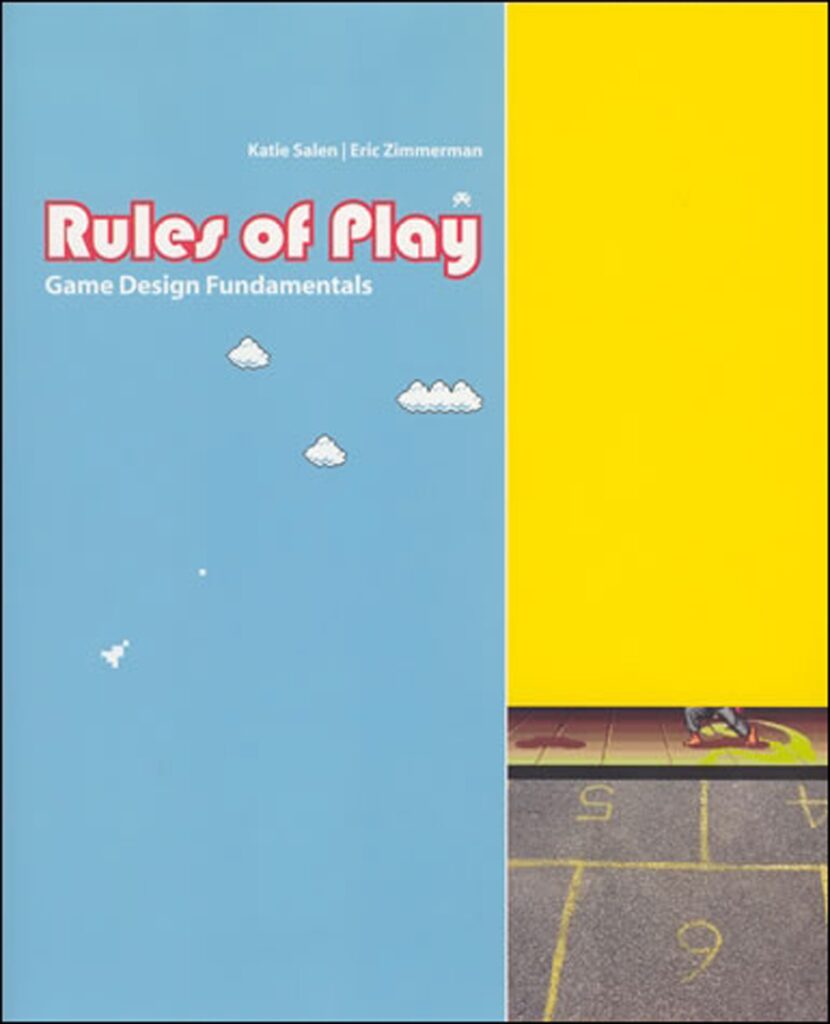
I am reading this classic book on game design, called Rules of Play. Katie Salen and Eric Zimmerman. The book manages to join thoughtfulness with a practical breakdown of things.

In chapter 12 there is a note about what drives a game designer. It can be:

  • The will to change some rule
  • Explore storytelling
  • Visual aesthetics
  • Social interaction
  • Explore new technologies.

In my case, the context influences my drive. All those points are interesting to me, I have to feel there is a clear vision to help close up land down. I love to connect the dots, more than strive for a revolution.

There are “the Kojimas”, that come and shape the future with their vision and personality. But those are like unicorns, the majority of us are good to serve and deliver.

About storytelling

When we use the word storytelling, very often we mean “telling a story”.

Storytelling is the process of communicating through a story. The goal is to give emotion, to persuade, and also to sell something inside of the game.

Game design offers many tools to build the story to reach this goal:

  • Gameplay (or UX) design helps leaving to mechanics some story outcome. We saw the other day the critical success/failure
  • System design identifies resources, rewards, and balances to give proper meaning to each action
  • Narrative design offers concept, worldbuilding, characters, dialogues, cutscenes
  • Level design enables the learning of core concepts (skill atoms) and arranges the environment.

The storytelling process:

– starts from concrete goals to achieve

– identifies what is measurable and how*

– creates and implements the story to excite, persuade, and sell.

When your game is silent, still offers a narrative. Still tells a story. Dozens of games are published every day. The way of communicating through the story is one of the keys for the Players to choose us.

* Not everything should be measurable, that is a common misconception. Not everything that cannot be measured should stay out of the equation. But that’s another post.

A little on my freelancer life

When I chat with people in my industry, I see that there is some confusion about the freelance career.

  1. The first is that people decide to freelance when they can’t find alternatives. A stopgap solution.
  2. The second is that it is better to specialize a lot to become more recognized as a professional.
  3. The third is that we serve when there is too much work to do and generally for secondary tasks.

Well, like all myths, all the points mentioned have a basis of truth.

A stopgap solution?

I started to freelance because I couldn’t adapt to the typical “job application -> first interview -> test -> ghosted” loop, back in 2016. Instead of wasting time with processes that in 80% of cases lead to nothing, I decided to start creating value.

I decided to devote myself to being a game designer, first on personal projects. Fictional ones. Every day I dressed up, put my clock on, and started working imagining I was earning money for that. Fake it until you make it is about that! I started sharing everything online, I decided to be the best game designer I could possibly be. The first contacts arrived, from companies that had ghosted me! “Hey, would you be interested in a small commission?“.

So yes, at first it was definitely a stopgap solution. But then one discovers that there is a great hidden value. It is not for everyone, I had my fathers supporting me. Otherwise it would have been impossible.

Better to become a specialist?

For me, game design is divided into narrative, level, system, and gameplay. In f2p mobile, the words “system” and “gameplay” are very often changed for “economy” and “UX”. I do everything.

  • I write dialogues and conceptualize worlds.
  • I craft levels in the engine documenting everything.
  • I create systems and economies using simple and understandable spreadsheets.
  • I create wireframes, mock-ups, and flows based on player narratives.

I don’t want to specialize in anything, because it’s not convenient in my case. If you are “the level designer that made the most successful levels in <insert famous game name>“, go for specialization. But I have not (still) had the opportunity to work on a super successful game. And most of the professionals are the same. I prefer to be a Swiss knife, that way my life is more interesting and I get more assignments.

It is true that there are very capable specialists who earn even more. But it is not the only possible way.

Just for marginal tasks?

The third point also has some truth. The first contact comes either from startups or from bigger companies that are overworked. However the clients that remain are those who understand my potential, with whom I have established a relationship.

Having an external expert person in the first place costs less. Secondly, it can help you in case you can’t find the right seniors. Thanks to remote work, I can supervise the work in places where senior professionals don’t go to live. So, in practice, by paying me 1-2 days a week you save the money of a manager (who may even slow things down, if not the right one).

Is freelancing good?

Freelancing is not for everyone and not for every lifestyle. I lead a fairly austere life, without too many frills. But we bring a lot of value. Very often, people who have worked for a company for many years know how to work just for that company. I see everyday the problems of many different realities, so my perspective is broad and I can be faster than normal.

And the extra speed always has consequences, on the body and on the mind. Nothing is free. Some final hint:

  • Learn as many languages as possible. I speak 5 languages. Languages open a lot of opportunities.
  • Never stop learning. My Udemy is always ON and when I can afford I take extra courses.
  • Create connections with service providers to speed up your job. You need partners, as any business.
  • Avoid every kind of friction with people. If you don’t agree with something, say it. But avoid talking bad about people.
  • You need to make professional contacts. Lots of them. Prepare your strategy.
Questions to ask on culture

It happens to many of us to join a company and realize that it is not the place for us. Not for the product, not for the people, but for the type of culture there.

During some selection processes, we have the opportunity to speak with the founders. There is always a moment when they ask us if we have any questions. I recommend these 3 questions to understand where you are going to end up.

Are you running a race or a ride?

There is no right or wrong answer to this question. There are professionals who prefer racing. They want to feel the adrenaline rush and get some results first. Train hard and work hard. They don’t like to lose the race. They want to be at least on the podium and bet everything in their lives on that.

There are other professionals who, like me, want to last 100 years. If some competitor does better, who cares? There’s room for everyone. Take it easy. Do your job with patience, and dedicate yourself to those hours with all of yourself. But remember that life has many facets, not just work.

Fun fact: I worked for a beautiful company that ran a ride. The company was bought by a multinational whose vision was: “to become the best f2p company in the world“. From ride, work turned to race. In a race, people are left behind. I jumped ship immediately. Many of my former colleagues were fired in 1 year, probably for some number on a spreadsheet. Do you read the company vision? Do you meditate on that? That is very important, believe me.

I’m working for you. What are the elements that will lead you to say “nice job” in 6 months?

This question is essential to understand what are the things that the company is looking for. All businesses want to make big profits, big and small. This is obvious, otherwise, a sane person would never get into entrepreneurial ventures.

There are many different types of leaders. Ask this question and listen carefully to the answer.

Fun fact: I was in a bar having an informal interview with a company that wanted to land in Barcelona. I asked this question to the person who was supposed to be my future boss. This person replies “I’ll tell you that you’re doing a good job if I’m drinking champagne from PRADA shoes! Hahaha!“. I finished my coffee, said goodbye politely, and left. The company has never been able to create anything here.

If you fired in the last year, could you tell me why?

This is a question that will make us understand the intentions of the companies. It’s a question I’ve never asked anyone. Today I only interview for companies that really interest me. With solid projects.

But given the recent times, where the job market treat people like commodities. This question is fundamental.

In fact, we need to understand what kind of monster we are entering through the jaws. If this monster will spit us out, shit us out.

Or if we will become part of his organism contributing to its functioning.

Conclusion

People who don’t know how to manage often manipulate the topic of cultural fit to serve their ego. Other times, it professionals who don’t know how to ask questions view this topic not so important.

Remember: you should become the member of a company to improve its culture. No one should never force you in their schema.