I rewatched one of the most beautiful talks on the official GDC channel. It’s great because it evidences we need truly understanding and reach deep empathy with the players. I rewatched thanks to my bootcamp, I suggested this talk to my students.
We need to do the homework to improve as designers. We need to understand the games, especially the ones who are played by people that are different from us. It’s our job to understand players, and a necessary step for every game designer. Do your homeworks!
I read the post from performance marketing expert Matej Lancaric on “fake ads”. With data, he demonstrated that big spenders do not care about fake ads, and they help to lower CPI (cost per install) for mobile games. Fake ads are regulated in other industries, not in mobile games.
From 200 real payers (including whales):
75% uninstall instantly when the game doesn’t match the ad
40% leave negative reviews
27% ask for refunds
But 17% of paying users STILL stay… and STILL spend
And here’s the uncomfortable part nobody wants to admit:
Those 17% often represent 60–80% of total revenue in 4X, SLG, and Casino.
Whales don’t care about fake ads. Whales care about depth, progression, and competition. And if fake ads drop your CPI from $60 → $15, the math wins. Every time.
The point here is that we, game creators, rely on algorithms to distribute our games nowadays. Speaking simply, a computer program decides on the visibility of our creations. We need to make good games but also think about how to trick the machine in order to make our craft arrive to the people. In the case of free-to-play the thing is worse because we need huge volume of people to find our real clients who are big spenders (described as “whales”, a term that comes from casinos).
The post doesn’t clarify WHY big spenders don’t care and fake ads spread rapidly. Also, it doesn’t explain what happens when people are exposed over a long period of time to fake ads. But we can make hypotheses:
Whales are often addicted to gaming, so anything that stimulates their dopamine system is OK.
Algorithms prefer easy to get, average, exciting moments.
On the long term, brands corrode because of continuous exposition to fake ads.
I am still worried about those 75% of people who uninstall instantly. I mean, we are still paying for those people to install in first place. What if, instead of making fake stuff we make simple onboardings and put those into our fake ads? Maybe the conversion would be better and we could find more players.
As I am reading about another studio closure (I am sorry for the colleagues at SUPERVIVE), I am thinking on the distribution problem we have right now. I believe than on one hand you have to create a truly unique experience to have chances in this environment. Easier said than done, of course, because it’s a matter of taste and also realism. I worked on many derivative projects, and the leaders were absolutely sure of their uniqueness.
You need to put the right glasses on, and be extremely aware of your game unique selling points. A way to do that is by making business: if you’re not able to sell your game to publishers, if you don’t engage with players or other entities, you are on a dangerous track. We tend to look inside too much, when we should look outside and check if Players really have the same perception as us on the product. In this case, Players are also potential business partners.
I believe that videogames have still lots of margin for improvement, so we should stop repeating old formulas over and over and we should try to make a step forward.
Yesterday I wrote an introduction on LinkedIn because suddenly I got lots of new contacts due to my post on The Game Awards. I was taking care of things here at home and wrote that piece spontaneously, got much more traction than other times where I have the time of think and structure better my thoughts.
I got two new leads for clients, and the post shows nothing about my knowledge and skills, that is surprising. On the other side, the temptation to go always more personal and deep is strong.
I am sure that this is valid also for game making. If we create something that connects truly with us at a personal level, chances are we can achieve better results than making things just for the sake of business. It’s a delicate art, and it’s easy to believe to weak theories I am aware of that. But I am also aware that I have maybe 20 years of career in front of me and it would be better to spend them on something that truly matters.
I got a flu, so I had the chance to watch much more videos while on my bed, resting. I felt a big nostalgia when I found out interesting videos on “The Legend of Zelda: Ocarina of Time”. I believe that I am a game designer also because of that game.
But I will probably never find any job to work on something like that, in my entire career. If I keep working for others, I will continue work on projects that can be more or less interesting to me, but not THAT, right? That’s an issue, to me. What am I doing with my time?
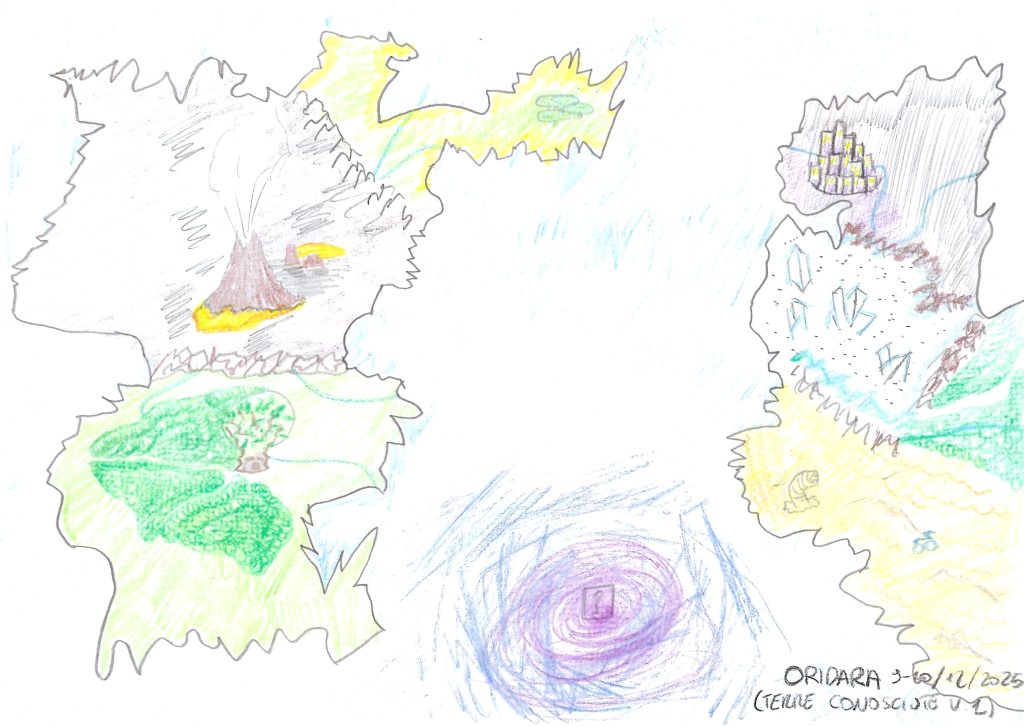
My little daughter is starting making drafts with her ballpen and I took one of them and recognize in its lines a map. So I draft a map on top of it:
In my dreams there is this game, this RPG fully inspired by Zelda, where you control a girl who moves with a skate and fights with a martial art heavily inspired by Capoeira, which is one of my passions outside of games.
The (known) world of Oridara is made out of 7 different biomes:
Forest
Volcano
Mushroom
Tecno
Ice
Desert
Abyss
You have to imagine everything in a SOLARPUNK fashion, imagine a world where nature and technology found the perfect balance somehow. Pokemon, Studio Ghibly, worlds like that are solar punk.
Now I am starting to work on this world, I will post updates over here.
The new game from Santa Ragione, Horses, has been banned from the main stores: Steam and Epic, at the moment I write this post. Humble just enabled the game again in their list, they delisted for a while.
I watched a gameplay and Horses is a game about cruelty. The experience is about helping a dark organization in torturing and abuse people. It is pornographic, as well. That’s why it was censored from the two main PC stores out there.
There is a lot of discussion online regarding censorship, capitalism, politics, and it’s not just something coming from young players. It comes from developers as well, and that shows the ingenuity (to say the least) of certain professionals. In fact, Steam warned the company Santa Ragione 2 years ago about the impossibility of publishing this game. They decided to go on and Steam maintained its promise. It is what it is.
I believe Santa Ragione was coherent in their choice to continue develop the game, but I also believe that putting your whole business at risk for a principle is not a good choice. I cannot manage to feel admiration for them, also if I empathize because I know they want to tell a unique story. And I saw that they did manage to deliver something unique. Lots of game design issues (in my humble opinion) but a clearly identifiable game with a unique voice. Let’s hope they manage to continue with their business, as they deserve. But they made a mistake.
Marketing works better if the marketer believes in the product. Game design can help with this, if the company allows the communication between designers and marketers.
Sometimes, though, we are working on a game we don’t really believe in. We are there just for the job, someone above makes all the calls and we do not see any value behind the strategy. It happens, more than it should actually.
Everything gets more complicated from there, so one of our duties in this case is to find common ground and push to focus the efforts on that. Because only that may become unique, in the end.
Mr. Owen Mahoney is one of the few outspoken gaming CEOs out there that speaks actual game development language. I listened to this interview and one thing has made me think a lot, also because it’s not well explained.
Mr. Mahoney talks about the importance of looking at the future intentions of a team or company to understand its shape. He makes the specific example of the founder of Embark, who wanted to make something new, something different. But that’s always the case whenever there is a sales opportunity. We do want to show what we did, our experience, but we also want to say, “Hey, we are building the future here; do not miss the opportunity to go with us towards it.”
How can we really understand when we are in front of a good company? Now I want to switch my discourse from the perspective of an employee or a consultant. How to understand that the client or employer we have in front of us is the right bet for our next 2-5 years? That’s a matter of gut feeling, but is there a way to make a sort of due diligence? That’s what I would like to ask Mr. Mahoney.
I read this article that expresses something I started saying at least 7 years ago: social media are new forms of online role playing games.
Back in 2015 I was working for a soccer games company and I pitched them a farm game but with soccer. My pitch got approved, but we didn’t manage to arrive to the first playable of the game for a series of reasons. Regarding my responsibility, it was because basically I had no experience in managing a big budget project within an already estabilished company. Plus I was in a hard moment of my life and well, things didn’t get good for me.
But the idea evolved in my mind and years later, in 2019, I pitched another game based on the same concept of a youth soccer academy to a local videogames incubator. My vision was exactly that the game should perform like a social media. There was an infinite feeds of event, and many characters posted their updates. By interacting with those posts, you basically managed the evolution of the school and the success of your team.
I still believe in that vision, but it didn’t worked because I had no money and didn’t had good founders for that stage. I got people that just wanted a job, and it wasn’t the case.
I am thankful for all these experience and I believe in waiting for the right moment. Maybe the right moment for me to put out something truly mine will come, maybe it will not. The important thing is to have the possibility of designing games every single day, in the end.
If you are making levels professionally, you cannot just jump in the engine and placing shapes and mechanics here and there. You need a way of plan and communicate your design choices ahead. The big picture of the level and how it fits into the overall scheme of things is very much needed.
That’s why we use beat charts, a spreadsheet that puts everything in perspective. In my case, I have these fields:
Level ID: Unique name for the level, it should also correspond to the actual scene or map name inside of the engine.
Layout: a screenshot (or a link to a screenshot) of the level so that you and your teammates can directly recognize them when you have dozens levels.
Skill atom: the original unique thing the Player should learn or confirm during this level
Twist: if there is a special twist, describe it here. This can be filled later and just planned with a true/false text
List of mechanics: each column a single mechanic and a true/false if that mechanic is present inside of a level. Put the columns in order of appearance
Difficulty: the % of players who will not pass the level or die at least once.
Narrative: a short brief of what you are conveying to the Players (it can be a story, but also specific emotions)
Mood: useful to suggest your mood to environment art or in general artists. Try to put a mood board for them to understand. You can reuse the same mood boards over and over, of course. In this way you will also predict the weight of your design choices.
Music: similar to mood but put your musical references focusing on the feeling the Player should experiment during the level.
We use cookies on our website to give you the most relevant experience by remembering your preferences and repeat visits. By clicking “Accept”, you consent to the use of ALL the cookies.
This website uses cookies to improve your experience while you navigate through the website. Out of these, the cookies that are categorized as necessary are stored on your browser as they are essential for the working of basic functionalities of the website. We also use third-party cookies that help us analyze and understand how you use this website. These cookies will be stored in your browser only with your consent. You also have the option to opt-out of these cookies. But opting out of some of these cookies may affect your browsing experience.
Necessary cookies are absolutely essential for the website to function properly. These cookies ensure basic functionalities and security features of the website, anonymously.
Cookie
Duration
Description
cookielawinfo-checkbox-analytics
11 months
This cookie is set by GDPR Cookie Consent plugin. The cookie is used to store the user consent for the cookies in the category "Analytics".
cookielawinfo-checkbox-functional
11 months
The cookie is set by GDPR cookie consent to record the user consent for the cookies in the category "Functional".
cookielawinfo-checkbox-necessary
11 months
This cookie is set by GDPR Cookie Consent plugin. The cookies is used to store the user consent for the cookies in the category "Necessary".
cookielawinfo-checkbox-others
11 months
This cookie is set by GDPR Cookie Consent plugin. The cookie is used to store the user consent for the cookies in the category "Other.
cookielawinfo-checkbox-performance
11 months
This cookie is set by GDPR Cookie Consent plugin. The cookie is used to store the user consent for the cookies in the category "Performance".
viewed_cookie_policy
11 months
The cookie is set by the GDPR Cookie Consent plugin and is used to store whether or not user has consented to the use of cookies. It does not store any personal data.
Functional cookies help to perform certain functionalities like sharing the content of the website on social media platforms, collect feedbacks, and other third-party features.
Performance cookies are used to understand and analyze the key performance indexes of the website which helps in delivering a better user experience for the visitors.
Analytical cookies are used to understand how visitors interact with the website. These cookies help provide information on metrics the number of visitors, bounce rate, traffic source, etc.
Advertisement cookies are used to provide visitors with relevant ads and marketing campaigns. These cookies track visitors across websites and collect information to provide customized ads.