Skip to content

Tag: professional

Inspiration and pragmatism

There is no secret formula to make a successful game, otherwise it would have been discovered already. It’s true, though, that success cases generally involve the right doses of inspiration and pragmatism.

The inspiration is needed to create something novel, something unique, something people wants. When I see games starting from charts and SensorTower reports I already know they are doomed. Games should start from something intimate to someone, and inspiring. It can be a childish fantasy, there is absolutely no need to be a tormented artist.

For instance, think in Royal Match the match-3 game from Turkey: they clearly started from the fantasy of breaking expensive dishes and pots in a royal mansion. Something that many of us had when children, visiting historical places with our family or schools. You need something like that, if you don’t have that do not throw away your money and find it first.

Pragmatism is needed because you need to be very aware of what the market actually wants. In this way, we would have avoided the $80B investment in “the Metaverse” by Meta, for instance. Lots of effort, creative energies involved to try to find the Grail, and for what? It is clear that people doesn’t want VR devices covering their faces. Also Activision/Blizzard, recently presenting a MOBA game for mobile phone with Overwatch IP, for Western audience. People here do not want to play MOBAs, why are you greenlighting something like that?

You need to be inspired by some fantasy and read the room before of starting a new expensive venture, things that I would like to see more here in Europe.

Management and direction

Last year I found a great client; good team, excellent leadership, profitable company. The project was (well, is) ambitious and novel. I felt part of the leadership team, I contributed to the development of their MVP. And then, a more expert designer joined and I was out. I had an interesting chat with my client, and he explained me exactly why the decision. It made sense, I learnt a lot. Still, it hurt because everything worth in life hurts a little.

Now that it’s one month since I joined GSC Game World, I already feel there is something very different in the way of managing high-quality projects compared with mobile f2p. Mobile needs pragmatism: you are chasing big numbers because you are investing huge amounts of money to give a highly technological product in the hand of distract people for free with the hope to engage their attention. High quality games, on the other end, are for people who decide to light a console up to be immersed into an experience they paid for.

And this leads to a fundamental difference: (product) management is what leads mobile, while creative direction is what leads high quality games. Of course, I am passionate and prepared designer and I can tackle any challenge, plus I have a certain age and experience so I can be a great leader. But mobile games are managed in a McKinsey-an style, and companies chase perfection. And the best way to avoid the risk of not having it is to hire people with a real pedigree (which I don’t have). On the other end, PC/Console single player high quality games (open world, FPS, survival) look for people capable of prototyping and realize the creative vision being away of design pillars, vision, and so on.

Two different worlds that I am sure can learn from each other. I know I will bring learnings from premium to mobile, and viceversa.

Updates on my career: Remote and AI

One month ago I have started a new full time gig at GSC Game World. It’s been years of doing extra work to learn the technologies and methods of high-quality games, finally the stars aligned and I got my opportunity. I am excited by this new venture, and I am rearranging forces to keep my consulting services on, thanks to the help of a game design assistant who I recently selected among my students.

I want to say just two things on this; the first is that it would have been impossible to get this new job without the existence of remote working. And it would have been impossible both for me and for the company that hired me. I know that a lot of people believes that we need to be in the same place to make a good job, I am not a guru so I don’t know. I only know that GSC Game World has become more international thanks to the advent of remote work.

Second thing is that I could hire an assistant thanks to the existence of LLM platforms, specifically Claude in my case. Having collaborators and assistants means communication, alignment, management, and lots of other things. I need to measure well my words, and provide concrete schedules. All of this constitutes an overhead that would have been simply impossible to tackle without the help of some automation of sort. Also on the other end, I am able to frame and solve the right problems faster and deliver both with my employer and my clients.

My services are becoming more sophisticated, and I hope to share with you important learnings on this channel. Stay tuned.

Ubisoft and the “Efficiency Trap”: Why Algorithmic Logic Can’t Save a Lost Vision

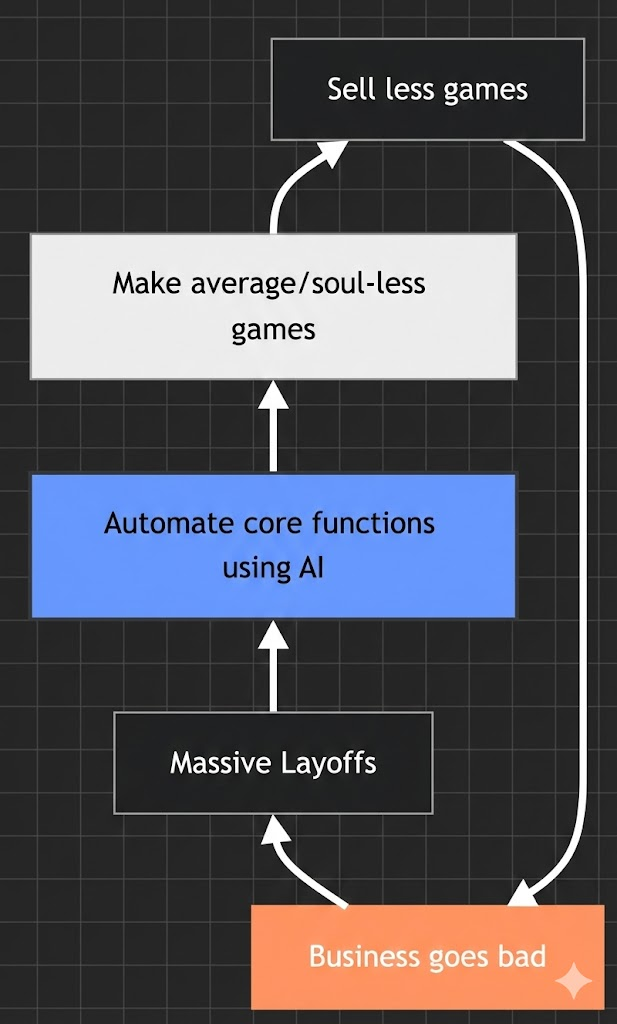
The recent news regarding Ubisoft isn’t just another headline about industry layoffs; it’s a “leading indicator” of a systemic crash. When the numbers don’t add up, the corporate playbook is predictably uninspired: cut the talent, automate the core, and pray the spreadsheet balances itself out.

But creativity isn’t an assembly line, Ubisoft might be the “canary in the coal mine” for an industry chasing its own tail. This isn’t just a trend; it’s a form of “drowning.” When inefficiency (ROI) drops too low, leadership grabs whatever is in reach—AI, NFT initiatives, or massive restructuring—often without even knowing what questions to ask their experts. They are borrowing against a future they don’t understand, hoping that money alone can catch the wind.

The “Glass Ceiling” of the French Elite

A company is only as brave as its leadership, and here we find a significant bottleneck. Ubisoft’s executive team is roughly 90% French, educated at the same elite business schools (ESSEC, ISG), with tenures spanning 30 years.

While these credentials are impressive on paper, they’ve created a cultural monoculture. This “upper-middle-class business elite” is now tasked with innovating for a global, diverse audience they are increasingly disconnected from. When leadership hasn’t seen the inside of another studio in three decades, they stop leading and start rehashing.

The AI Gamble: Partner or “Slop” Generator?

The debate around AI in development is often polarized. Someone argues that AAA gaming is “dead” without AI to reduce the staggering $200m+ budgets. I don’t disagree that budgets are exploding, but I disagree that AI is the silver bullet for quality.

AI isn’t the root of the problem, but it’s a risky “solution”. Relying on a technology that hasn’t yet delivered on its creative promises to save your strategy is a bet, not a plan. If you use AI to generate “slop,” you might save on costs, but you’ll lose the player.

From Rational Design to Brand Decay

Ubisoft once had a superpower: Rational Game Design. It was a method that allowed them to optimize the creation of epic adventures while maintaining a clear vision. But as they chased whales, “Games as a Service,” and unsustainable growth, they lost the creative DNA that made them special.

A software (and AI is just that) cannot solve a brand crisis. AI can’t fix the fact that Ubisoft has distanced itself from player fantasies and instinct—things that aren’t taught in prestigious business schools.

The Opportunity in the Chaos

The failure of long-term vision in these managers is an opening. The collapse of the old guard creates space for those who actually understand imagination and positioning.

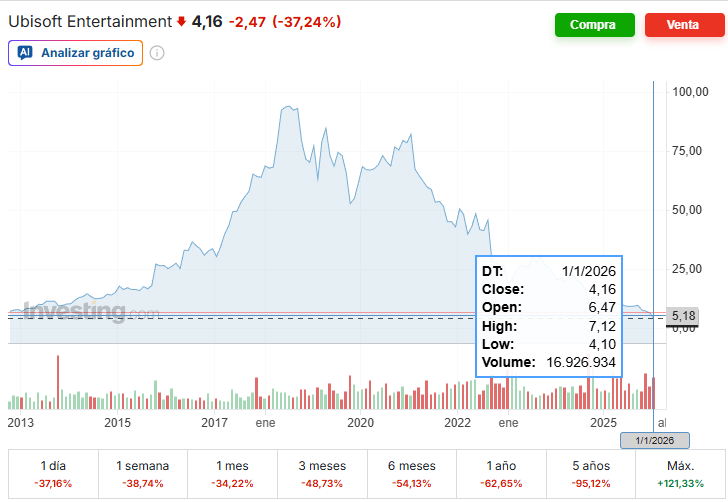
Ubisoft’s stock may be back to 1998 levels, but the talent is still out there. The question is: will they be allowed to lead, or will they be replaced by an algorithm until there’s nothing left to automate?

Good leaders and alignment

I am playing Clair Obscur: Expedition 33 these days and I am honestly amazed by the game. As a designer, what interests me the most is the tricks they have used to avoid too much costs on things like cutscenes, level design, and so on. No worries, I am not going to spoil anything.

To me, that game is a case of good leadership; you can feel that the people involved worked on something they truly believed in. You can feel the responsibility of each one of them, and also the clarity of the vision holders. This game is a small miracle, in a way.

In fact, imagine you are the leader of a new game, let’s say it’s your own idea. How do you know it’s the good one? You don’t, so it’s better to keep it clear to your team while you cultivate relationships with them. I define this as “alignment”, but this includes lots of things: empathy, problem solving, team involvement and so on.

A good leader is not a genius, it’s the one who leads the team towards success. And that means you should be very aware on where they are stepping into, and how. And if you don’t know what to do (pretty common situation), just say it and find a solution together.

When you start a new game

Today I started with a brand new client, the first client of the year, and I am happy. They onboarded me in the project and already gave me my first things to do.

When you start with a new game, the first thing you need to do is to engage with the target audience. There is nothing more important than that, actually the best games are designed to steal audience from other games. By being better, by removing frustrations and steps that aren’t fun. That’s what I did today, while starting taking notes and research.

The real challenge is that, also if games are designed for people, you need as a designer to convince stakeholders first. So, in a sense, it’s like you are designing for them not for the final audience. The secret is to include them in the overall audience, trying to transport them in an empathetic state where they can really feel the power of your verbs, and so on.

4 indie advices

I just read the latest blog post from Tom Francis, a clever piece on indie game business and development. There is a clear difference when you read/hear from people who actually make games compared with “opinionists” and influencers you see out there who only criticize others.

Things I liked the most:

  • If you double your people, so your burn rate, you should earn at least the double. Which puts your game in a harder spot. Good to take that into account.
  • If your idea is not prototypable, probably it’s not a good one for an indie studio.
  • Playtesting is good also to check the position of your game. If you cannot manage to find 100 people to test your game for free, that means that your game has probably no chances in the market of today.

Show your impact

The interviewer just asked you: “Tell me about a game project you’re proud of, and why.

You may hear a casual request for a portfolio highlight, but what the hiring manager, especially a leader, is listening for is impact. They want to know what behavior you changed, and what value that behavior drove.

As game designers, we often fall into the trap of talking purely about mechanics or systems: “I designed a beautiful, highly iterative combat loop” or “We built a seamless crafting system.”

But that misses the crucial connection. The best answers connect various layers of validation, proving that your design decisions were not just creative, but strategically effective.

Three Layers of Impact

To succeed as a senior designer, your answer must connect the micro (player behavior/action) to the macro (company value).

Layer 1: The Behavioral Change (The Micro)Layer 2: The Game Metric (The System Validation)Layer 3: The Instinct & Business Goal (The Value)
How did the player react? (e.g., Rage quitting on a particular level, persistent use of an unintended social tool, high frequency of “Skip” button presses on a narrative sequence, time spent in the new social hub.)How did this affect the game’s core health? (e.g., D1/D7/D30 Retention, Feature Usage Rate, Churn Rate on a specific difficulty level, Average Session Length, Conversion Rate from free-to-play to paid content.)What was the ultimate “why”? (e.g., Instinct Fulfillment like Gregariousness or Acquisition) and How did it drive Lifetime Value (LTV)?

You don’t need perfect attribution to demonstrate value. But you must be able to frame your work like this:

“We noticed [Behavioral Change], players were consistently rage-quitting Level 4 because the difficulty curve was too steep, violating their [Instinct] for Assertiveness. We responded by [Design Change Y], adding a mid-level checkpoint and a combat hint system. This immediately decreased our [Metric] Level 4 Churn Rate—by Z%. This mattered because a lower early churn rate directly feeds into higher [Business Goal] Player LTV.”

Even if your design is one small piece of a giant system, you must show you understand the full context it belongs to.

The Game Designer’s Advocate

In games, data is often incomplete. Hiring managers know this. What they want to know is: Do you understand what you should have measured?

If the data is missing, here is a simple framework to demonstrate your value:

  1. Qualitative Signals: Don’t dismiss soft feedback. What did you hear repeatedly in user testing? Did you receive unsolicited positive feedback about a new Flow state or a new feeling of Acquisition (the primal instinct) in a specific community channel? Did internal teams start referencing your work as a new standard?
  2. Advocate for Tracking: Proactively explain what success would have looked like and what specific metric you would have put in place (e.g., “We were aiming to increase the Gregariousness instinct, so I would have implemented a metric to track spontaneous friend requests after a shared victory.”). This shows you think like a business owner and are an advocate for measurement.
  3. Connect to the Missing Instinct: The ultimate question is always “What human problem did this solve?” If you can’t prove the financial success, prove the Instinctual Success. Show that your design fulfilled a deep human need, which, given proper resources, would eventually translate to business success.

Stop describing your design. Start describing its effect on the player and its impact on the business.

Christmas Morning Lesson

Happy Holidays! As you’re likely watching kids tear into giant boxes this Christmas morning, let’s talk about the biggest mistake in game development. A mistake even massive, experienced AAA studios repeat every single year.

They are falling into the rookie trap of mixing beauty corners with gameplay prototypes. I’m talking about that moment when you force a prototype, meant for raw mechanic testing, into a beautiful, highly polished “vertical slice.”

Prototypes with Fancy Bows

Why do studios do this? Because they chase ambition over clarity. They want the investors, the publisher, or even their own team to feel the final game instantly. But when you try to turn a gameplay test into a forced fake vertical slice, you are wasting massive time and money. You are making iteration slow, silly expensive, and often impossible.

You are creating a heavy dependency where there should be two separate, lightweight streams of work.

Keep the Gifts Separate

This Christmas, remember the golden rule of efficient development—and assembly:

  1. Gameplay Prototypes are the Instructions (The WHY): These are built for mechanics, feel, and flow. The art should be block-out geometry and colored cubes. They answer: Is the core system fun? Meaning, is there something interesting for the Players to discover? If the answer is no, you throw it away.
  2. Art Prototypes are the Decorations (The HOW): These are built for style, pipeline, and tech validation. They answer: Can we achieve this visual fidelity at this frame rate? If the answer is no, you pivot the tech without breaking the core fun.

Mixing them only adds a heavy dependency. Imagine getting a toy for Xmas, and the functional components are glued to the decorative exterior. If the gears break, you have to destroy the entire fancy shell to fix them. That is your silly expensive iteration.

You only merge them in the final vertical slice, once both sides stand on solid ground.

So, as you enjoy the day, remember this lesson from the trenches: Stop making your prototyping process a messy, expensive Christmas morning. Keep the gifts separated.

A tale of hope

The story of Clair Obscur: Expedition 33 is my favorite tale of 2025. Every successful game is a little miracle, but this one has been very well documented also by the mainstream journalism. As they say, the luck arrives while you’re working hard and that’s the case for this game.

The initial spark comes from a single guy working afterwork on Unreal Engine just because the program was fun to use. Then he contacted with a colleague to get extra guidance, he looks for connection and thanks to that he manages to stay 1-2 years working extra hours to find a possible formula for his game. Effort and connection, these things are both very important to me. In fact, it’s extremely hard to work solo on a project over a long period of time after your normal day job.

The third person is a business guy, ex university colleague, to focus on investments. Again, the founder of Sandfall Interactive looks to make business from the start, and that’s something very few people do.

And then there is the luck: they post on Reddit and other platforms to manage to find artists and voice over actors to sell better the idea (again, sell sell sell). And they have the luck to find the right people at the right time. After many pitches that went wrong, they found their way. And then everybody knows how the story ended, big success.

To conclude today’s post, let’s talk about hope, which is the true fun part of making games (or better, making everything in general). Everybody dreams of getting prizes, but the real fun is in MAKING games, especially for us designers and developers. It’s a struggle, includes lots of highs and lows, and also financial difficulties often. But we still do it because of our passion and talent. That’s exactly the important part, not the outcome. The fact of being together with other people and creating something we believe will be awesome, that’s what we truly strive for. The outcome is a little miracle, and great to have it, but it’s not the important part.