Skip to content

Tag: indie

How a Game Justifies Itself in 2026

This post was originally written in Italian by Paolo Gambardella. It has been translated by an AI agent and may contain inaccuracies.

Eduard and I are working on an independent project, since we’re at a point where we can build our portfolios. If this is your first time here, I’m a game design consultant specialising in the ideation and pre-production phase of new casual mobile f2p games. Eduard is my assistant, who joined me recently through a bootcamp where I was teaching. The collaboration is going really well, but as always there are quieter periods where the workload drops off.

The new project is called RETROFP for now, and it’s an idea I’ve been turning over in my head for a while: take the Habby method (find a meta-game that works across several titles and only swap out the core) and bring it to Steam, applying it to the classics that shaped us.

We’ve defined and built a first prototype, learned from it, and now we’re on to the second. It’s also a way to train my collaborator, so we’re taking our time. Lately I keep asking myself: why this game, why now? I think that question is no longer optional, and it breaks down into three parts.

What are you promising the player?

It’s about fantasy and identity: who does the player become while playing?

  • In RETROFP, the first game is inspired by F-Zero, but it’s futuristic rally racing. The most radical choice we made is this: the car never crashes. You never lose. You just go faster or slower, and that’s it.
  • F-Zero is a game about speed you have to survive. Ours is a game about speed you inhabit. The fantasy isn’t “hold it together and win” — it’s “nothing can stop you, chase the peak”. Speed as expression, not as risk.

The idea is to give players the freedom to experiment with the physics. In our minds, it’ll be a game that’s satisfying to watch live in front of an audience of fans. We’re building a series of prototypes around this fantasy.

Where do you sit on the spectrum between familiar and new?

Players always want something new, and every game positions itself on a spectrum. On one end, too familiar: it disappears into the noise, nobody has a reason to pick it over what already exists. On the other, too new: nobody understands what they’re looking at, the cognitive cost of engaging is too high.

  • RETROFP has plenty of familiar elements: the racing, the unlock meta-game, the live events. The new elements are more specific: no crashes, a Habby-style framework applied to Steam (practically non-existent in that form), and a core that changes with each title under the same umbrella.
  • The pattern is recombination: a proven mechanic taken somewhere it’s never been.

The risk isn’t just in the design — it’s in the marketing and communication too. “You never crash” risks landing as “too easy”. One of the things we’re trying to work out through our prototypes is how to get ahead of potential objections from players and from the people who’ll spread the word (journalists, streamers, and so on).

Why you, why now?

A solid pitch answers two distinct questions that often get muddled together. The first is the commercial why: why would anyone buy it? What space does it occupy in the market? Why now? The second is the artistic why: why are you making this game? What do you want the player to feel that other games aren’t giving them?

  • For RETROFP, the commercial why is the empty space between Habby’s mobile engagement and Steam’s indie quality. That territory is almost unoccupied, as far as I can tell.
  • The artistic why is different: we want people to feel the F-Zero fantasy, but we want speed to be a gift rather than an added risk.

The question “why this game?” isn’t a question for publishers. It’s a question for you, first and foremost. And if you don’t have the answer yet, better to find that out now.

Wish us luck!
Before your Eyes, design break down

Last week I purchased a bundle of narrative games from a popular store. The first game of that bundle, in alphabetical order, was Before your Eyes.

The game is a narrative experience. It doesn’t require much effort for a consumed player like me. There are minigames, but the story goes forward despite your ability to be successful at them. The story is short, but very emotional and effective. It’s about family, expectations, dreams, life, cats, death, disease, friendship, love. Developers managed, within 2 hours, to condense everything. My tears were out at the end of it, probably I am getting older.

Gameplay

As a player, you are in the shoes of a boy who lives his life and afterlife. The camera is in first person and there is a unique hook, which is a mechanic based on the blink of your eyes. If there is a webcam connected to your PC, the game detects (pretty well, in my case) when you close your eyes and play around that. The result is the feeling of a higher immersion into the story. Join that with well-written lines and characters and you get the idea.

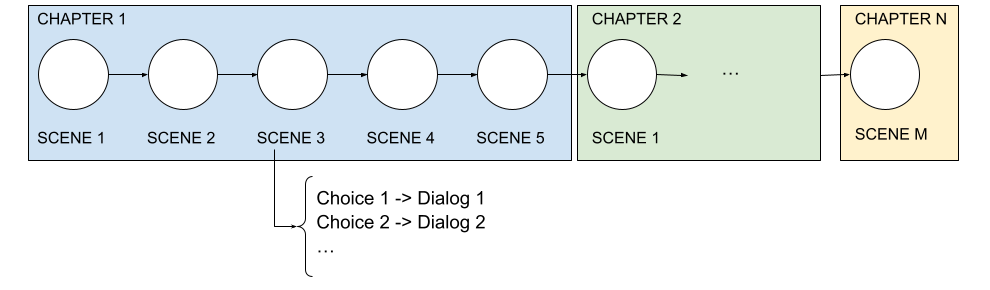
The game is divided into chapters, and every chapter has scenes. It usually goes like this:

  • The story and dialogue go, like in a movie. You do not control their flow. Sometimes they pause waiting for you to activate a mechanic.
  • Interesting spots activate on the scene:
    • circles: just look at them to activate the mechanic. Usually, you have to connect with another circle. This is used to open a book, for example.
    • eyes: point at them and blink your eyes to activate a mechanic.
    • eyes with effect: point at them and keep your eyes closed to continue with the scene.
    • musical notes: you have to follow an area to play sounds
    • hand: move your camera in the hand zone to write on a typewriter
    • pencil: look at it and it transforms into a scribble. Bring the scribble on a sheet and blink to draw.
  • In order to pass to the next scene, you have to wait for a metronome. Blink whenever you want to go forward.

Everything is very simple but effective. Also, it permits interesting dynamics. For instance, some scenes may activate the metronome while circles are still appearing. So you can choose to keep your eyes open and complete the scene. One issue is that if you blink you will skip to the next scene. Sometimes I didn’t want to do that. This is one limitation of this mechanic, it is imprecise. The real conflict offered by the game is there. So, it is unique and creates gameplay.

Journey

The game starts with the calibration of your camera. I believe it is pretty confusing, especially for the core audience of this kind of game. Then you start the game and you are immersed in a fantasy. The fantasy is about the afterlife, and the message is clear: life is an awesome thing, no matter what you achieve, no matter who you are.

Engaging with the minigames and making narrative choices brings you always to this same conclusion. The story is linear and goes from start to end. You have no agency over it, still, you can perform over it in one way or another. It’s a smart narrative design solution to not deal with branches and things that can compromise the quality of the final product. The development team is made by 9 people.

Review

Those are the games that remind me of why I chose this profession. These games are not made to trap people’s attention or to monetize. They are not designed for retention. They wait for you to step in their magic circle. And if you want, you continue until the end. Maybe you cry a little. And then they go. Maybe you can play them again after a few years.

If you want to give yourself a beautiful gift, this game is. And after you play it, you may want to watch this talk:

Everything I said in this article was written before knowing the truth about its development.