I would love to build my own company, after many years serving many projects and teams. I have developed a vision, I feel I can somehow foresee part of the future.
I would like to focus on gameplay first short games. I would probably start from PC games. 3 months development, plus 3 refinements and then 6 months to see the return on investment.
I have everything clear, but I don’t want to stay behind burocracy, contracts and all the things. I guess I will have to, at some point of course. If I want to really put in place all the knowledge I had those years.
Don’t get me wrong, I am not a guru or something like that. I know for sure that I am wrong in so many ways. I just feel that in order to really grow more I need a period building something I really believe in, in a way I feel the best.
As Italian, I am a fan of the stories of Olivetti and other entrepreneurs like him. To me a company needs to improve the society where it is founded, in a meaningful way.
We want to create a new game, often times because we played one. So that we got inspired and somehow we want to make our own version of it. Maybe we are working for a company which spotted a market opportunity. So that we start studying the games belonging to that market, try to reproduce the best things.
Games industry is very endogamic. We tend too much to take inspiration from the inside of it. But if we see the best products out there, they take a lot from the outside and bring it to the inside.
Days ago I was talking about the TikTok of puzzle games. That is a way of looking outside. You just study the apps market and think in a better UX for some classic game. It often works like that. If you look at games like Royal Match, they took well known mechanics and the real twist is completely on the UX side.
Another great reference is nature. From nature many game designers created memorable gameplay experiences. Think in Japanese legend Shigeru Myiamoto and the story of how The Legend of Zelda was conceived. If you like to walk and you really start observing you notice that nothing in nature is wrong. Recent game The Ants: Underground Kingdom is another evidence of the power of nature. Especially if you want to get better ideas on gameplay and lore, nature is the way.
Art, toys and objects without purpose are also a great way of getting inspired. The history of videogames is full of examples like that. Think in the indie success GRIS or the mobile game Monument Valley. There is not a superhigh challenge, nor a specific deepness in their economies. The Players can just enjoy the overall game feel.
I am very outspoken and I work mostly remotely since 2017. Way before of the pandemic I was providing my game design services to many companies all across Europe. My specialty is game economy and gameplay design for free-to-play. Companies contacted me for three main things:
To set up the vision for some new project of their.
To review and design a new tutorial for their game.
To add more monetization features to their games.
My main tasks are always been to become aware of a certain context, study a specific market and provide concrete solutions. All of that online, by remote.
I remember back in the days when I had to wait for the producer to call me after the internal meeting. I wasn’t allowed to participate to their daily standup because they were too lazy to set up a camera and connect with me.
Then the pandemic came and this is now the new normal. Now most of my work is online, but the processes are still the offline ones. I mean, I didn’t saw relevant updates to the game development practices. And that’s a problem.
Game development has many moments, good and hard ones. Especially the hard ones, when you need to tell the others your truth about something are getting always more complicated. Sometimes you notice that things are just not working out. So you should take the courage and speak with your boss and colleagues about that. You can do it by writing on a “public” slack channel or by contacting the leaders in private and have a virtual face to face with them. Still, with the remote something is missing. You always have that colleague with stays silent most of the time. And most of the time that colleague is one of the smartest. But they don’t talk, so you will never know. And possibly then they quit for a better job. And you remember that you never asked them directly to express themselves during meetings.
The games industry is estabilishing its processes step by step. Year by year. You work on a new feature and you are constantly studying other games. How is that feature implemented there? Why?
Then you discover an article or a video and you see that there are best practices to do that. Maybe a colleague, maybe your own boss show you the best practice. Often time you discover the best practice AFTER you did your breakdowns, your wireframes, your flows, your brainstorming with your team.
Best practices are the best because there is nothing better, right? They are based on facts. On data. On results. On money.
The temptation with best practices is to just implement those, because someone already figured that out. Why reinvent the wheel?
The risk is design something without even understanding why it should work and how to measure its effectiveness. In the meanwhile, a new trend and best practice popped out. Your design is old, maybe you should iterate on that.
Best practices are those things that, when they are publicly available and well defined online, are already surpassed. So that those are just common practices waiting for a new best.
I have learnt this the hard way. Often, people like to make experiments. They hire people like me as freelancer and then they hire juniors fulltime. They want results, good results in possibly a short time. Then our collaboration ends, experiment failed.
Why is that? Because people hardly accepts the reality of games. Making games is a serious thing. You will never make a good game with people part time. You can use part time freelancers, like me, to create specific content for something that already works. But if you want to make a new game you need to really invest heavily time and energies in doing it. 100%. There is no shortcut.
I always speak this clear before with my clients “this is hard, it will hardly succeed. I cannot dedicate more than X hours per week. You need more.”. Nothing. They want always to try. And sometimes they get upset because of the results.
In this post I will try to explain the basics of the freemium economics, because without those is impossible to understand why free-to-play games have to rely on strict calculations in order to work and scale properly.
Costs
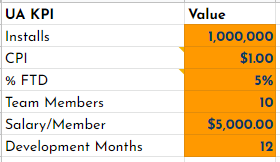
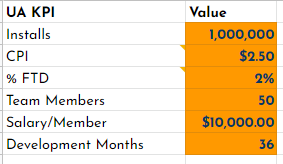
When you run a business you have costs, a f2p business has many costs that I can resume like this:
Installs: number of installs we want to achieve with our acquisition campaigns
CPI: cost per install. Each install will cost this
%FTD: first time deposit percentage. Basically, the part of Players that decides to invest something into our game
Team Members: our team is composed by…
Salary/Member: the cost per month of each member
Development Months: the number of months before of publish the complete game, ready for live operations.
If you are working right now in f2p you can notice that those numbers are VERY optimistic. Ad the end of this article I will propose something nearer to the reality. Another thing is that every company has its way of naming things, my approximation is just for the sake of explaining.
Cohorts
When you design a free to play game you should be aware of two things:
Vast majority of players (in my example 95%, but again it’s optimistic) never pays a dime
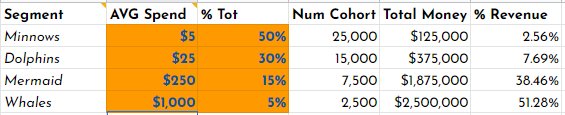
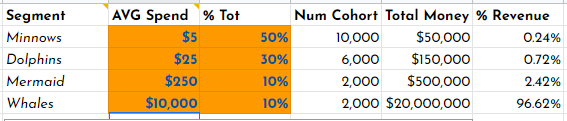
The payers have different spending profiles:
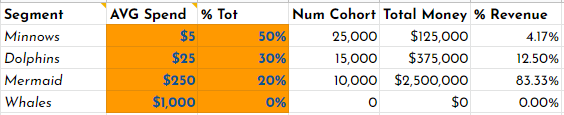
Minnows: they are the majority of payers and they invest just a little in your game
Dolphins: they are a big chunk of players and they invest a little bit more. Their spending habit is similar to PC/Console players somehow
Mermaid: they have a higher acquisitive power, and they decide to invest more over the time in your game
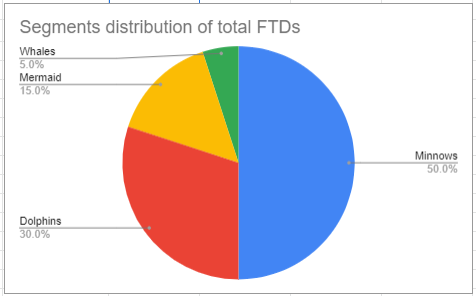
Whales: they are the real target of your monetization system. Without them, the f2p business is not sustainable. Here’s why:
You can clearly see that Whales are the vast minority of all payers (players that spend something). But:
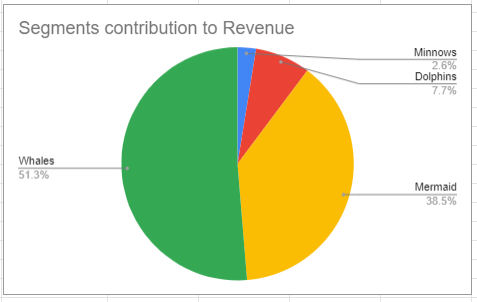
With this configuration, you can see the weight on your revenue of whales and mermaids.
Results
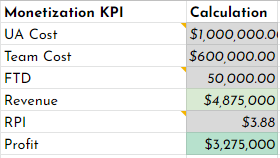
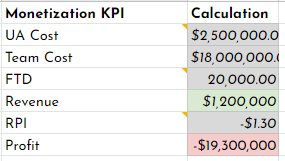
In this perfect scenario, those are the results:
UA Cost: CPI*Number of Installs. We spent one million dollar just to get people into our game.
Team cost: Members * Salary/Member * Development Months. We spent six hundred thousand dollars to develop our game. Development costs are cheap compared to marketing.
FTD: we have fifty thousand people paying something
Revenue: according to the cohorts, the total revenue is this
RPI: revenue per install. Total revenue divided per number of installs.
Profit: what we really earn. The total revenue less the costs. In this ideal case, it works!
We don’t want to make games for whales!
Ok, let’s make a game that doesn’t permit whales to pay that much then! We believe that FOMO, pay to win and lootboxes are the evil, so that we put a maximum cap on our spend depth.
The cohort whales, then, disappears. Let’s say we just have mermaids, that will increment their presence among the cohorts:
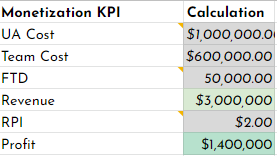
In this case, the impact on revenue will be HUGE. Still, with the idealistic costs structure it works! we can have a business:
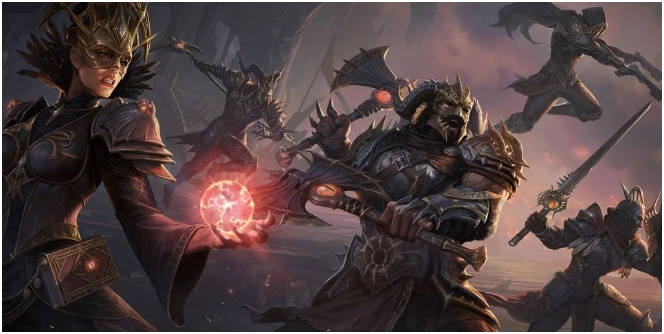
Diablo Resurrection
Lately, a lot of press is writing against the monetization of Diablo Immortal, the last game from Activision Blizzard. They say it’s too agressive, I have a different feeling. To me is not aggressive at all. Let’s study its costs.
The quality of this game is very high. But.. 15Gigas, really???
A game like that from a company like that will have a cost structure more similar to this:
I am completely biased here, please if you have more data let me know
With those cost structure, without targeting whales, the final result will be:
Why publish a failing game, right?
Which is why Diablo Immortal, because of its quality and narrative and everything it gives for free has to target heavily whales. This is for the vast majority of people to have fun. A possible cohort configuration can be:
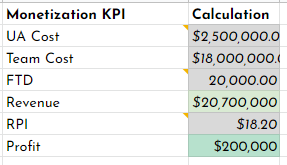
For the whales to arrive spending ten thousand dollars, the spend depth of Diablo Immortal has to be high. Still, in this way our business barely works:
You work like crazy to earn $200k? I don’t think so.
So, I get that many of you don’t agree with f2p and don’t like this business model. But it exists and if you want to be there you have to do very well your math!
I have noticed in those years of carreer three main things that all successful companies share.
When we are joining a game company, many times we are just looking for a job. We study the companies and we look at their games. The most probable thing is working on a game that will not be successful. That’s a fact, there are statistics for that.
The first thing is that they have a great administrative department. They know how to keep the bills in order, how much the company is spending and what is the revenue. They are tracking their burn rate and the house it’s in order.
The second thing is that there is at least one person dedicated exclusively to quality assurance. Testing the game every single day, reporting bugs and creating processes to improve and automate the process of finding bugs. QA people save games. Games without QA will most probably just be bad games.
Ultimately, there is at least one person dedicated to community management and marketing. Games nowadays work a little like a service. Even a small indie game when published receives feedbacks and reviews and devs have to iterate inevitably. You need people dedicated exclusively to the sales, external communications and support.
If you are about to join a project with no QA people, or no administrative people or no sales/support/community people believe me: red flag! If it is your first project it may be OK according to its scope, but not expect quality, security nor players satisfaction.
When I started this profession my dream was to participate in some really successful game. A successful game is a game that generates revenues, resonates with a community of Players and brings fun to the World.
Reality is that when you work as a game designer, you are not in charge of a whole project. You hear constantly a lot of success cases and great stories in the indie, AAA and f2p industry. But that is not the normality. The most common situation is you working on a game that is not working and will probably fail. That is the truth.
The temptation is to constantly look for a new job, especially when you clearly see that your game will never be published or will never be viable and sustainable.
But there is a value also in working for failing games. You can inspire people, you can improve processes and you can do something meaningful everyday. It is a struggle, and it’s very hard to resist. And yes, you probably have to look out for a new gig. But try to not stress too much: remember that it’s the most common thing.
Our job is not to design the next hit. Our job is to understand the context and provide the best solutions for that contest. Our job is to own our tasks and do the best job we can do.
This post is about ownership of the development of a feature or mechanic in a video game. Many companies say that they need people who really own the tasks they have. Ownership is very important but also a little fuzzy concept.
What I understand for ownership is different from what you mean with the same word. It is also different from reality to reality. It is not the same to own the design and development of a secondary feature than to own the core mechanic of a new game.
To me, the secret of good ownership is being able to maintain a vision while adapting to the context. The term ownership can be easily confused with property ownership. If your duty is to own some feature, the best you can do is to build on what you have, leaving the borders of your property open.
Vision
In the world of data driven development it is very easy to fall into the trap of thinking “data is everything”, repeating the same mistakes over and over or offering the same formula to the Players.
Data is not everything. Data is a resource that has to be translated into information, otherwise everything can be read. Ownership means also to be able in doing this translation. You need to make hypotheses, you need to verify those hypotheses using concrete experiments and then you can discuss how to transform the information in actions.
It is very hard having the right data ready at the start of some new implementation, so that often you need to rely on other elements to form your vision:
Your own personal experience brings inevitably something interesting to the discussion table.
Never forget that game design is also art, you should put something very personal in if you want to really engage your team and Players in your vision.
You need to know the state of the art, breaking down the same feature implemented in other games. It is not necessary to reinvent the wheel.
You need to connect with the people playing those games and really understand what it works and why.
Context
It is very unlikely to create the next f2p success with a team of 3 developers and 2 artists and no QA, right? If you have a small team, a feature can take aeons to get right. Most of the times you cannot iterate properly, your manager will pass to the next feature and your work will cripple. This happens in the majority of companies, and it is completely normal. Owning your design means accepting this and move forward. It’s hard, I know.
From the other side, it is very hard to create a fresh core loop with a team of 80 people. Politics, meetings and dispersion of the information will make you struggle to properly transmit your insight with the rest of the team. In that case, it is way better to take a strong base and then focus on improving the experience in terms of UX. Believe me, you will save a lot of stress.
Being aware of the context is very important, the magic lies where you can do the best you can with what you have. When you have the feeling that you can do everything with no limitations, it probably means that the context is not clear to the leadership nor to the team. Red flag. When you own a feature, you should try to clarify:
Goals with all the stakeholders
Concrete deadlines with weekly/bi-weekly intermediate milestones
Concrete quality expectations for the feature you own.
Final thoughts
The rise of automation is solving a lot of problems and saving us a lot of time. If we really want to be the professionals of tomorrow, we should focus our attention on providing the right solutions and vision according to the context we work in.
Ownership is one of the most important factors of the future landscape of professional game design.
I work as a game designer and I don’t want to specialize. The Industry is constantly looking for high specialization, but if I imagine myself blocked in a specific role I can easily out of video games.
When I meet some people who wants to join the industry and asks me for an advice, I translate this way of thinking to my mentorship to. Don’t try to specialize.
To me, game designers are a kind of designers. Game design is already a specialization. I am in the f2p sector because it is very common to be there in Europe. Someday, I would love to work on AAA or Indie games, too.
I like everything in game design: the narrative, the system, the level and the gameplay design. I like all their branches. And my dream is to work on a little bit of everything. That’s what motivates me, in the end.
If you are new, do not think in specialization. Start by picking a field, instead. Imagine you pick level design.
Then scan all the companies you would like to work for someday and make some specific level design for one of their titles. Iterate and take notes on every problem faced. Share only the best things. Build your portfolio like that!
Start by picking a specialization, then try to go general!
We use cookies on our website to give you the most relevant experience by remembering your preferences and repeat visits. By clicking “Accept”, you consent to the use of ALL the cookies.
This website uses cookies to improve your experience while you navigate through the website. Out of these, the cookies that are categorized as necessary are stored on your browser as they are essential for the working of basic functionalities of the website. We also use third-party cookies that help us analyze and understand how you use this website. These cookies will be stored in your browser only with your consent. You also have the option to opt-out of these cookies. But opting out of some of these cookies may affect your browsing experience.
Necessary cookies are absolutely essential for the website to function properly. These cookies ensure basic functionalities and security features of the website, anonymously.
Cookie
Duration
Description
cookielawinfo-checkbox-analytics
11 months
This cookie is set by GDPR Cookie Consent plugin. The cookie is used to store the user consent for the cookies in the category "Analytics".
cookielawinfo-checkbox-functional
11 months
The cookie is set by GDPR cookie consent to record the user consent for the cookies in the category "Functional".
cookielawinfo-checkbox-necessary
11 months
This cookie is set by GDPR Cookie Consent plugin. The cookies is used to store the user consent for the cookies in the category "Necessary".
cookielawinfo-checkbox-others
11 months
This cookie is set by GDPR Cookie Consent plugin. The cookie is used to store the user consent for the cookies in the category "Other.
cookielawinfo-checkbox-performance
11 months
This cookie is set by GDPR Cookie Consent plugin. The cookie is used to store the user consent for the cookies in the category "Performance".
viewed_cookie_policy
11 months
The cookie is set by the GDPR Cookie Consent plugin and is used to store whether or not user has consented to the use of cookies. It does not store any personal data.
Functional cookies help to perform certain functionalities like sharing the content of the website on social media platforms, collect feedbacks, and other third-party features.
Performance cookies are used to understand and analyze the key performance indexes of the website which helps in delivering a better user experience for the visitors.
Analytical cookies are used to understand how visitors interact with the website. These cookies help provide information on metrics the number of visitors, bounce rate, traffic source, etc.
Advertisement cookies are used to provide visitors with relevant ads and marketing campaigns. These cookies track visitors across websites and collect information to provide customized ads.