Skip to content

Tag: myself

My takes on The Game Awards

Today my post came later because I wanted to watch the whole show of The Game Awards, so I took my time. I loved the show, in my opinion it is getting better and better. I liked it better than last year, because I found the new teasers less like a Tool video and with more hope.

The first take is that it is a great time for independent developers. The creative director of Sandfall told that he is thankful for youtubers for putting out tutorials because he had no idea on how to make a game. And the game he made with the team was the most appreciated in the history of TGA, so yeah… I guess it’s easier to make games nowadays. The important part is the creativity, now more than ever. And I believe that now it’s a moment where we can, and should, risk a little bit more in that sense. Avoid repeating formulas, find new recipes. Now the tech permit beat everybody else with less than $10M.

Another trend I am noticing is that horror and monsters is casualizing. Monsters are getting cool, I saw zombies dressed like rappers and cool things like that. Sci-fi, instead, is animalizing always more, with bears and dogs in tech armor. These are two new trends that have been started years ago (in my opinion, from Twilight and Guardians of the Galaxy, respectively) but that now are exploding.

During my view of the show there were tears in my eye. First reason is because the show is fantastic if you love videogames. There is music and stunning visuals, incredible people coming on the show. There is everything I love. But I cried also for a little bit of nostalgia/sadness: it’s because it’s very hard to participate into something like the games presented there. Most of the work in games is on very poor experiences, so I feel that maybe I am losing my time. Maybe I do need to really care about my own world, things I want to put out there, and leave the chase of the next client. I have to think about that.
Meaningful coincidences

I got a flu, so I had the chance to watch much more videos while on my bed, resting. I felt a big nostalgia when I found out interesting videos on “The Legend of Zelda: Ocarina of Time”. I believe that I am a game designer also because of that game.

But I will probably never find any job to work on something like that, in my entire career. If I keep working for others, I will continue work on projects that can be more or less interesting to me, but not THAT, right? That’s an issue, to me. What am I doing with my time?

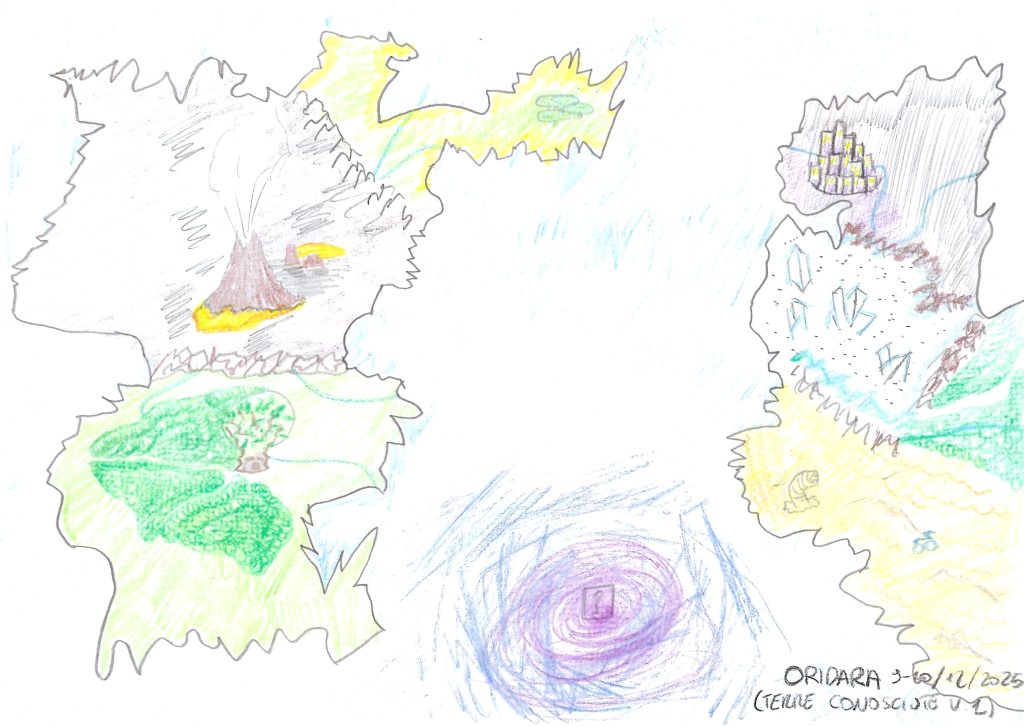
My little daughter is starting making drafts with her ballpen and I took one of them and recognize in its lines a map. So I draft a map on top of it:

In my dreams there is this game, this RPG fully inspired by Zelda, where you control a girl who moves with a skate and fights with a martial art heavily inspired by Capoeira, which is one of my passions outside of games.

The (known) world of Oridara is made out of 7 different biomes:

  1. Forest
  2. Volcano
  3. Mushroom
  4. Tecno
  5. Ice
  6. Desert
  7. Abyss

You have to imagine everything in a SOLARPUNK fashion, imagine a world where nature and technology found the perfect balance somehow. Pokemon, Studio Ghibly, worlds like that are solar punk.

Now I am starting to work on this world, I will post updates over here.

Let’s talk about Horses

The new game from Santa Ragione, Horses, has been banned from the main stores: Steam and Epic, at the moment I write this post. Humble just enabled the game again in their list, they delisted for a while.

I watched a gameplay and Horses is a game about cruelty. The experience is about helping a dark organization in torturing and abuse people. It is pornographic, as well. That’s why it was censored from the two main PC stores out there.

There is a lot of discussion online regarding censorship, capitalism, politics, and it’s not just something coming from young players. It comes from developers as well, and that shows the ingenuity (to say the least) of certain professionals. In fact, Steam warned the company Santa Ragione 2 years ago about the impossibility of publishing this game. They decided to go on and Steam maintained its promise. It is what it is.

I believe Santa Ragione was coherent in their choice to continue develop the game, but I also believe that putting your whole business at risk for a principle is not a good choice. I cannot manage to feel admiration for them, also if I empathize because I know they want to tell a unique story. And I saw that they did manage to deliver something unique. Lots of game design issues (in my humble opinion) but a clearly identifiable game with a unique voice. Let’s hope they manage to continue with their business, as they deserve. But they made a mistake.

Quick tip for LinkedIn

I am using LinkedIn less for posting, and I am just leaving comments here and there. I met a couple of haters (it’s completely normal when you have ideas to share and you reach some reader more), and I decided to post less. Also, the social network is suffering the classic “enshittification” typical for this kind of platforms where you are the product and the angry product invests more.

Another policy I activated is this one: only answer to critics if they are also admirers. There are people who only comment to criticize, those are the worse. It’s better to ignore them or, in some cases, block them all together.

I beat “Detroit: Become Human”

Yesterday I completed “Detroit: Become Human” for the first time. I think I reached the worst possible ending, but still I loved any minute of the experience. I believe that Quantic Foundry is a fantastic company and should expand its business vertically, reaching more devices with its games and not changing completely its business.

In fact, they are very strong in high quality single player hardcore games, and in recent news I read they are making a MOBA. Apart from the fact that the MOBA genre is not well accepted in the western audience, I believe that these business line extensions are too dangerous for a business. They should insist in going stronger into single player hardcore AAA games, in my opinion.

Detroit: Become Human is a game where your choices matter, the story is the most important part of their formula. And in its story equation we have a unique (and weird) things in its characters. The world is a normal world (accepting the characters of course) and the plot is a good but predictable one in terms of umbrella plot. Then there are lots of interesting twists and expansion that make the experience memorable.

The fantasy of the game is that you are the mind of a robot, but since you have a human mind (right???) it’s interesting that somehow you give a conscience to the artifact. On top of this fantasy, which is cool, the actions are: answer choices, attacks, jumps, defense, movement. The quick time events fit perfectly in the concept of robots and algorithms.

The economy is based on completing story sequences of the three protagonists of the story and earning new story paths and points you can invest into unlocking special content like artworks, models, music and so on.

The world is our world but in the future, the technology is sci-fi and the artstyle is realistic. The story is fantastic, is about cyborgs adquiring concience. Right from the menu you can feel the story with one of them interacting with while you select the game mode and prompting you surveys with existential questions.

I see few games like this and I personally love them. I hope Quantic Foundry will surprise us with something new like this in the future.

What I did while waiting

I read this article that expresses something I started saying at least 7 years ago: social media are new forms of online role playing games.

Back in 2015 I was working for a soccer games company and I pitched them a farm game but with soccer. My pitch got approved, but we didn’t manage to arrive to the first playable of the game for a series of reasons. Regarding my responsibility, it was because basically I had no experience in managing a big budget project within an already estabilished company. Plus I was in a hard moment of my life and well, things didn’t get good for me.

But the idea evolved in my mind and years later, in 2019, I pitched another game based on the same concept of a youth soccer academy to a local videogames incubator. My vision was exactly that the game should perform like a social media. There was an infinite feeds of event, and many characters posted their updates. By interacting with those posts, you basically managed the evolution of the school and the success of your team.

I still believe in that vision, but it didn’t worked because I had no money and didn’t had good founders for that stage. I got people that just wanted a job, and it wasn’t the case.

I am thankful for all these experience and I believe in waiting for the right moment. Maybe the right moment for me to put out something truly mine will come, maybe it will not. The important thing is to have the possibility of designing games every single day, in the end.

I connect through game design

I work in games not as an individual creator, but to do it with others. Game design is a way to get in touch with others, teammates and potentially players. I am not a solodev, I struggle really hard when I do projects completely alone also if at times is necessary to push my boundaries.

That’s another reason why I do teach and I join online courses, as well. As a freelancer, I don’t always have clients. There are periods in which I dedicate to personal project, such as the book I am writing, and I feel very alone professionally speaking. Having the excuse to meet other people to teach them or to study with them fixes partially that problem. I am also on Discord channels, but I feel hard to follow discussions there because of the way Discord is designed.

Vulnerable latitude

I have met plenty of professionals who don’t actually love working in games, including game designers. I’m sure this is not news to you, and I also believe that everyone has a right to work in an industry as big as gaming, even if only for a while.

Yesterday, I met one of these people, who told me, “Videogames are your beach!” (using a Brazilian, Rio de Janeiro slang phrase). And I agree; I genuinely love my profession.

I have proof of that because I often put myself in a vulnerable financial position just for the sake of engaging in game design. A client might offer me shares as part of my compensation. If I like the client or the project, I accept, even if I know I may never see any money from it. I know that my task will end, the client will close the collaboration, and I will lose all shares.

I know this, and I consciously make that choice because I love what I do.

But I deeply respect the professionals who don’t care too much—the ones who pass through the industry like tourists, earn some money, and move on. They will have the opportunity to explore different things, and their minds probably won’t be 110% focused on games all the time, unlike mine. I respect that attitude very much as well.

Why I teach

This week I started teaching a new bootcamp on video game design and conceptualization. I feel very lucky to have the opportunity to teach, even though it’s not a well-paying job. My method requires a lot of effort, and frankly, I would like better financial recognition for that effort.

I believe in the games education, though I must say there are many courses out there that aren’t worth the investment, they just slow students down and drain their wallets.

I’ve found a surprising number of people who study not to learn, but simply to have something to do, too. They aren’t genuinely interested in the subject; they are just there to fill their time.

My mission is always to leave a lasting mark on my students, and to inspire even the most bored ones. To me, game design is a serious craft. I love it with all my soul, and I want to spread its beauty.