Skip to content

Tag: indie

Clone a Game with AI: Should This Be Done?

This post was originally written in Italian by Paolo Gambardella. It has been translated by an AI agent and may contain inaccuracies.

Mark Brown, the creator of Game Maker’s Toolkit, has published a video in which he tells a story that could apply to anyone making games today, big studios or solo devs alike.

What happened

Two Hungarian developers, working as a hobby project, used Claude Code to build a word game that they themselves describe as “Word Play with a bunch of extra stuff on top”. Word Play is the word roguelike Mark released in 2025. It took them eleven days, and they added a time mode, a daily challenge, multiplayer, and a meta-progression system. Before doing anything with it, they emailed Mark to ask what he thought, and promised to keep the game private if he wasn’t comfortable with it.

Mark spent twenty minutes thinking out loud: he’s losing money on it, clones have always existed, he’s not a fan of AI, and their game is better than his in some respects. In the end he didn’t reach a conclusion and asked his viewers for their opinion.

I watched the video from a particular vantage point, because I use these tools every day. I work with Claude and ChatGPT together, each one checking the other. At work, at GSC, I use them to build prototypes, update documentation, make sense of the many texts written in Ukrainian, and cross-reference information across a huge number of documents. At home, this blog has expanded to nine languages, and I’ve picked my dog game back up: on one side I’m migrating it from Blueprint to C++, on the other I’m laying the groundwork for the mechanics and game feel. The results genuinely surprise me.

In my view, the two Hungarians did the right thing. They built something they cared about and, before going public, they asked. What they made is legitimate. Mark is right to be concerned — Word Play still brings in revenue every month — but if I were in his position, I’d see it as an opportunity. Two people who’ve put hundreds of hours into your game, who know it inside out and have already built the features you never got round to finishing: why not bring them into the original project? They could handle live ops, updates, new modes. Mark himself admits he was too burnt out after launch to keep working on it. That strikes me as a far more productive path than a video spent airing grievances.

Clone or homage?

Where’s the line? For me, cloning means “I don’t care about the thing itself, I only care about the outcome.” Inspiration — even outright copying — can be a wonderful way of paying tribute to what came before. Word Play itself comes from Balatro, which comes from Luck Be a Landlord, which comes from Slay the Spire.

The line is about how much you care that the thing actually exists, for its own sake. There’s really only one question worth asking: does this thing deserve to be made? The money and the followers come later.

There’s a moment in the video that stuck with me. Mark reads through the chat logs and sees Claude add twenty-one modifiers in one go — something that had taken him months to code. I understand the frustration, and it’s a perfectly natural reaction. A farmer today uses a machine to do what once took hours with a scythe. Nobody expects him to miss the scythe.

Mark also mentions Lucas Pope, the creator of Papers, Please, who stopped talking about his games before release out of fear of clones. That’s his call and I respect it. Even so, I’m convinced that people will always prefer a new Lucas Pope game to any potential clone of one. Players follow the author — their sensibility, their perspective, the way they see the world.

Then there’s the advice from a Valve executive: don’t rely on a single mechanic, because it’s too easy to copy. Advice — especially from people who aren’t in the trenches — should always be taken with a pinch of salt.

If your game finds a market, a single mechanic can be enough. The real work starts afterwards, when you have to sustain it. And this is where technology plays in our favour: today it’s affordable to grow games that previously weren’t worth maintaining at all. The very tool that’s worrying Mark could help him pick Word Play back up and finish the daily challenge and speedrun mode that, by his own admission, he left half-written in the codebase.

What I’m taking away from this

Mark received that email and was able to turn it into a video watched by a huge number of people, because years of work had earned him an audience. That’s the real asset: the people following you are waiting for your next game, and anyone can rewrite the code in twelve minutes. So let’s use these new tools to help the things that deserve to grow grow better.

What would you say to Mark? And what would you say to the two Hungarians? Feel free to reach out directly on LinkedIn.
Mobile F2P: How Small Studios Rewrote the Rules

This post was originally written in Italian by Paolo Gambardella. It has been translated by an AI agent and may contain inaccuracies.

I asked Claude to study 2.5 Gamers, the podcast by Jakob and Matej that dissects a mobile game every week. Here’s the prompt I used:
I want you to browse the most-viewed videos from the past five years, pull the transcripts, and go through the content carefully, word by word. Then write me a breakdown of mobile F2P trends over recent years, with a particular focus on games coming from lesser-known developers.

What makes this podcast compelling is that the main characters are often two-, seven-, twenty-person teams — frequently based in Turkey, Vietnam, China, or some small town in Northern Ireland — pulling in numbers that turn heads.

A note on figures: almost all the revenue numbers I mention are estimates made by Jakob and Matej using market intelligence tools. Treat them as ballpark figures.

2023: the rise of hybrid games

After Apple’s privacy changes, user acquisition costs climbed to the point where the hyper-casual model — masses of downloads at a few cents each, monetised purely through ads — stopped making sense. In early 2024, a Voodoo executive said it plainly: hyper-casual is dead as a business, and their entire prototype pipeline is now aimed at hybrid casual.

Hybrid casual means starting with an ultra-simple hyper-casual core and layering a meta on top of it: currencies, progression, events, battle passes, some in-app purchases.

  • SayGames set the template with My Perfect Hotel: over a year in soft launch, then 13 million installs in the first month.
  • Habby did the same with their action RPGs, building a template they reuse from one game to the next.

User acquisition has increasingly spilled over into design, to the point of actually driving it. Whiteout Survival by Century Games, for the first thirty minutes, is indistinguishable from an idle game. Then a “World” button appears and you realise you’ve been playing a 4X all along. They grafted a low-CPI idle game onto a deep strategy title, because idle sells cheaply in ads while the 4X monetises for years. You’re essentially building two games in one.

2024: core mechanics start to matter again

2024 is the year small studios prove that a fresh mechanic is worth more than any amount of market research.

  • Lessmore is a remote team of 17 people. The prototype for We Are Warriors was built by two people in two weeks, with zero market research: they believed in a moment-to-moment gameplay loop that nobody had done yet. Estimated result: around $200k a day from ads alone, with rewarded ads capped at two per day to stop ads from becoming the main strategy.
  • Quokka Games, based in Turkey, has about ten people. Screw Jam is a mash-up of three existing games: the nuts and bolts from Nuts & Bolts, the exit limit from Bus Jam, and the bench mechanic from tile-match games. Within four months it goes from zero to roughly $130k a day in in-app purchases.
  • Hexa Sort, published by Lion Studios, invents a new puzzle mechanic and builds the whole thing around advertising: ten-minute levels, rewarded ads that appear directly on the board when you need space, and an interstitial when you reopen the app.
  • Offline Games — a collection of solitaire, chess, minesweeper, and clones of well-known games, apparently made by a single person. Zero progression, zero currencies, virtually no ads. By July 2024 it’s hitting one and a half million downloads a day. No paid acquisition campaigns found anywhere: just solid ASO, a YouTube channel with trailers racking up tens of millions of views, and cross-promotion across its own apps. One line from the episode stuck with me: “maybe the answer to monetisation is not having one.”
  • The WeChat mini-game market has around 400,000 developers, 70% of teams have between 5 and 30 people, and a game takes two or three months to make. China is running one to two years ahead of the West.

2025: execution and speed

By 2025 the mood shifts. The ideas are out there, but the trend is to copy them fast — and in mobile, it looks like the winners are whoever executes that best.

  • Rollic becomes the master of “deterministic puzzlers” — levels that play out identically every time — and bets on many games doing one or two million a month rather than chasing a single Royal Match.
  • Block Blast by Hungry Studio, a small Chinese team obsessed with A/B testing, takes Tetris, strips out the time pressure, and turns it into a three-piece puzzle with dynamic difficulty tuned to each player. It becomes the second most downloaded game in the world.
  • Grand Games, a Turkish studio, takes water sort — a genre packed with low-effort games coasting on ads — and applies the same level of polish as Royal Match: effects, animations, the game immediately telling you when you’re stuck and offering you an extra bottle.
  • Falcon Games, in Vietnam, copies Royal Match’s events system wholesale and drops it onto a puzzle about sorting objects onto shelves, overtaking the games that had invented the genre.

To me, this is a clear sign of dwindling originality and creative ambition. The sector is increasingly being taken over by a pure-greed mindset.

2026: the sort genre and the 30-day window

By 2026, execution is optimised even further — the winning teams are the ones who move fastest.

  • Pixel Flow comes out of Loom, a Turkish team of 7–8 people who left Rollic. No investor wanted to back them — according to Akin Babayigit, because they hadn’t come from Peak, the “right” studio. They put in all their own money, ran UA themselves, and went from zero to over a million dollars a day in ninety days. Then Scopely acquired them. A one-to-one Vietnamese clone reached $140k a day within two months, before being pulled from the stores.
  • Cube Land by RotateLab, a remote Turkish team, arrives after about twenty released games with nothing to show for it. Idea in November, retention test in March, $300k a day six months later. They call it “volume of shots”: keep taking them.
  • Smash Fest takes its core from a mini-game inside a Toon Blast live event — a cannon shooting balls at physical structures — and turns it into a full game. It scales to 300k downloads a day. Within a month, seven clones drop from established studios. Pixel Flow had three months before being copied; Smash Fest had one. The advice they keep repeating is blunt: you’ve got 30 days to scale.

The creative arms race

If there’s one thread running through all four years, it’s the weight of ad creatives. Since 2023, the volume of videos a game needs to produce has kept growing. Vita Mahjong, a simplified mahjong game aimed at older players, produced 23,000 creatives in a single month. One example cited: 1,800 creatives tested to find one capable of sustaining a million in spend. The takeaway is “whoever executes at volume wins.”

AI has accelerated everything. Some Chinese studios claim to produce 70% of their videos with AI. But the same technology has reached smaller players too: Matej, who’s developing his own game solo, generated ten videos starting from nothing but the store link, in an hour and a half. His conclusion is that ten imperfect videos beat one perfect one.

And there’s a darker side to this, which needs saying. Ads featuring fake neurologists, falsified gameplay, Marvel and Nintendo characters used without permission, families freezing to death to sell a gardening game. The platforms do very little about it. It’s one of the reasons I look at this market with a mixture of admiration and unease.

What I take away from all this

Laid out in order, these three years tell me a few things I want to keep in mind.

The barriers to entry are low; the barriers to excellence are sky-high. Akin says it, and the facts back him up. Anyone can clone Pixel Flow in two weeks. Meowdoku copied an almost note-for-note sudoku that had been sitting on the market for eighteen months going nowhere, and made it explode. Block Out took the same mechanics as Color Block Jam with a completely opposite level design philosophy and surpassed the original. The idea gets you through the door; execution decides who stays.

Specialisation pays off. Loom came from years of deterministic puzzles. Malpa Games spent ten years sharpening their production on word games and sudoku before hunting for new ideas, because “ideas get copied immediately if you’re not precise and fast.” People who know a genre inside out spot where it can be pushed before anyone else does.

Fresh ideas come from outside the genre. A mini-game from a live ops event becomes a full game. A game for older players becomes a monetisation model. Township, after seventeen years, is a match-3 with a tycoon layer in front of it that exists purely to lower the cost of acquisition. “People don’t look outside their own genre,” they say in the Township episode. Those who do find room to move.

Organic reach still exists, but it’s the exception. For most small studios, distribution remains the core problem — and with AI bringing production costs down, it’s only going to become more so.

What reassures me, in all of this, is that the game still matters. Akin says the industry has swung too far towards data, and that today the ad networks’ algorithms raise the quality bar at launch: you can’t ship a half-finished game and test your way to success anymore. You need instinct. You need someone who knows what to keep and what to cut.

And for anyone working in design, that’s good news.

How a Game Justifies Itself in 2026

This post was originally written in Italian by Paolo Gambardella. It has been translated by an AI agent and may contain inaccuracies.

Eduard and I are working on an independent project, since we’re at a point where we can build our portfolios. If this is your first time here, I’m a game design consultant specialising in the ideation and pre-production phase of new casual mobile f2p games. Eduard is my assistant, who joined me recently through a bootcamp where I was teaching. The collaboration is going really well, but as always there are quieter periods where the workload drops off.

The new project is called RETROFP for now, and it’s an idea I’ve been turning over in my head for a while: take the Habby method (find a meta-game that works across several titles and only swap out the core) and bring it to Steam, applying it to the classics that shaped us.

We’ve defined and built a first prototype, learned from it, and now we’re on to the second. It’s also a way to train my collaborator, so we’re taking our time. Lately I keep asking myself: why this game, why now? I think that question is no longer optional, and it breaks down into three parts.

What are you promising the player?

It’s about fantasy and identity: who does the player become while playing?

  • In RETROFP, the first game is inspired by F-Zero, but it’s futuristic rally racing. The most radical choice we made is this: the car never crashes. You never lose. You just go faster or slower, and that’s it.
  • F-Zero is a game about speed you have to survive. Ours is a game about speed you inhabit. The fantasy isn’t “hold it together and win” — it’s “nothing can stop you, chase the peak”. Speed as expression, not as risk.

The idea is to give players the freedom to experiment with the physics. In our minds, it’ll be a game that’s satisfying to watch live in front of an audience of fans. We’re building a series of prototypes around this fantasy.

Where do you sit on the spectrum between familiar and new?

Players always want something new, and every game positions itself on a spectrum. On one end, too familiar: it disappears into the noise, nobody has a reason to pick it over what already exists. On the other, too new: nobody understands what they’re looking at, the cognitive cost of engaging is too high.

  • RETROFP has plenty of familiar elements: the racing, the unlock meta-game, the live events. The new elements are more specific: no crashes, a Habby-style framework applied to Steam (practically non-existent in that form), and a core that changes with each title under the same umbrella.
  • The pattern is recombination: a proven mechanic taken somewhere it’s never been.

The risk isn’t just in the design — it’s in the marketing and communication too. “You never crash” risks landing as “too easy”. One of the things we’re trying to work out through our prototypes is how to get ahead of potential objections from players and from the people who’ll spread the word (journalists, streamers, and so on).

Why you, why now?

A solid pitch answers two distinct questions that often get muddled together. The first is the commercial why: why would anyone buy it? What space does it occupy in the market? Why now? The second is the artistic why: why are you making this game? What do you want the player to feel that other games aren’t giving them?

  • For RETROFP, the commercial why is the empty space between Habby’s mobile engagement and Steam’s indie quality. That territory is almost unoccupied, as far as I can tell.
  • The artistic why is different: we want people to feel the F-Zero fantasy, but we want speed to be a gift rather than an added risk.

The question “why this game?” isn’t a question for publishers. It’s a question for you, first and foremost. And if you don’t have the answer yet, better to find that out now.

Wish us luck!

Before your Eyes, design break down

Last week I purchased a bundle of narrative games from a popular store. The first game of that bundle, in alphabetical order, was Before your Eyes.

The game is a narrative experience. It doesn’t require much effort for a consumed player like me. There are minigames, but the story goes forward despite your ability to be successful at them. The story is short, but very emotional and effective. It’s about family, expectations, dreams, life, cats, death, disease, friendship, love. Developers managed, within 2 hours, to condense everything. My tears were out at the end of it, probably I am getting older.

Gameplay

As a player, you are in the shoes of a boy who lives his life and afterlife. The camera is in first person and there is a unique hook, which is a mechanic based on the blink of your eyes. If there is a webcam connected to your PC, the game detects (pretty well, in my case) when you close your eyes and play around that. The result is the feeling of a higher immersion into the story. Join that with well-written lines and characters and you get the idea.

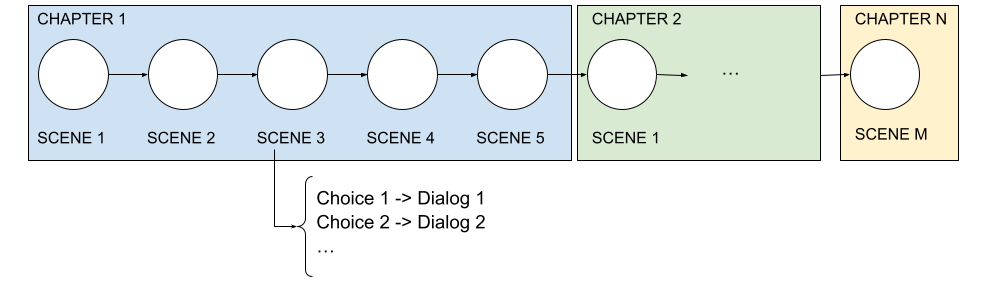
The game is divided into chapters, and every chapter has scenes. It usually goes like this:

  • The story and dialogue go, like in a movie. You do not control their flow. Sometimes they pause waiting for you to activate a mechanic.
  • Interesting spots activate on the scene:
    • circles: just look at them to activate the mechanic. Usually, you have to connect with another circle. This is used to open a book, for example.
    • eyes: point at them and blink your eyes to activate a mechanic.
    • eyes with effect: point at them and keep your eyes closed to continue with the scene.
    • musical notes: you have to follow an area to play sounds
    • hand: move your camera in the hand zone to write on a typewriter
    • pencil: look at it and it transforms into a scribble. Bring the scribble on a sheet and blink to draw.
  • In order to pass to the next scene, you have to wait for a metronome. Blink whenever you want to go forward.

Everything is very simple but effective. Also, it permits interesting dynamics. For instance, some scenes may activate the metronome while circles are still appearing. So you can choose to keep your eyes open and complete the scene. One issue is that if you blink you will skip to the next scene. Sometimes I didn’t want to do that. This is one limitation of this mechanic, it is imprecise. The real conflict offered by the game is there. So, it is unique and creates gameplay.

Journey

The game starts with the calibration of your camera. I believe it is pretty confusing, especially for the core audience of this kind of game. Then you start the game and you are immersed in a fantasy. The fantasy is about the afterlife, and the message is clear: life is an awesome thing, no matter what you achieve, no matter who you are.

Engaging with the minigames and making narrative choices brings you always to this same conclusion. The story is linear and goes from start to end. You have no agency over it, still, you can perform over it in one way or another. It’s a smart narrative design solution to not deal with branches and things that can compromise the quality of the final product. The development team is made by 9 people.

Review

Those are the games that remind me of why I chose this profession. These games are not made to trap people’s attention or to monetize. They are not designed for retention. They wait for you to step in their magic circle. And if you want, you continue until the end. Maybe you cry a little. And then they go. Maybe you can play them again after a few years.

If you want to give yourself a beautiful gift, this game is. And after you play it, you may want to watch this talk:

Everything I said in this article was written before knowing the truth about its development.