Skip to content

Tag: game design

What if students made the video game instead of studying it?

This post was originally written in Italian by Paolo Gambardella. It has been translated by an AI agent and may contain inaccuracies.

You’re studying how Hitler’s rise to fame unfolded in the Weimar Republic. Economic causes, political crisis, beer hall rallies, cut-price populism. Serious stuff, but heavy going.

Then someone in class says: what if we made a beer hall simulator?

You pour pints, serve customers, make money. Hitler wanders between the tables spouting nonsense. Get him drunk enough and his popularity drops. Let him talk and it rises.

That’s a video game. You just designed it. And an AI builds it while you’re talking.

This is the after-school activity I have in mind.

AI applied to video games applied to the humanities. History, philosophy, literature, economics. Games have always been rule systems built on real-world activities and events.

The format is simple. The class sits down. The teacher is the only interface with the AI agent. The students focus on coming up with ideas and coordinating to give it instructions. The teacher types, guides, asks questions. The agent builds. At the end, everyone plays together.

No one needs to know how to code. No one needs to know how to use Godot. What you need is the ability to reason about a problem and work together.

History translated into mechanics.

When a student decides that “drunk equals less popularity”, they’re reasoning about how political consent actually worked in Weimar Germany. They’re building a causal model. They’re doing what historians do, with a tool that feels like their own.

The game forces you to simplify — deliberately. You have to choose what matters, what to measure, what to leave out. That choice is the critical thinking you’re trying to teach. And then you play. And you have a laugh. And that laugh is memory.

New frontiers

Today, anyone with a clear idea and an AI agent can have a working prototype in hours. Not a masterpiece — a prototype. Something that runs, that you can touch, that responds.

Access to creation is no longer filtered by technical ability. It’s filtered by clarity of thought.

Schools already have after-school activities like robotics, drama, and computing. All perfectly valid. But there’s a new territory I think is worth exploring: using AI to turn humanities subjects into interactive experiences that students design together.

Someone will do it, sooner or later. It could start in any classroom.

How a Game Justifies Itself in 2026

This post was originally written in Italian by Paolo Gambardella. It has been translated by an AI agent and may contain inaccuracies.

Eduard and I are working on an independent project, since we’re at a point where we can build our portfolios. If this is your first time here, I’m a game design consultant specialising in the ideation and pre-production phase of new casual mobile f2p games. Eduard is my assistant, who joined me recently through a bootcamp where I was teaching. The collaboration is going really well, but as always there are quieter periods where the workload drops off.

The new project is called RETROFP for now, and it’s an idea I’ve been turning over in my head for a while: take the Habby method (find a meta-game that works across several titles and only swap out the core) and bring it to Steam, applying it to the classics that shaped us.

We’ve defined and built a first prototype, learned from it, and now we’re on to the second. It’s also a way to train my collaborator, so we’re taking our time. Lately I keep asking myself: why this game, why now? I think that question is no longer optional, and it breaks down into three parts.

What are you promising the player?

It’s about fantasy and identity: who does the player become while playing?

  • In RETROFP, the first game is inspired by F-Zero, but it’s futuristic rally racing. The most radical choice we made is this: the car never crashes. You never lose. You just go faster or slower, and that’s it.
  • F-Zero is a game about speed you have to survive. Ours is a game about speed you inhabit. The fantasy isn’t “hold it together and win” — it’s “nothing can stop you, chase the peak”. Speed as expression, not as risk.

The idea is to give players the freedom to experiment with the physics. In our minds, it’ll be a game that’s satisfying to watch live in front of an audience of fans. We’re building a series of prototypes around this fantasy.

Where do you sit on the spectrum between familiar and new?

Players always want something new, and every game positions itself on a spectrum. On one end, too familiar: it disappears into the noise, nobody has a reason to pick it over what already exists. On the other, too new: nobody understands what they’re looking at, the cognitive cost of engaging is too high.

  • RETROFP has plenty of familiar elements: the racing, the unlock meta-game, the live events. The new elements are more specific: no crashes, a Habby-style framework applied to Steam (practically non-existent in that form), and a core that changes with each title under the same umbrella.
  • The pattern is recombination: a proven mechanic taken somewhere it’s never been.

The risk isn’t just in the design — it’s in the marketing and communication too. “You never crash” risks landing as “too easy”. One of the things we’re trying to work out through our prototypes is how to get ahead of potential objections from players and from the people who’ll spread the word (journalists, streamers, and so on).

Why you, why now?

A solid pitch answers two distinct questions that often get muddled together. The first is the commercial why: why would anyone buy it? What space does it occupy in the market? Why now? The second is the artistic why: why are you making this game? What do you want the player to feel that other games aren’t giving them?

  • For RETROFP, the commercial why is the empty space between Habby’s mobile engagement and Steam’s indie quality. That territory is almost unoccupied, as far as I can tell.
  • The artistic why is different: we want people to feel the F-Zero fantasy, but we want speed to be a gift rather than an added risk.

The question “why this game?” isn’t a question for publishers. It’s a question for you, first and foremost. And if you don’t have the answer yet, better to find that out now.

Wish us luck!

The present is cross-functional, the future is high-quality

This post was originally written in Italian by Paolo Gambardella. It has been translated by an AI agent and may contain inaccuracies.

The stores are drowning in games. We can all see it, and it’s a direct consequence of something obvious: making a simple game has become quickly accessible. Godot, Unity, asset stores, AI for code, YouTube tutorials for absolutely anything. Development time has compressed brutally. So everyone’s doing it.

The result is a flood. Clones, games generated through semi-automated pipelines, products assembled rather than designed. Each of these games shares the same trait: made quickly, with a small team or solo, with little investment per unit.

When everyone does the easy thing, the hard thing gains value. Even Roblox is proving this, with its new strategy of focusing on HD games. If simple games become a commodity, then games that require something you can’t auto-generate become rare.

The thing that’s been living rent-free in my head

Teams in the near future have one new defining characteristic: they can be genuinely cross-functional. Not in the buzzword sense we’ve been hearing from companies for years. In a concrete, practical, radical way.

Some examples.

  • A designer no longer has to wait for a programmer to build a prototype. With today’s tools, they can build something functional in hours. They can test their game loop before the meeting with the tech team is even in the calendar.

  • An artist can implement directly in-engine without waiting for tech artist support. An artist who understands a bit of how the engine works is no longer an exotic exception — they’re just a normal asset to the team.

  • A writer can test their narrative in a working build without filing a ticket and waiting for the gameplay team to “find a slot in the next sprint”.

The roles don’t disappear. The excuse does.

To be clear: I’m not saying specialised roles will become useless. An experienced tech artist does things a shader-graph artist will never pull off. A senior programmer solves problems that a designer with an AI coding assistant can’t even properly articulate.

That’s not the point. The handoff barrier between roles gets lower. And with that barrier goes the industry’s most comfortable excuse: that’s not my responsibility.

If in the past you could sit in a cosy niche and wait for someone else to do their bit, today that’s changing. A team that sits around waiting for the “programmer bottleneck” when the designer could prototype, or the “tech artist bottleneck” when the artist could implement, is a team wasting time artificially.

Agility isn’t an abstract value. It’s the concrete ability to take an idea from your head to a working screen in as little time as possible, with the resources available. Today, those available resources have changed.

The thing that’s hard to copy

There’s an underlying question running through all of this: what can’t be automated or cloned?

The answer I’ve landed on is: a team that genuinely works well together, around a vision that’s actually worth building, with enough overlapping skills that no single bottleneck can hold everything up.

That combination can’t be copied. You can’t prompt your way to it.

And it’s exactly that combination you need to make the games that, in the coming years, will have the best shot. What does that mean in practice? That the smartest companies will be the ones capable of retaining talent — not working people into the ground and then laying everyone off the moment the title ships.

A Brief Survival Guide for Junior Designers

This post was originally written in Italian by Paolo Gambardella. It has been translated by an AI agent and may contain inaccuracies.

Last night I was at BCN Gamedev Society, a monthly meetup for game developers in Barcelona. I spoke to a lot of people and caught up with old friends. I also got to chat with several juniors who want to break into the industry — concept artists and game designers. All of them dealing with the same problem: how do you get experience when nobody will hire you because you don’t have experience?

It’s not a new question. But today the answer looks very different from what it did ten years ago.

The code is being rewritten

I read a LinkedIn post that got me thinking. The core idea was this: money has always been the code society uses to translate human time into something its systems can read.

  • You have a skill → it becomes a salary.
  • You have a need → it becomes a price.
  • You have a future → it becomes credit.

The trouble is that money is a low-resolution system. It can measure output, not meaning. It can reward production, not direction.

And now AI is dismantling exactly that promise: if generating asset variants, doing QA on repetitive scenarios, or brokering information between teams are all things machines do better — what’s left for the junior who was learning by doing precisely those things?

The actual problem

Let’s take a concrete example. A junior concept artist wants to break into the industry. They’ve studied, they have a decent portfolio. But a studio will often choose a senior who, with ComfyUI and well-crafted prompts, produces in under a day what the junior would take a week to deliver.

You build experience by doing things — but if the entry-level work gets automated, where do you actually learn? How do you learn by osmosis in this new reality?

Survival tips

Here are some concrete ideas.

1. Stop competing where AI wins.

AI wins on production speed, consistency, and infinite variation. It doesn’t win on taste, art direction, or the intuition for what will land with that player, in that cultural context, with that emotional tone.

If your portfolio says “I can write a GDD quickly”, you’re on the wrong turf. If it says “I know how to choose, curate, direct, and explain why a decision works”, you’re in a much better position, in my view.

2. Ship small things, made with other people.

A junior game designer with five small games on itch.io, all made as part of a team, is worth more than someone with a portfolio full of unrealised concepts. What you’ve shipped shows you’ve been through the full cycle: idea → prototype → feedback → release.

That’s real experience, in a team context. And it doesn’t require anyone to hire you first.

  • Game jams to work directly with other people
  • Personal projects you then put in front of players and take notes on how they actually behave
  • Weekend experiments you publish on a public Discord to collect feedback

The goal is to build a track record of decisions made in response to real interactions — and real player behaviour you’ve observed yourself.

3. Look for a senior to work alongside, not a junior position.

The “senior + AI” dynamic that’s becoming the norm paradoxically creates room for informal collaborations. A senior with too much on their plate and too few reliable juniors is often open to accepting help in exchange for a small financial arrangement and some mentorship. It’s not ideal, but it’s how things work. And when you’re around someone with experience and judgement, you learn by osmosis. That’s always been true.

BCN Gamedev Society, online communities, indie studio Discords — those are the places where those conversations happen.

4. Use AI to develop your taste.

The trap for juniors is using AI to produce more stuff, and ending up just producing more mediocrity, faster.

  • Generate 50 variants with AI.
  • Then pick one.
  • Know why you picked it.
  • Then iterate.

Your ability to judge — what to keep, what to cut, and why — is the one thing that won’t be automated any time soon.

5. Short-term survival is a separate problem.

I’m not going to tell you universal basic income is just around the corner and everything will be fine. Maybe it arrives, maybe it doesn’t. In the meantime, there are bills to pay.

Some concrete options for keeping the lights on while you build your track record:
– Gamification freelance work for clients outside the industry (startups, corporate training, educational)
– Content creation: if you can explain game design in an interesting way, there’s an audience for it
– Tutoring, online courses, local workshops
– UX writing, product design, narrative design for non-game clients

None of these are the career you want, but they’re bridges.

Conclusion

The experience paradox isn’t new, but it’s getting sharper. And the answer is to build real experience in unconventional ways:

  1. make small things and use them as a way to connect with others
  2. stay close to people who know more than you
  3. develop taste, and learn to communicate it.

Money measures what the system can already read. What systems can’t read yet is taste. Intuition. A sense of what’s actually worth making.

For now, that’s still our territory.

Prototypes for Learning

This post was originally written in Italian by Paolo Gambardella. It has been translated by an AI agent and may contain inaccuracies.

Prototypes are one of the areas where game design has evolved enormously over the past few months. New machine learning and automation tools mean everyone can move much faster when building the artefacts we need to learn from — and to help our team learn. That’s a real step forward, but it can amplify a tendency I’ve noticed in some teams: building a prototype that’s too polished and ends up becoming a demo.

A prototype exists to help you learn, to answer questions. A demo exists to convince people, to get a greenlight, to sell. The problem appears when you create something refined enough to look convincing, but too ambiguous to tell you whether you actually learned anything. You end up neither learning nor convincing anyone.

Let me give a concrete example. If this is your first time reading this, you should know I’m a game design consultant specialising in concepting and pre-production for new video games, primarily free-to-play. I run a small studio, and last week my team and I built this prototype using Godot:

  • The project kicked off on Monday with a vision I’d been carrying around for a while, which I then shaped into a vision document
  • My assistant Eduard researched other games and handed me a concept document on Wednesday
  • On Thursday I fed that document to Claude Code and asked it to generate a basic prototype
  • From Friday to Sunday I made small tweaks based on ideas that came to me while I was doing other things.

After handing the result to my assistant, he played it for a whole day and gave me his take. The conversation drifted heavily towards things like “the generated track is monotonous” or “you can’t really collide with the other cars” — all valid concerns from demo stage onwards, but not at this point. The two of us, talking it through, managed to identify the real learning: what we actually like about this prototype. We set it aside, document it, and move on to the next learning phase.

If it had just been me, or if we’d been at a bigger company, we’d probably have also needed to put together a presentation of the learnings to get everyone aligned. That’s how I like to work — but I’ll be honest: the temptation to fix the technical issues or improve the AI of the enemy vehicles was real. Why? Because right now it’s easy. It’s quick.

You can do it, but so can your competitors. The way I see it, the winners are the ones who focus on the right things at the right time. Discernment matters more than ever today. A contact of mine mentioned that App Store review times are getting significantly longer, given the volume of vibe-coded apps now landing in moderators’ queues. If we’re going to wait longer for approval anyway, we might as well be waiting on something genuinely worth shipping.

A Good Era for Game Design

This post was originally written in Italian by Paolo Gambardella. It has been translated by an AI agent and may contain inaccuracies.

During the free-to-play mobile boom, this corner of the games industry was quickly taken over by product management. In a way, that makes sense — the free-to-play business revolves around player acquisition, which means performance marketing. If the cost to acquire a player is lower than what that player spends on average in the game, you’ve got a working business.

So, working as a game designer in those companies very often became a conversation purely grounded in data. I myself repeatedly found myself arguing with my bosses over things we could summarise as: my taste VS the current state of the market. A practical example: if I — as a designer — felt that a certain fantasy needed to be expressed through specific mechanics because I had a hunch it would work, the default response was: “okay, and where have you seen this? In which other games?” Very often it was something that came from a personal experience, or something else entirely. Maybe an app, a film, or an exhibition I’d visited had sparked an idea. Nothing doing — I had to find a way, absolutely, to back it up with data.

And in fact, the designers who built the most successful careers in that sector very often describe themselves as data-driven. They know how to research what’s already there in successful games and reapply it like a mathematical formula to whatever they’re working on. Fair enough — it’s a real skill. But to me, a designer must have both a sense of the business context and a genuine taste. If we’re going to put this much energy into something, we might as well create something new — put something of ourselves into it. People notice when you actually have something to say.

I think this is our moment, right now. This is the moment for designers who want to express their own taste. In my opinion, data-driven design is dead. It was always repetitive, not particularly creative work, but I believe that in the age of AI — where an agent does all of that in far less time and at a fraction of the cost — we’re better off cultivating our own taste instead. Better to watch films, study different kinds of apps, go to exhibitions. Better, in short, to genuinely search for our own voice.

What I believe in — and have always believed in — is data-informed design. Any self-respecting designer should always try to empathise with their players, and there’s no better way to do that than collecting data. But that data shouldn’t dictate our taste, or else we’ll always be offering horses to people who need something new — like selling carriages in Henry Ford’s time. A designer can’t fly blind.

But a game designer needs to have the freedom to create, to bring something genuinely new into the world. Hiring people to repeat formulas is absurd, and I think that practice is destined to disappear — because now we have the right algorithm. One that lets us focus on what truly matters.

Optimize Screen Real Estate

I was asked to review a game recently. The game was a simple puzzle game, something we’ve seen around. It had some cool level design, but the overall experience was underwhelming.

One of the thing I noticed is that screen real estate wasn’t used optimally. Buttons were too small, important elements weren’t visible enough and the camera was distant to the puzzles.

In the grand scheme of developing a game, developers -especially solo developers- can have blind spots. Everyone has their own strengths and weaknesses and this developer’s strength was more about the puzzle design.

When thinking about screen layouts and how to optimize screen real estate you need to be very deliberate in your decisions. There are a couple of things to take into account, such as the importance of each element in your game. You can break importance up in multiple segments, such as importance to functionality, importance to communication of function, importance of game feel, importance to theme, importance to story and there are probably some more factors that could possibly be added to the pile of importance.

In addition, games and particular genres and even particular devices have conventions that player’s expect. It is important to make very deliberate choices if you want to break those conventions, but in most cases you want to adhere to them.

After having a clear understanding of the importance of every element on screen, it is simply a matter assigning the amount of space it deserves. The most important element needs the biggest amount of space, and the least important elements need the least amount of space.

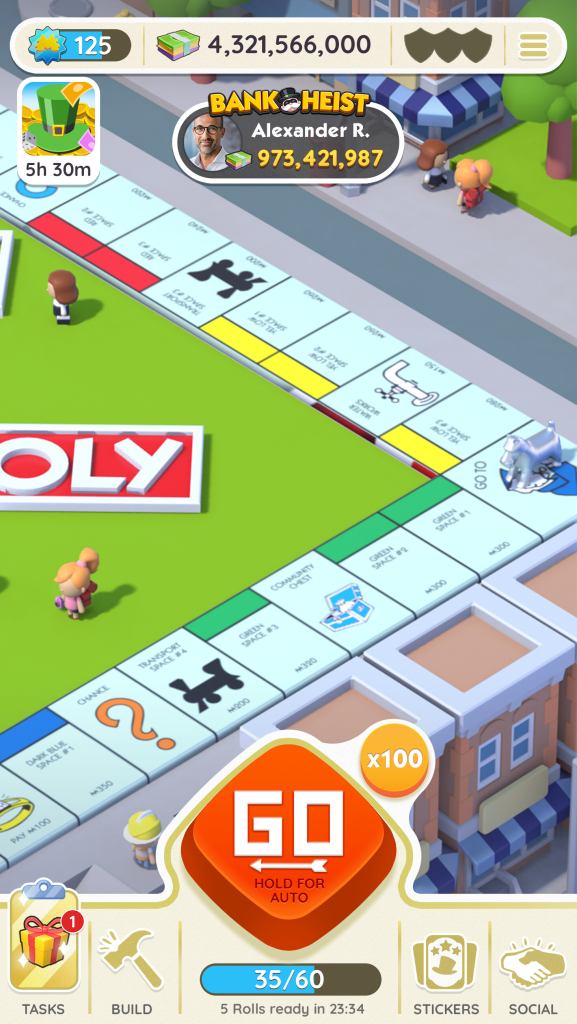
Consider Monopoly go and it’s visual hierarchy and the real estate every element occupies.

There are 2 main things that stand out, the monopoly board and the giant GO button.

It is logical and intuitive that the board is a big part of the experience and no one would question to make the gameplay field occupy the the largest space on the screen.

But it is undeniable that the big GO button is the center of attention. Your eyes are automatically drawn to it, due to its size and contrasting color. It communicates “press me” and “easy one button game”. It screams to the player that this is a deliberate design decision and players are drawn to these clear decisions.

Deliberate design is the key.

Don’t let circumstances decide anything about your game, every decision needs to be deliberate and conscious, as your players will feel it without them understanding why.

The mission of Sentendo

My mission.

This is day two since the big decision. Yesterday I published a banner. Today I have another claim better suited to online communication.

I want to tell you a little about my vision. When analyzing the target audience of a game, first of all we have to find the right fantasy to meet. Fantasy is the aspirational aspect of the game. Being a juggler, traveling the whole world, traveling through space. Some fantasy can be abstract. Think of Candy Crush Saga, which offers the fantasy of ordering an open box of sweets. Or Clash Royale where the fantasy is to dominate the opponent.

It’s about understanding people’s dreams and desires to resonate with them on a deep level. And it’s not something abstract. I have developed a very practical method to do it. My secret sauce that makes me have happy customers all over the world.

A compelling fantasy helps create more engaging experiences. And this translates into concrete numbers. Two KPIs that measure the result of a good strategy of this type:

  1. Average session time: you know those games that make you forget what time it is?
  2. Average number of sessions per day: you have a free moment, you decide to open the game again to be able to disconnect. The number of times you open the game is a clear sign of interest.

It is a question of carrying out a qualitative research of the gaming market aimed at:

  • analysis of existing games in this light
  • engagement with their communities
  • competitors playtest to structure the whole design of the game or feature (in case of live operations)

The process takes the form of deliverables that vary from a simple power-point to playable prototypes. Passing through spreadsheets, which are the most used tool by game designers. I design concrete levels in Unity and craft narratives using the most common tools.

I truly believe in this vision and I am pleased to share it with you readers. Wish me luck!