It is dangerous to scale a game with questionable product/market fit because of The Traction Treadmill. Sometimes players show up in your game, and a small percentage of them retains.
You may think it’s time to scale. Just add players, instead of improving your game. And this works, for a time. You can grow fast just by doubling ad spend. Or tripling ad spend.
You have 10.000 players, you buy 20.000 more.
Then a large percentage of those players go away and never returns back. You have to replace the percentage you lost plus buy more players to grow. You lose a percentage of players fast, and you have the budget and funding to replace them- but then can’t keep grow on top!
You may want to optimize your campaigns and spend less per Player. But inevitably the problem will reappear at some point. Team’s morale will do down as options become scarce. Increase retention becomes too slow and complex.
That is why is extremely important to polish your product but also understand when you cannot fix it. Also the best companies in the world know when to kill projects.
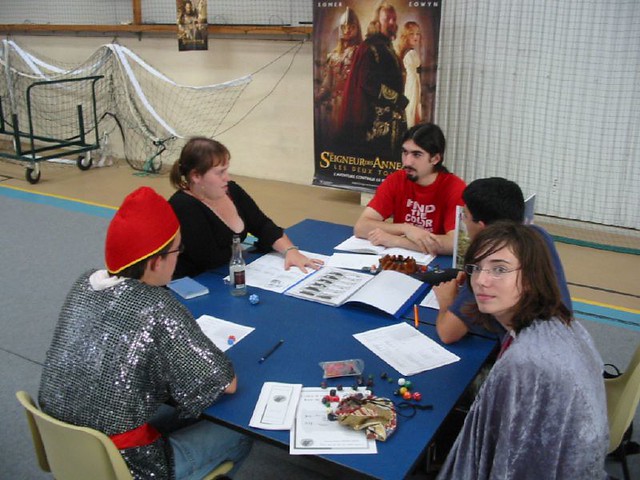
There is something that I have always missed out while playing role playing video games: interpretation.
Producing a story with many branches and possible endings costs too much, then you have to translate it in many languages. That is simply not viable. Reproducing that feeling of “do whatever you want” that is present in tabletop role playing games is hardly achieved by the videogames of today.
You will also need a human (dungeon master) to adapt the scene and the story to the spontaneity of the moment.
What we have
What is possible right now is to provide tools for the people to connect together in a server. Create and explore virtual worlds, also in real time.
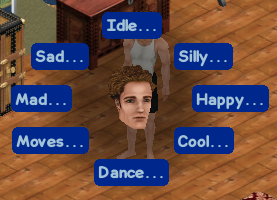
Having a customized avatar that can interact with things and make gestures is also pretty suitable nowadays.
I was just thinking that maybe those new technologies which promise uniqueness and decentralization may grant tabletop role players being rightly represented inside a virtual community.
The journey
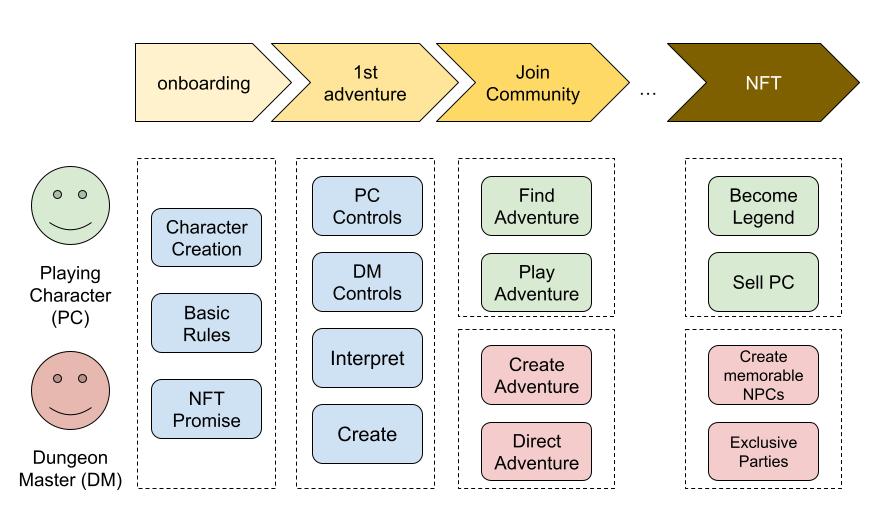
You start playing some designed adventure, just to get in touch with the controls and functionalities from a Player standpoint. Then you can look for your first party.
When you reach a certain status in the community, playing or mastering stories, the game government (developers) recognize your contribution by issuing NFTs.
If you are a player, the more you play, the higher the value of the Character (PC) represented by the NFT. You can sell it and start with new characters. New players may decide to buy a PC and skip the process of getting noticed, for instance. Developers earn a part of every transaction.
If you are a DM the Worlds and Stories you create will become publicly visible and free for everyone. You may want to pay for the developers to issue you a World-NFT or Story-NFT. Having one of those you can decide to let parties having an entry fee to your adventures, because you got a name in the community. As a dungeon master you should also create and use NPCs. The more you use those, the more your Players will be able to get in touch with them and enrich their background. Developers may decide to issue you an NFT to the highly recognized NPCs inside of the community, encouraging you to create meaningful NPCs.
Your creativity and interpretation, in that way, can be truly compensated!
I lived in first person the success of the free-to-play business model. I remember the times when you could register your bank account to Facebook, purchase credits and use those to buy items inside of a videogame.
That thing was completely different from what is today the NFT-gaming. One of the main goals for the experience of this new kind of game is not pure fun. It is to try to guess where to put your money in order to get the most benefit. It is speculation.
When I read that NFT games are the future I think: maybe the games of the future will also feature this technology, who knows.
When I read “people were skeptic also with f2p”, I say caution. Free-to-play has been born thanks to widely accessed technologies such as social networks and mobile phones without messing with people investing skills. The business was built on facilitating spending for the 5% of people who are willing to. The value proposition was pretty clear: you invest your money, you get the items you want, you get to overcome your pains and you get extra content. This is NOT what NFT is about.
NFT games are hard to access ON PURPOSE and clearly give advantage to wealthier players thanks to a base of poor grinders.
If you are willing to start the adventure of developing a new Metaverse, you may want to learn from the history of games the good and the bad things happened to the creators and players of MMOs.
I spot this beautiful channel which dedicate each video to a different title. You can see the struggles and the values that a lot of MMOs brought to the industry.
Josh Strife Hayes, check him out and consider support his Patreon!
I wish that in 2022 more and more industry professionals will start sharing their knowledge. This year has been amazing.
I learnt a lot from a lot of different people all over the world. The global pandemic made it possible, we got in touch with people with huge experience. I feel that my knowledge base improved surprisingly much.
My wish for the new year is to learn more and more from the people working on the games of the future!
Those days I will publish everyday my wishes for the games industry in 2022.
My first desire for the new year is to see our beloved games industry reach new audiences. We saw in the last decade the increase of the audience thanks to the democratization of gameplay brought by free-to-play.
I believe that play-to-earn will bring new people in. Concretely, those who already like to play on the stock market, making growing or going down real stocks. Those people would probably never invest their time in a videogame. Well, with the opportunity to earn real money I am sure they will. With play to earn for them will be like playing on the stock market, except in a more fun way, without affecting too much the capitalistic market. A true game!
New technologies will probably bring new things that now we cannot imagine. I am happy to live this new change!
We use cookies on our website to give you the most relevant experience by remembering your preferences and repeat visits. By clicking “Accept”, you consent to the use of ALL the cookies.
This website uses cookies to improve your experience while you navigate through the website. Out of these, the cookies that are categorized as necessary are stored on your browser as they are essential for the working of basic functionalities of the website. We also use third-party cookies that help us analyze and understand how you use this website. These cookies will be stored in your browser only with your consent. You also have the option to opt-out of these cookies. But opting out of some of these cookies may affect your browsing experience.
Necessary cookies are absolutely essential for the website to function properly. These cookies ensure basic functionalities and security features of the website, anonymously.
Cookie
Duration
Description
cookielawinfo-checkbox-analytics
11 months
This cookie is set by GDPR Cookie Consent plugin. The cookie is used to store the user consent for the cookies in the category "Analytics".
cookielawinfo-checkbox-functional
11 months
The cookie is set by GDPR cookie consent to record the user consent for the cookies in the category "Functional".
cookielawinfo-checkbox-necessary
11 months
This cookie is set by GDPR Cookie Consent plugin. The cookies is used to store the user consent for the cookies in the category "Necessary".
cookielawinfo-checkbox-others
11 months
This cookie is set by GDPR Cookie Consent plugin. The cookie is used to store the user consent for the cookies in the category "Other.
cookielawinfo-checkbox-performance
11 months
This cookie is set by GDPR Cookie Consent plugin. The cookie is used to store the user consent for the cookies in the category "Performance".
viewed_cookie_policy
11 months
The cookie is set by the GDPR Cookie Consent plugin and is used to store whether or not user has consented to the use of cookies. It does not store any personal data.
Functional cookies help to perform certain functionalities like sharing the content of the website on social media platforms, collect feedbacks, and other third-party features.
Performance cookies are used to understand and analyze the key performance indexes of the website which helps in delivering a better user experience for the visitors.
Analytical cookies are used to understand how visitors interact with the website. These cookies help provide information on metrics the number of visitors, bounce rate, traffic source, etc.
Advertisement cookies are used to provide visitors with relevant ads and marketing campaigns. These cookies track visitors across websites and collect information to provide customized ads.