Skip to content

Tag: professional

We are based on deadlines

The games industry is a deadline-based industry. That’s why you often see terrible practices like crunch. Crunch is typically concentrated in the last few weeks of a project, and it is fundamentally a management failure. Systemic crunch makes things unsustainable. People will become stressed, burn out, and quit—and this could eventually damage the entire industry.

Great games are made by teams that strive for success. If you are both ambitious and smart, you can design a game to be sustainable. But you must be acutely aware of deadlines and accept that our sector is based on them, because you can’t really control everything else.

Vision and clocks

Recently, I was hired for a gig as a fractional leader on a new genre. The team was skilled and talented, and the environment was fantastic. Also, the vision was clear, and my client was very creative. Without even noticing it, I worked lots of hours—much more, actually, than the hours I billed.

Some time ago, I was working on another project with a different client. The vision was messy and definitely not based on anything apart from personal opinions. The team was split across multiple projects, and the goals weren’t clear. Someone told me on a Monday, “I wrote you the whole weekend over Slack, where have you been?” And I answered, “I’m sorry, I don’t work on weekends.”

I believe that crunch is a systemic issue in our industry, and since we have pipelines, it’s avoidable. However, a team truly aiming for success will always have certain members willing to work extra to contribute to a good project. If someone asks me to work more, I will probably be reluctant. But when I feel I want to, I am happy to work extra hours. Things aren’t always black and white.

Collage of features

I met a colleague yesterday who is working on a project with no clear vision. Because of this, plans are constantly shifting, and prototypes are discarded just by pointing a finger to the sky. There is no one accountable for the game’s vision; the Creative Director is the company founder, and of course, he cannot be fired. The game feels like a collage of features, not a proper, cohesive experience.

I told him that this is very common, and it’s one of the main reasons behind the failure of so many games. Someone years ago said that 80% of games never see the light. This is why: you don’t have a clear vision of the experience you want to deliver. You only decide on the genre, and then you add, “but we’ll make it more casual,” without even intensively playing those kinds of games. You aren’t connecting with the audience. You aren’t willing to embark on the creative journey for real. So, you end up trying out things, making one prototype, not properly evaluating the results, and then moving on to something else—like throwing spaghetti at the wall to see what sticks.

Maybe something will stick, and in rare cases, you might even get lucky and make some money. But that is not the way you build long-lasting, billion-dollar games.

Motivation and performance

I was at a conference a couple of weeks ago, and I noticed the absence of a couple of friends. I met one of them on Saturday, and he’d been laid off from the company where he used to work. He explained it was due to a low score on his performance review, and then he was out in the next round of layoffs. Now he’s going to take a break; he got a decent severance and can take the time to reflect on what to do next. He looked tired and somehow older.

His partner was with him, and she was worried about the instability of the games industry. She told me that she doesn’t know what he should do. Her eyes, though, suggested that the answer lies outside of the industry. And yes, if you look for stability, games are probably one of the worst fields in tech nowadays.

Performance reviews are fundamentally biased. First of all, I’ve always noticed certain affinities within companies that inevitably lead to better reviews. Second, we are not cyborgs (at least, not yet). You join a company for a specific project, and then you are moved to another one you don’t really like. But a job is a job, and you have to go on. Then you witness questionable choices or no choices at all being made. And you are expected to stay there, with energy and motivation, performing.

Well, to me, it just doesn’t work like that. Performance reviews should be normalized by taking into account the real motivation of teams toward a project. Very often, especially big companies embark on odysseys to basically copy existing success stories. That is something that brings entire teams down, and of course, there are casualties—people who simply cannot continue working as before on something they clearly don’t believe in.

This friend was one of them. I know it because last year he told me something like, “The project is clearly going nowhere, but you know: it’s a job.” Which is the normal thing to think when they put you to work on something you don’t believe. You cannot just refuse to employ your mind on that game that is going nowhere. You have to push, but if the forces abandon you it’s not your fault.
The AI Counter Wave

Our relationship with AI is still very much in development, like our relationship with other technologies, it will be shaped by time and usage. Take our smart phones, we seemingly can’t live without it, but school and parents seem to try and keep our kids away from them – at least for a while. AI is a different beast all together, but pros and cons are discussed daily everywhere. It seems that the technology is fundamental and it already affects many peoples lives.

It seems there’s a double standard that many are not aware of they possess. For instance, I noticed how recruiters and managers seem to praise AI in their work. Summarizing batches of resumes, auto filtering great from good candidates and offloading batches of work to optimize their workflow. AI is great! But when candidates use AI to write the perfect cover letter, create position based resumes and extraordinary motivations, recruiters and managers seem to hate and automatically deny the application. This is a double standard where the technology seems to be both great and very bad at the same time and in many cases this double standard isn’t felt by the person who possesses it.

But I think this double standard provides a clue to what the counter wave of AI will be. I believe all things come in pairs of opposites. Light and darkness exist only in relation to each other, like noise and silence, like chaos and order. AI will create a zest for CounterAI, the deeply personal, the things that exist because of effort and human suffering. The recruiter and managers that make their work impersonal and soulless by using AI to sift through their candidates demand heartfelt personal motivational letters and carefully crafted resumes with a clear human touch. AI will expose the need for humans to grow through hardship, suffering, commitment and purpose. Like microwave meals make you hungry for your mother’s favorite dish, so to will AI make you hungry for the purpose full and human.

The Console Business Has an Accessibility Problem

When I started playing games, the controller was a simple D-pad and two buttons, A and B. As I grew, the industry added more buttons and sticks. Today, we have at least 21 buttons, two sticks, and a D-pad.

What if you’re a kid just starting to play video games? Today, you have to choose between a complex controller or a mobile game like Roblox, where your friends probably already are. Maybe they’re on Fortnite, in which case you’ll still have to learn how to use the controller.

But let’s face it: it’s harder than before. On top of that, add all the time you “lose” by waiting for your game to appear. It wasn’t like that before; you inserted the cartridge and got the game immediately on screen. No need for loading, connecting, updates, and so on.

In my opinion, the console business needs to understand and fix this accessibility issue if they truly want to improve their market reach.

Regulatory missteps

I recently read the New European Consumer Protection Guidelines for Virtual Currencies in Video Games after days of discussion on the topic. On one hand, I feel proud to live on a continent that prioritizes consumer protection, but on the other, I’m worried that regulators fundamentally misunderstand our industry.

I’ve worked mostly in casual mobile free-to-play (F2P). Development usually involves at least six months for the first version, followed by a ‘soft launch’ period of 5 to 15 months, where we figure out metrics, tune the performance marketing strategy, and tweak the economy—often without making any profit.

Successful F2P games operate somewhat like luxury goods. The business is primarily sustained by superfans (call them whales or big spenders). Crucially, even in games where the typical player might be a parent or older adult, these superfans are generally heavy gamers who also buy and play many console and PC titles. For example, the biggest spender in Royal Kingdom is likely an Elden Ring player, not a grandmother saving money for her grandkids.

Regarding the new regulations, three points are particularly worrisome:

  1. Clear and Transparent Price Indication: The price of in-game content or services must be shown in both in-game currency and real-world money, ensuring players can make informed decisions about their purchases.
  2. Avoiding Practices That Obscure Pricing: Game developers should not engage in tactics that obscure the true cost of digital content. This includes practices like mixing different in-game currencies or requiring multiple exchanges to make purchases.
  3. No Forced Purchases: Developers should not design games that force consumers to spend more money on in-game currencies than necessary. Players should be able to choose the exact amount of currency they wish to purchase.

I understand the underlying goal, but these rules reveal a fundamental ignorance of game design and development:

  1. Inflation and Value: Virtual items and currencies constantly change their actual value during a game’s live operations due to in-game inflation and economic adjustments. Forcing us to show the real-money equivalent at all times will quickly become nonsensical.
  2. Multiple Currencies: F2P game systems rely on multiple gameplay loops to be effective. To support these loops and give players meaningful choices, multiple currencies are essential. Without them, balancing becomes hellish, and the player experience suffers—a genuine lose-lose scenario.
  3. Purchase Flexibility: When a game is published, you set specific, pre-defined prices for all in-app purchases on stores like Google Play. Implementing the option to purchase something like “23 gems” would either require rounding that purchase to the nearest predefined value (which violates the rule) or registering a huge number of specific values. That is frankly crazy.

I am genuinely worried that these measures will negatively impact Europe as a total addressable market for F2P games. Knowing the spending habits of superfans, they will simply go elsewhere. And regarding the promised protection for children, let’s be serious: social media is far more dangerous for kids. F2P games require interaction and can develop useful life skills. Infinite-scrolling video feeds are pure fentanyl. The problem isn’t games.

Wolves in a Fairy Tale

The CEO of Supercell, Ilkka Paananen, released a message yesterday asking European legislators to consider European free-to-play game developers before approving new player safety measures.

I currently work mostly in free-to-play (F2P), and I’ve worked in gambling games in the past. I must admit that I see many common practices between these two sectors of the gaming industry. The F2P high-spending players are called whales, a term that actually comes from casinos. And these players are fundamental to the profitability of a game you give away for free.

Certain practices, often called dark patterns, surely influence people’s decision-making. Vulnerable people, like children, can be induced to spend too much. That’s why the regulator often comes in with an axe and suddenly cuts off everything. The same thing happened with the web; nowadays, the experience is completely ruined, and I have to close endless pop-ups for policies I will never read.

I don’t like to be treated like a child. My daughter will never have access to a connected smartphone as a child, full stop. It’s about responsibility. I am aware that many parents don’t have that responsibility, or aren’t capable of facing their children, though. That’s why we need regulations, but to me, it’s important to include everybody in the discussion and not treat developers like wolves in a fairy tale.

Before Gameplay

Before players decide to step into your magic circle and start having a good time, they have feelings. They might watch a video on YouTube, read an article about your game, or simply land on your store page and look at the trailers, screenshots, and descriptions.

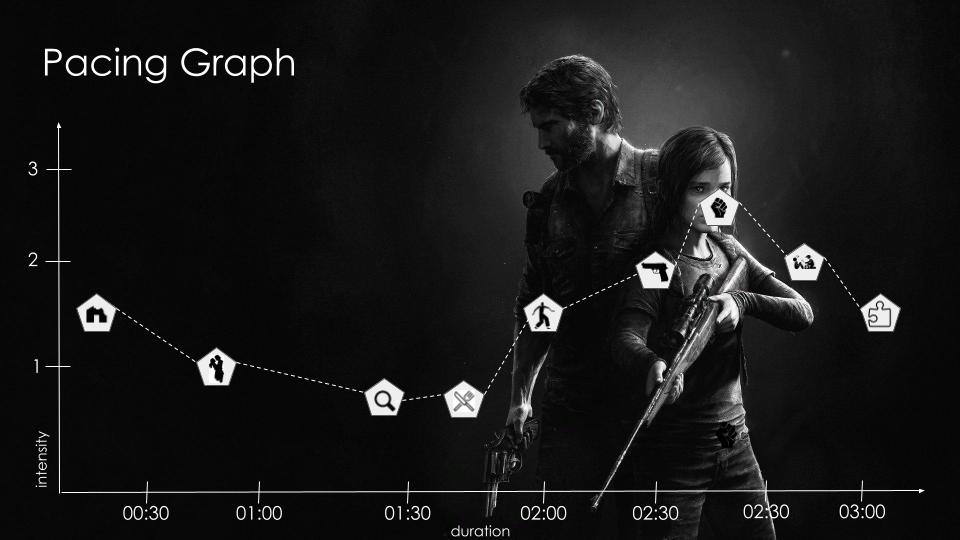
All of this evokes emotions and feelings. Emotions are the first step of perception. That’s why when you start designing levels for a narrative-driven game (RPG, adventure, platformer, and so on), you need to think first about the emotional intensity curve over time. This way, you can properly estimate the moment-to-moment experience.

I recently used this approach for a personal exercise: creating a hypothetical level for The Last of Us.

You can see each step is associated with a specific dynamic I want the Player to experience during the level. This curve was the final one, but I worked on many iterations. You plan a curve, and then you iterate over time.

I still code

I started my journey in games as a programmer. More specifically, I began using LUA scripting on a Linux-based engine designed for a coin-operated venture in a small village in Southern Italy.

Then I moved to Barcelona and got my first job in gambling games. I was a C/C++ programmer at Zitro, working on video bingos. I owe them a lot; I learned Spanish there, and today, I design games because of gambling games. It’s true that there are ethical issues with them, but I believe that their simplicity and clear motivational framework make them a great way to start in game design. I began buying books on game design because of gambling games, trying to understand why they were so boring to me yet so profitable.

Life and my career moved on, and I kept programming on the side. Today, I’m more on the strategic/executive side of things, thankfully because I gained more experience and managed to stay in the industry. Still, I love the sensations that programming gives, and I particularly enjoy Python and C++. I bought a course to learn a bit of Unreal Engine this week. My goal is to start it and perhaps create a prototype for my Capoeira ARPG game.

Stay tuned and have a great week, everybody.