This post was originally written in Italian by Paolo Gambardella. It has been translated by an AI agent and may contain inaccuracies.
The issue of creating and distributing video games is a complex reality. Talk to anyone working in the industry and you’ll always hear the same thing: “making games is hard.”
During the years when video games received massive investments (especially during COVID), an illogical mindset crept into the industry: treating this delicate reality as if it were a complicated problem.
Complicated problems are solved with the left side of the brain. Building a rocket to go to Mars is a complicated problem. You need experts who, with the right knowledge and reasoning, will get you there. Once the process is found, the problem is solved — barring human error, of course.
A complex reality, on the other hand, requires entirely different skills. Skills for which the right side of the brain is better suited. It requires building certain relationships — both with people and with creative work. There is no single method, no formula. Companies that succeed and rely solely on formulas eventually pay the price.
Game creation and distribution cannot be treated as a complicated problem: it must be respected as a complex reality. Otherwise, it boils down to a game of stolen ideas and performance marketing tricks that only bring in money in the short term. Then, inevitably, someone comes along who is willing to work with fewer protections and longer hours, and overtakes us.
Sometimes I get the feeling that we need more humanists and artists, and fewer mathematical minds and business people, among our executive ranks.
This post was originally written in Italian by Paolo Gambardella. It has been translated by an AI agent and may contain inaccuracies.
During the free-to-play mobile boom, this corner of the games industry was quickly taken over by product management. In a way, that makes sense — the free-to-play business revolves around player acquisition, which means performance marketing. If the cost to acquire a player is lower than what that player spends on average in the game, you’ve got a working business.
So, working as a game designer in those companies very often became a conversation purely grounded in data. I myself repeatedly found myself arguing with my bosses over things we could summarise as: my taste VS the current state of the market. A practical example: if I — as a designer — felt that a certain fantasy needed to be expressed through specific mechanics because I had a hunch it would work, the default response was: “okay, and where have you seen this? In which other games?” Very often it was something that came from a personal experience, or something else entirely. Maybe an app, a film, or an exhibition I’d visited had sparked an idea. Nothing doing — I had to find a way, absolutely, to back it up with data.
And in fact, the designers who built the most successful careers in that sector very often describe themselves as data-driven. They know how to research what’s already there in successful games and reapply it like a mathematical formula to whatever they’re working on. Fair enough — it’s a real skill. But to me, a designer must have both a sense of the business context and a genuine taste. If we’re going to put this much energy into something, we might as well create something new — put something of ourselves into it. People notice when you actually have something to say.
I think this is our moment, right now. This is the moment for designers who want to express their own taste. In my opinion, data-driven design is dead. It was always repetitive, not particularly creative work, but I believe that in the age of AI — where an agent does all of that in far less time and at a fraction of the cost — we’re better off cultivating our own taste instead. Better to watch films, study different kinds of apps, go to exhibitions. Better, in short, to genuinely search for our own voice.
What I believe in — and have always believed in — is data-informed design. Any self-respecting designer should always try to empathise with their players, and there’s no better way to do that than collecting data. But that data shouldn’t dictate our taste, or else we’ll always be offering horses to people who need something new — like selling carriages in Henry Ford’s time. A designer can’t fly blind.
But a game designer needs to have the freedom to create, to bring something genuinely new into the world. Hiring people to repeat formulas is absurd, and I think that practice is destined to disappear — because now we have the right algorithm. One that lets us focus on what truly matters.
I read the last email that the new CEO of XBox sent to her employees. It is honestly an inspiring take on what’s next for XBOX, I am positive about this person. Maybe the fact she is not a games veteran is good for her actual position. Or maybe I am just a dreamer, I don’t know.
There is one use case that I believe they can tackle pretty “easily”, and position themselves like the platform for everyone they want to become. There are successful f2p midcore titles that occupy too much space on the smartphone. Often they require the latest models to run at the higher quality. I believe that the f2p player doesn’t care of having a copy of what he is playing.
If XBOX manages to become the platform from which you can play the “Genshin Impacts” of the future in cloud on streaming, and maybe engage with mods and UGC for your fav games, there is the chance from them to become THE platform of the future. A sort of Roblox for Mobile f2p games. Of course, there are lots of limitation that may come from Apple and Google. Still, if they manage to do this right, they can really disrupt the market in my opinion.
Of the many applications of AI in games, I am more interested in those that can unlock new form of experiences. First thing that comes to mind is narrative, of course, but since as a developer you are paying for hosting a server with an LLM I think you need to focus more on the return of the investment on that infrastructure.
One idea is to have new forms of special offers related with the fact that you can or cannot engage with certain systems within a game. Maybe you played heavily during the last event, but you have no time this week. You can say it, and the system can find special solutions for you. Just one example.
I was watching the last Deconstructor of Fun podcast, shooter monthly, on Highguard.
I downloaded the game days ago, completed the tutorial and played three matches. I am not really into hero shooters, but I have to admit that I also had the sensation, as these expert say, that the game was not properly play tested. Which is a common issue in the industry that leads to many games to fail miserably. You need to engage with your future clients, especially with service games. You cannot simply launch early access anymore, early access in current market is perceived as a full launch, especially if you game has been announced in “pompa magna” at The Game Awards by Jeff Keighley in person.
Regarding the market segmentation
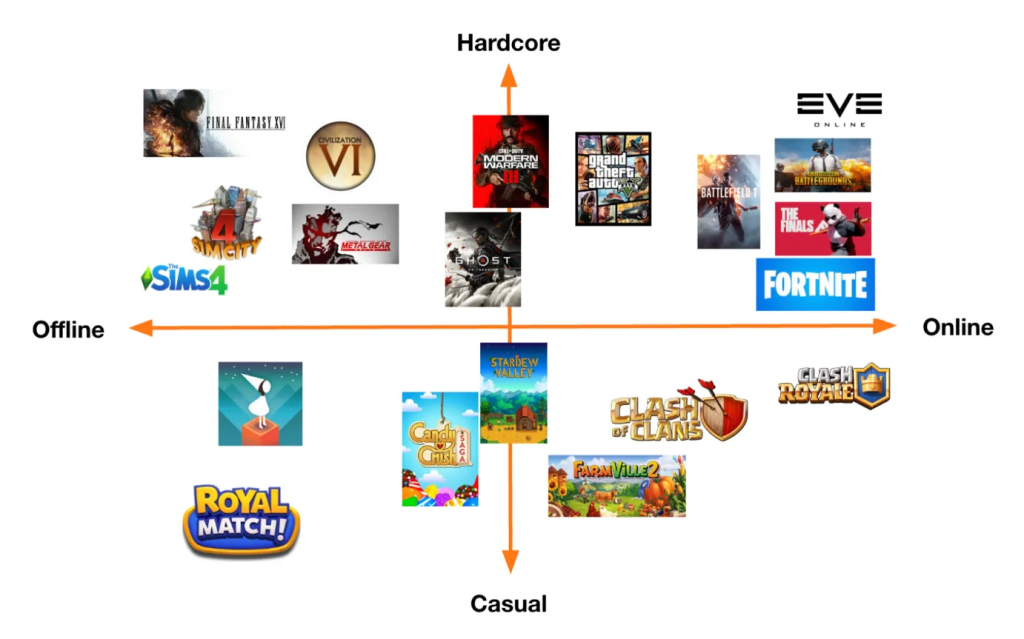
The experts seem to agree (but not fully) on the fact that there are just two kind of profitable shooter genres: tactical and battle royale. I am not sure about that, I prefer this Owen Mahoney’s segmentation:
Owen Mahoney’s view of the industry
I believe that shooter as a genre fits in at least 2 quadrants: online and offline hardcore. Nicholas Lovell also has his view on the industry in general.
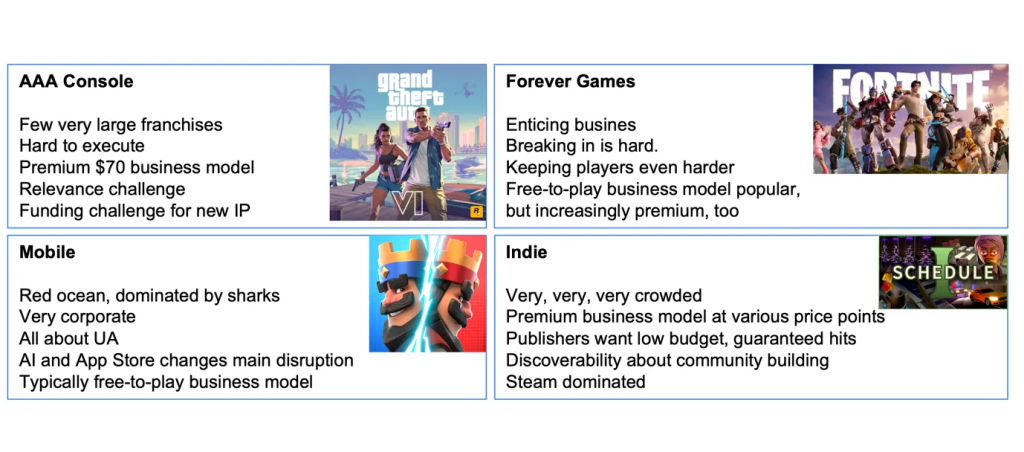
Nicholas Lovell’s view on the industry
And we know there are AAA fps, forever fps like Fortninte, mobile FPS, and also indies who build on top of boomer shooters. Finally, there is Christopher Dring view of the industry:
Under this lens, I see games like STALKER being fps with stories. Fortnite and so on, are for socializing, but also competition/sport. COD and Battlefield as well. Boomer shooters are for passing the time, especially indies like this one.
I believe that the market is more complex and varied than the one pictured by Phillip Black in the DoF shooter monthly podcast.
What I do believe about the game modes
In the podcast, they insisted that the right number of people should be 5vs5 or 3vs3vs3, and I agree with them. But I believe that are also other problems with general game pacing:
Mining crystal is not the best during a shooter session, in my humble opinion. I know it’s a basic in Fortnite, but there you can then build things instantly. Here, instead, is to buy stuff from a vendor.
The vendor itself is slow and boring, can be put in another place
Upgrading/reparing walls is not so exciting, too.
First idea I would try to pitch and eventually design is to buy weapons and repair walls when you die. You die and while you wait, your “soul” can repair stuff. I know, maybe you prefer to watch what is happening, but that can be an extra cam or something while you fix things.
Another thing I noticed is that the most exciting part is when you raid or you need to defend from a raid. Still, I had the feeling that the attackers, the raiders, were stronger than the defenders. Maybe it’s just psychological, but I would like to try something asymmetrical, like 3vs5 (5 defenders).
Running on the horse while shooting is also cool, I remember that from RDR2, which lead designer works for Highguard. Maybe there can be the moment of earning crystals instead of mining.
3 ideas I would pitch:
Buy weapons and manage base on death
Asymmetrical raids
Earn crystals while killing people from the horse
Maybe these would create more exciting/unique moments for Highguard.
I’m not convinced by this “AI is just a tool.” We’re wired for stories and narratives, in the sense that our perception is very attentive to them and our memory contains narrative sequences. A tool capable of creating a narrative structure ceases to be a simple tool for me.
It’s a bit like saying “movies are just a tool,” or “video games are just a tool.” Well, it’s certainly possible to use movies and video games as tools. How many times in school were we shown a movie to explain a story? Some teachers use role-playing games or even computer games to explain concepts.
However, these artifacts aren’t just tools. And AI isn’t one for me either. It can heavily influence the way we implement an idea, given that it’s capable of arguing (often bullshit) very well and could catch us at a stressful moment when it’s easy to give in to the temptation to trust. And this inevitably leads to missed opportunities.
Of course, you can cut off your finger with a knife. With Photoshop, you can gather a series of images and make a collage. But that’s a direct use during which you’re aware of the error, either before or just after.
AI isn’t just a tool; it can only be used as a tool, that’s true. But it’s designed, like many things these days, to capture our attention (so we pay the monthly subscription) in exchange for the feeling of being more productive.
I wish you and your family a merry Christmas and a happy 2026. I scheduled a couple of posts for key dates, but I will spend some day with my family in Italy so I will not post over here during two weeks.
See you next year, I hope you will find your “Zelda’s Lullaby”, your key for multiple solutions.
One of the things I like the most about the games industry are the success stories. I like when people, for a reason or another, join together and achieve great success, higher than they expected. This possibility is one of the elements that keeps me within the games industry.
I am aware of the “survivorship bias” here, and I know that I cannot reproduce the success of others. I have been in enough projects to understand that every successful game is a little miracle. A combination of multiple factors. You cannot just follow guides and tips and be successful. And that’s exactly what I find attractive of this business.
When I celebrate concrete case studies over here is not to give false hopes to people. It’s not a “hey, look at them! they did that with few resources, you should do the same, it’s easy!”. Not at all.
It’s just that my LinkedIn feed in the last 2 years is filled with empty messages, sexy selfies, and bad news. And I just genuinely like to spread good news, and say “hey, everything is freaking hard, but I am a gamer and believe me: an epic win is always possible.”
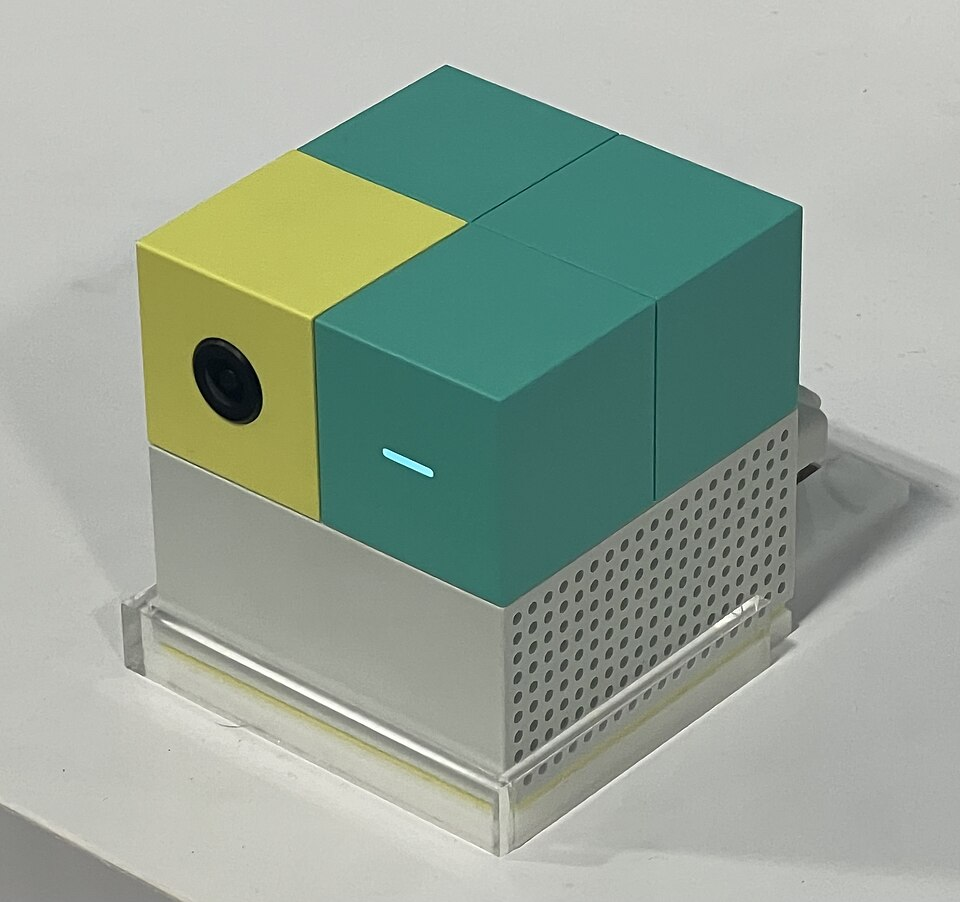
According to the popular marketing insight service Circana, on November this year the 3rd most sold console has been NEX Playground. In case you don’t know what it is, here’s the console.
The console is small and cubic, and has no controller. You play videogames like you did on XBOX Kinect years ago. The target audience is clear, the same as WII, families. The business model is subscription. You buy the console for around $250 and then you pay a monthly fee to get access to all games. The power, according to a recent interview of its company founder, is similar to a PS3. No next gen, no controller, simplicity at its best.
Will this console beat next gen consoles like PS6? No, of course not. But to me, the fact that has oversold XBOX for instance is a sign that:
Console market is not dead at all, as someone says
The market needs something simpler
Europe needs something like this, for me. Especially now that we are researching more on making our own chips to not be dependent on China, it would be great making our own console, as an excuse and for the chance of building our own Nintendo. I would probably target 10-13 preteens in full “obsession age” and make cool games. I would probably also add a simple 2 buttons controller for having better kinesthetics for whoever who doesn’t want to move.
The main feature, to me, should be that the console should work like old consoles: you turn ON and the game appears. No connections, no loadings, no system checks before it’s truly needed. It would be so cool to participate in a project like that!
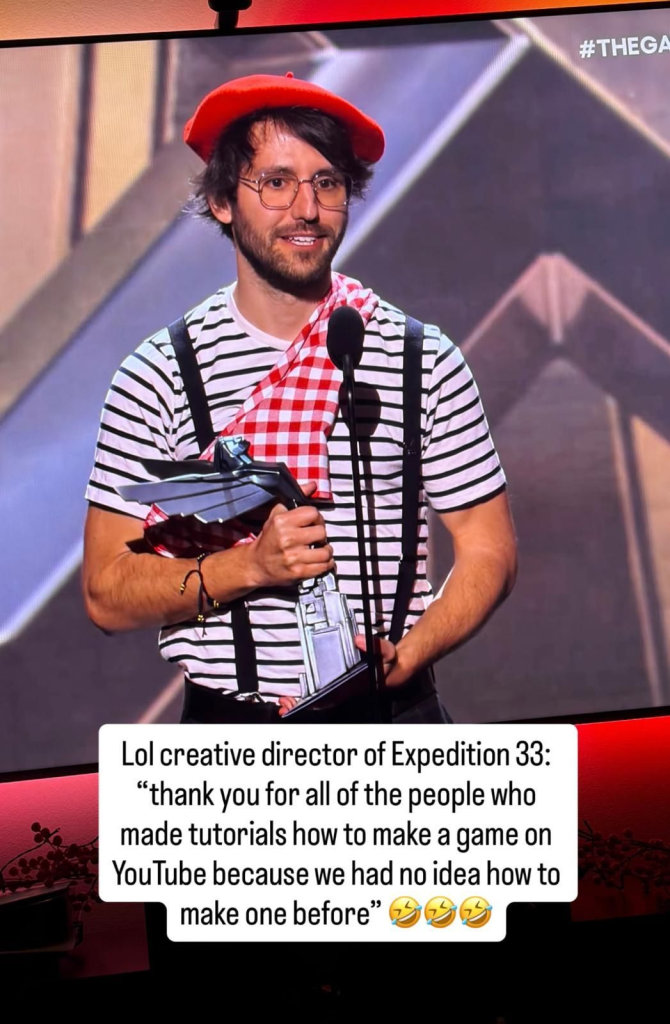
My feeling is that 2026 will be the year of people with the courage of creating new worlds and putting them out. We have not only tutorials, but plenty or resources to visualize and realize our dreams. To make them playable from people from all over the world. My feeling is that independent creators will benefit the most from recent technological advancements.
Of course, there are many factors that can influence the course of events so don’t take it as a prediction. I loved The Game Awards, I watched it with emotion, including some tears of joy and nostalgia. And the desire of helping build something memorable.
We use cookies on our website to give you the most relevant experience by remembering your preferences and repeat visits. By clicking “Accept”, you consent to the use of ALL the cookies.
This website uses cookies to improve your experience while you navigate through the website. Out of these, the cookies that are categorized as necessary are stored on your browser as they are essential for the working of basic functionalities of the website. We also use third-party cookies that help us analyze and understand how you use this website. These cookies will be stored in your browser only with your consent. You also have the option to opt-out of these cookies. But opting out of some of these cookies may affect your browsing experience.
Necessary cookies are absolutely essential for the website to function properly. These cookies ensure basic functionalities and security features of the website, anonymously.
Cookie
Duration
Description
cookielawinfo-checkbox-analytics
11 months
This cookie is set by GDPR Cookie Consent plugin. The cookie is used to store the user consent for the cookies in the category "Analytics".
cookielawinfo-checkbox-functional
11 months
The cookie is set by GDPR cookie consent to record the user consent for the cookies in the category "Functional".
cookielawinfo-checkbox-necessary
11 months
This cookie is set by GDPR Cookie Consent plugin. The cookies is used to store the user consent for the cookies in the category "Necessary".
cookielawinfo-checkbox-others
11 months
This cookie is set by GDPR Cookie Consent plugin. The cookie is used to store the user consent for the cookies in the category "Other.
cookielawinfo-checkbox-performance
11 months
This cookie is set by GDPR Cookie Consent plugin. The cookie is used to store the user consent for the cookies in the category "Performance".
viewed_cookie_policy
11 months
The cookie is set by the GDPR Cookie Consent plugin and is used to store whether or not user has consented to the use of cookies. It does not store any personal data.
Functional cookies help to perform certain functionalities like sharing the content of the website on social media platforms, collect feedbacks, and other third-party features.
Performance cookies are used to understand and analyze the key performance indexes of the website which helps in delivering a better user experience for the visitors.
Analytical cookies are used to understand how visitors interact with the website. These cookies help provide information on metrics the number of visitors, bounce rate, traffic source, etc.
Advertisement cookies are used to provide visitors with relevant ads and marketing campaigns. These cookies track visitors across websites and collect information to provide customized ads.