Every game plays around 3 factors: skill, luck, and stats.
The first is the actual cognitive effort required to play it.
Luck is about everything generated at runtime, developers set up rules for generation.
Stats are carefully designed values that give the Players the first goal: grow them.
There are skill-based, luck-based, and stat-based games. Games whose principal factor is one of the 3. Within this game is possible to add more of the other 2 factors. You may earn more opportunities, for instance for monetization. On the other hand, you complicate a little the things. This translates usually to a more niche game.
What’s the key to creativity? The capacity of scoping things, removing the superfluous. Many successful games started with this concept in mind. Eventually, they evolved more complicated as their popularity grew. Some of the new Players will resist a little bit of friction to be part of the crowd, to not be left out. It’s important to see where they started if you desire to replicate their success.
Some other day you feel like nothing works. It’s the worst game ever.
This is completely normal and common. Track these days. Play the build, every single day. And speak with your team. Do you believe you are on the right track?
If you are not sure about that from many milestones, it’s time to question harder topics.
Loops are a great way to drive design discussions with everyone on the team. They are a simplified version of a flowchart and the last element connects to the first. I see that there are different definitions of loops and today I want to show you mine.
As with many other definitions related to game design, the fact that there are different versions implies often that you need to make an effort to understand the point of view of who’s driving the conversation.
Game, Core and Meta loops
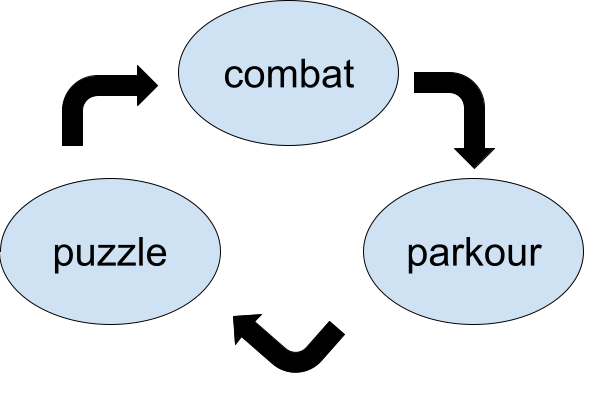
When I say game loops, I mean the sequence of most used features within the game.
The example above represents an action-adventure game like Uncharted
Every circle represents a feature, a collection of mechanics that creates one or more dynamics
The arrows represent how the game is supposed to lead the Players to the next feature
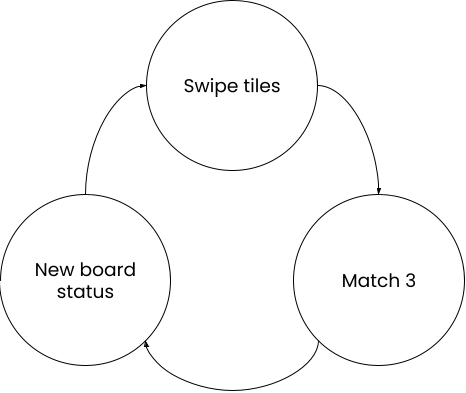
With core loops I mean the sequence of actions that the Player performs more often during the gameplay
The example above is the core loop of a match-3 game
Every circle represents a mechanic
The connecting arrows can be read as “so that”: As a Player, you swipe tiles SO THAT you match 3 or more tiles you get a new board status SO THAT you can decide which tiles to swipe next.
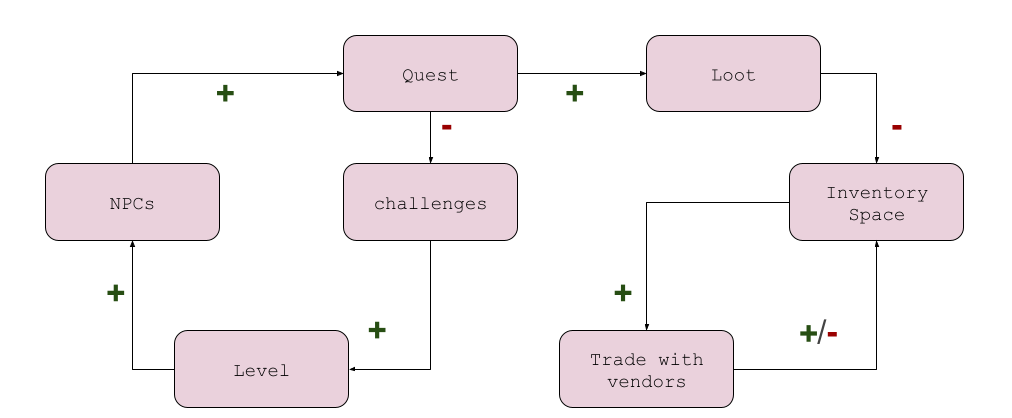
Finally, there are the metagame (or economy) loops, which represent the construction of the economy on top of the actions. A good economy makes you think about the game when you are not playing.
the example above represent (a simplification of) a possible metagame for an RPG
every rectangle represents a game feature, mechanic, or concept
arrows indicate that a system adds or subtracts elements from the next rectangle. For instance, speaking to an NPC will increment the number of quests that the Player has. Collecting loot will remove inventory space.
Conclusion
There is not a single way of looking at loops, what is important as a designer is to have your voice. Oftentimes clients show me their “core loops” and in my definition, those are “game loops” instead. And there is no problem, the client is always right and I can adopt their jargon easily. The important is to keep my base strong to drive meaningful discussions.
Loops are useful to express concepts and drive discussions, they don’t have to be perfect. They are a medium for a concrete purpose: clarity. I saw very complicated loops, for instance, that do not add clarity. In that case is better to break it down into different feature loops (which are game loops that describe a single feature, when it’s too big).
Finally, the loops should be meaningful. Good loops have a long-term goal associated with them. You decide to repeat the loop over and over to reach that goal. So ask yourself what is the goal for every loop you identify.
We live around 75 years. We have 75 summers, around 80 travels (in my personal economical condition of course). The people we will meet are relatively few, the projects we can tackle too.
Imagine you start to work at 25 years, because you are born in the lucky side of the World. You have 40 years working. If a game takes 3-5 years, you can make around 8-14 games in your life. Game for companies, that may be successful or not.
Or you can go indie, maybe solo dev, going alone and try to publish one game per year. Small game, of course. In that case you can leave 20-30 good games (the first will surely be a disaster). That can be your legacy as a game designer.
This weekend I was scrolling the infinite feed of LinkedIn and reading updates from many experts. I have to say that lately from one side there are lots of challenges. Many layoffs across the whole IT sector and people looking desperate. From the other, lots of experts are sharing their knowledge online. This is absolutely a good thing.
One of the main topic is about the future of games. Right now, it seems that everyone can make and publish a PC game very easily. But the cost of AAA games production is rising and the value perceived by the players is going down.
There is a demand/offer problem, too many games and it’s hard that the people notices you. To me, the solution should come by adopting a different perspective. Unless you have a strong IP, like Call of Duty, you cannot just make a game and sell it. You cannot afford to assume that people will come buy it. Nowadays, you should first get in touch with people, make them notice you. Then the people will eventually buy your things.
There is a trend among content creators, especially tech ones. They use Patreon to arrive to their audience. They build little by little. Play-to-earn crypto games were scam, but they were making something good: making contact with people super early. Of course, the focus there was money which is never something good to relate with entertainment. Still, I liked this very fact.
The key to me is in being able to create a strategy to go towards the people, the Players. Not the other way around. If you are making a game and then you will invest your money in marketing to spread the word, it’s very possible you join the rest of noise. It’s better to start build your player base right now, instead.
There is something I love in tabletop games rulebooks: they refers to YOU, not to the Players in general.
I think that documentation should adapt a similar method in order to the readers to empathize with the Players. You introduce who are the Players and their traits, behaviors and needs. And then you invite the reader to be one of them.
Using you instead than third persons can really improve with simplicity the effectiveness of your docs.
There was a time when companies decided if you were apt to join the games industry or not. That time is well gone.
I see a lot of messages on social networks, especially LinkedIn, by people looking for the next gig in a company. Someone is looking for the first job. Which is normal and good, LinkedIn was created exactly for that reason.
But, you cannot permit to stay at the border of the river waiting for your opportunity to pass. You have to be what you want to be first. Don’t just look for a job, do the job.
Many years ago it was impossible or very hard to do something without working for a company. Companies acted like a filter, they decided somehow you were worth or not. That is not the case anymore. You have all the material to do what you like to do. In case you have to pay the bills, there are nowadays alternatives to do that.
Be a professional first, then companies will look for you! It’s not the other way around anymore.
Every gaming business founder wants to reach that milestone. 1M players and counting. So, how do you design for 1M?
You simply don’t. You design for 3-7 people instead. Be prepared for the growth, of course. But good design is a personal thing. Is for someone!
Who’s that someone? When you work for a company, that someone is first of all your manager. You don’t design for players, you design with players in mind. But your client is your manager.
There is a Brazilian word I learned by practicing Capoeira: mandinga.
Like many words from Brazilian Portuguese, its origin goes up to Africa. The original “mandingueiros” were Muslim literates who compared to other enslaved people knew how to read and write. That’s why they were considered like magicians, almost.
“Mandinga é fazer com pouco, muito!”. Old Capoeira masters speak these words: mandinga is to make a lot with a few things.
This knowledge from the history of our World can be adapted to game design, too:
When you have budget 10, it’s better to design a game for budget 3. Your team will thank you later. Explain mandinga to the voices telling you you are not being ambitious enough.
When you don’t have access to all the best talents in the World, remember that games like Counter-Strike, League of Legends, and Candy Crush Saga were not created by people with huge tracks.
It’s better to do one-two things very well than five-seven average. Remember that the value is in the IPs you create, not in the features you add.
Put a little bit of mandinga in your game design!
We use cookies on our website to give you the most relevant experience by remembering your preferences and repeat visits. By clicking “Accept”, you consent to the use of ALL the cookies.
This website uses cookies to improve your experience while you navigate through the website. Out of these, the cookies that are categorized as necessary are stored on your browser as they are essential for the working of basic functionalities of the website. We also use third-party cookies that help us analyze and understand how you use this website. These cookies will be stored in your browser only with your consent. You also have the option to opt-out of these cookies. But opting out of some of these cookies may affect your browsing experience.
Necessary cookies are absolutely essential for the website to function properly. These cookies ensure basic functionalities and security features of the website, anonymously.
Cookie
Duration
Description
cookielawinfo-checkbox-analytics
11 months
This cookie is set by GDPR Cookie Consent plugin. The cookie is used to store the user consent for the cookies in the category "Analytics".
cookielawinfo-checkbox-functional
11 months
The cookie is set by GDPR cookie consent to record the user consent for the cookies in the category "Functional".
cookielawinfo-checkbox-necessary
11 months
This cookie is set by GDPR Cookie Consent plugin. The cookies is used to store the user consent for the cookies in the category "Necessary".
cookielawinfo-checkbox-others
11 months
This cookie is set by GDPR Cookie Consent plugin. The cookie is used to store the user consent for the cookies in the category "Other.
cookielawinfo-checkbox-performance
11 months
This cookie is set by GDPR Cookie Consent plugin. The cookie is used to store the user consent for the cookies in the category "Performance".
viewed_cookie_policy
11 months
The cookie is set by the GDPR Cookie Consent plugin and is used to store whether or not user has consented to the use of cookies. It does not store any personal data.
Functional cookies help to perform certain functionalities like sharing the content of the website on social media platforms, collect feedbacks, and other third-party features.
Performance cookies are used to understand and analyze the key performance indexes of the website which helps in delivering a better user experience for the visitors.
Analytical cookies are used to understand how visitors interact with the website. These cookies help provide information on metrics the number of visitors, bounce rate, traffic source, etc.
Advertisement cookies are used to provide visitors with relevant ads and marketing campaigns. These cookies track visitors across websites and collect information to provide customized ads.