Skip to content

Category: Personal

Two Days, Two AIs, and a Princess Turned into a Melon

This post was originally written in Italian by Paolo Gambardella. It has been translated by an AI agent and may contain inaccuracies.

Last week a colleague showed me an interesting video: a game dev getting ChatGPT’s Astra and Claude’s Fable 5.1 to work together inside Unreal Engine, to build a Souls-like boss fight.

The video itself is about game development, but what struck me was seeing two different AIs working on the same material rather than just one. It reminded me of a story I’d had in my head for a while — “Princess Melon”: I’ve been telling it to my daughter Maria Laura at bedtime since she was born, and over the past month I’ve actually sat down and written it up properly in my spare time. So I thought: why not try the same thing myself, with Claude and ChatGPT, but to finally put a face to its characters?

I spent two days getting the two services to talk to each other: one would propose a character, the other would refine or build on it, until we landed on a consistent cast across all the illustrations — from King Ant to the Little Mist, who feeds on the gossip of people who judge without looking. The process helped me understand who these characters really are, and gave me a much clearer picture of the story itself. When I showed Maria Laura the princess and the friends I tell her about every night, her jaw dropped: for the first time she could see them, not just hear about them.

This morning at the gym I was already thinking about the next step: getting in touch with a professional illustrator to give the book a proper, original look — and maybe, who knows, self-publishing my first fairy tale.

There’s a small irony in all of this. “Princess Melon” is about a Little Mist who thrives on “apparently…” and people who laugh before they’ve even bothered to look for themselves. When I read the comments from the usual modern-day luddites, quick to pass judgement on AI instead of actually trying it, I feel like I’ve somehow wandered into my own fairy tale.
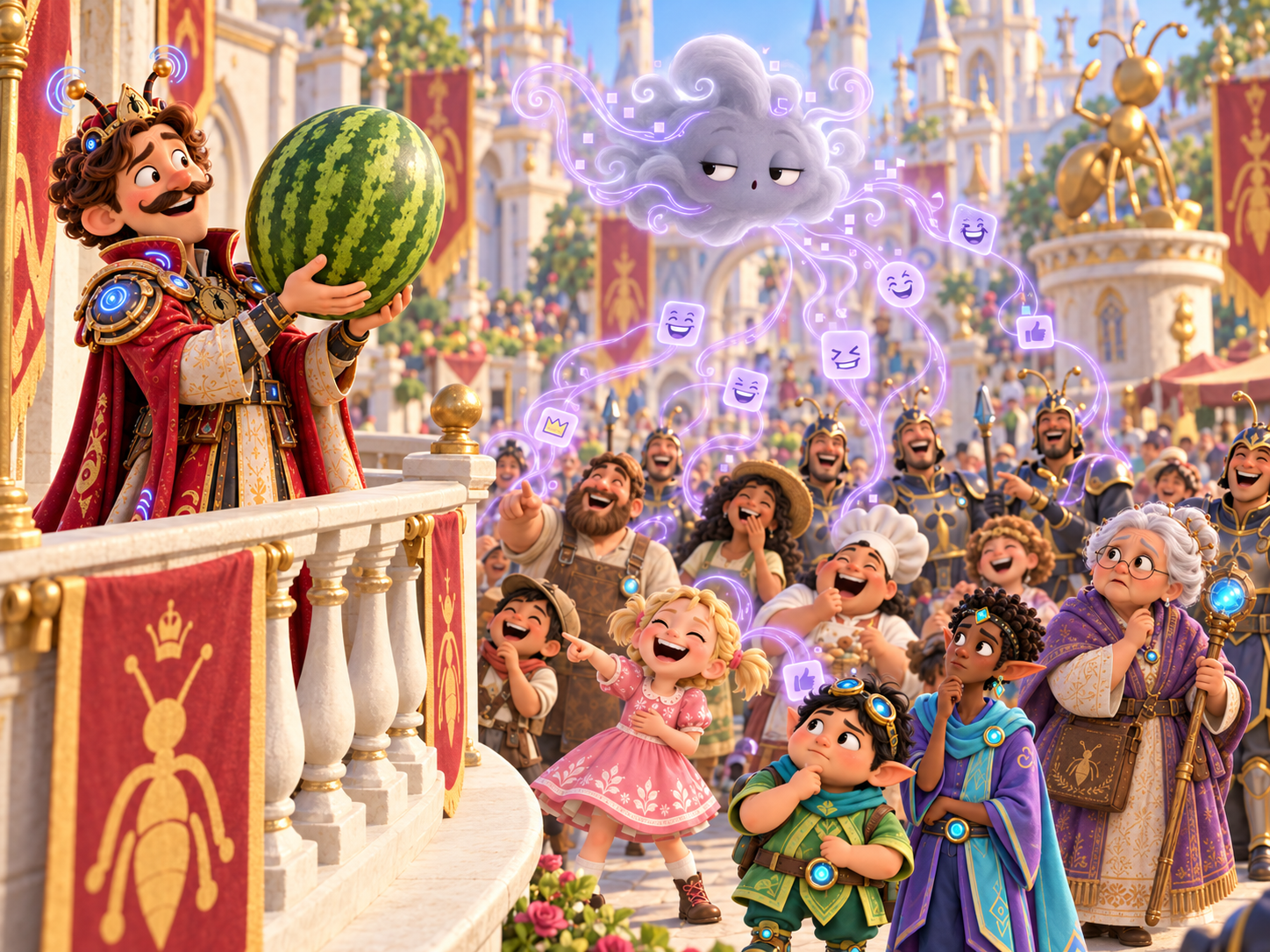
Princess Melon presented to the kingdom

Digital Eye Strain: The Hidden Cost of Hyper-Focus

This post was originally written in Italian by Paolo Gambardella. It has been translated by an AI agent and may contain inaccuracies.

These days I’ve been getting to grips with the agents from Anthropic and OpenAI, and I can genuinely see improvements in the speed and quality of my work. Where I used to need developers to build prototypes, it’s now much more straightforward to tackle that kind of challenge with Claude or Codex guiding me along.

That said, I’ve recently been noticing a strange heaviness in my eyes by the end of the working day. This weekend was rough, especially Saturday. It felt as though something was stopping my eyes from even moving properly, on top of a general dryness and fatigue.

I found out — credit to Gemini, actually — that this is a pretty common problem. Using AI tends to pull us into states of hyper-focus.

Having to think forces us to take breaks

The first thing worth noticing is that before, I had to take lots of breaks to think things through, look up tutorials, or browse various forums. Everything was slower, obviously, but that also meant natural breaks for my eyes and spending longer on the same block of text.

Now, though, working with an agent means receiving large chunks of text in quick succession. You have to skim through them fast to separate the useful parts from the hallucinated ones, and more often than not you fire off another question straight away — which brings you back to reading another big wall of text.

AI interfaces with dark mode, VS Code with light mode

I’ve moved to using VS Code to manage my agents, since I find it better for keeping an eye on token usage and for other perks like keyboard shortcuts and so on.

The thing is, AI interfaces generally use a dark background, whereas in VS Code I prefer a light one. So I’m constantly switching between the two, which puts extra strain on my eyes.

It seems that parsing text-heavy content like code also makes us blink around 60% less than normal. Medicine calls it Digital Eye Strain, and it’s an increasingly widespread issue.

I hope this post helps others identify the problem. The fix comes down to:

  1. Sync your fonts and sizes so everything is large enough to read comfortably
  2. Reduce contrast where possible, and avoid constantly ping-ponging between different windows
  3. When the AI gives you a long explanation, close your eyes and listen to it instead
  4. Use CLAUDE.md or instructions.md files rather than chatting back and forth with the agent, to cut down on the number of iterations

AI Slop vs. Creative Power: A Love-Hate Relationship

I have mixed feelings about the integration of artificial intelligence into our digital spaces. On one hand, public platforms are deteriorating. From YouTube recommendations to mobile game ads, our feeds are flooded with low-quality “AI slop”—clickbait thumbnails and content engineered purely around anger and hyperbole. The internet has become a frantic, exhausting battle for our attention.

Yet, as a creator, generative AI has completely revolutionized my workflow by automating the tedious parts of development:

  • Game Design Documents (GDD): I can instantly generate a robust structural base for 15 GDDs a month without redoing the groundwork every time.
  • Workflow Automation: Converting a massive document into actionable JIRA tasks used to take days; now, it takes an hour of high-level planning and bulk creation.

Beyond productivity, experimenting with these tools has brought back a sense of community. Sharing new AI discoveries in private chats feels exactly like the early days of the internet—reminiscent of finding an old IRC channel or a niche forum.

While the public internet grows increasingly dull due to algorithmic noise, the backend world of AI innovation has unlocked a frontier that is just as exciting as the internet itself once was.

Christmas break

I wish you and your family a merry Christmas and a happy 2026. I scheduled a couple of posts for key dates, but I will spend some day with my family in Italy so I will not post over here during two weeks.

See you next year, I hope you will find your “Zelda’s Lullaby”, your key for multiple solutions.

Things that matter

Yesterday I wrote an introduction on LinkedIn because suddenly I got lots of new contacts due to my post on The Game Awards. I was taking care of things here at home and wrote that piece spontaneously, got much more traction than other times where I have the time of think and structure better my thoughts.

I got two new leads for clients, and the post shows nothing about my knowledge and skills, that is surprising. On the other side, the temptation to go always more personal and deep is strong.

I am sure that this is valid also for game making. If we create something that connects truly with us at a personal level, chances are we can achieve better results than making things just for the sake of business. It’s a delicate art, and it’s easy to believe to weak theories I am aware of that. But I am also aware that I have maybe 20 years of career in front of me and it would be better to spend them on something that truly matters.

Quick tip for LinkedIn

I am using LinkedIn less for posting, and I am just leaving comments here and there. I met a couple of haters (it’s completely normal when you have ideas to share and you reach some reader more), and I decided to post less. Also, the social network is suffering the classic “enshittification” typical for this kind of platforms where you are the product and the angry product invests more.

Another policy I activated is this one: only answer to critics if they are also admirers. There are people who only comment to criticize, those are the worse. It’s better to ignore them or, in some cases, block them all together.

I connect through game design

I work in games not as an individual creator, but to do it with others. Game design is a way to get in touch with others, teammates and potentially players. I am not a solodev, I struggle really hard when I do projects completely alone also if at times is necessary to push my boundaries.

That’s another reason why I do teach and I join online courses, as well. As a freelancer, I don’t always have clients. There are periods in which I dedicate to personal project, such as the book I am writing, and I feel very alone professionally speaking. Having the excuse to meet other people to teach them or to study with them fixes partially that problem. I am also on Discord channels, but I feel hard to follow discussions there because of the way Discord is designed.

Vulnerable latitude

I have met plenty of professionals who don’t actually love working in games, including game designers. I’m sure this is not news to you, and I also believe that everyone has a right to work in an industry as big as gaming, even if only for a while.

Yesterday, I met one of these people, who told me, “Videogames are your beach!” (using a Brazilian, Rio de Janeiro slang phrase). And I agree; I genuinely love my profession.

I have proof of that because I often put myself in a vulnerable financial position just for the sake of engaging in game design. A client might offer me shares as part of my compensation. If I like the client or the project, I accept, even if I know I may never see any money from it. I know that my task will end, the client will close the collaboration, and I will lose all shares.

I know this, and I consciously make that choice because I love what I do.

But I deeply respect the professionals who don’t care too much—the ones who pass through the industry like tourists, earn some money, and move on. They will have the opportunity to explore different things, and their minds probably won’t be 110% focused on games all the time, unlike mine. I respect that attitude very much as well.

Working in a team is self-discovery

Today I discovered something more about myself, thanks to the creative director of the project I am working on with a company.

I tend to not insist too much on my vision. I explain it, defend it, and usually that’s it. When I see too much resistance from the other side, if I have no real power over the decision, I desist and try to meet the boss’ vision.

This is good, but it can lead to a passive-aggressive way of communicating. “I will do like you say, but I do not agree”. At first it may seem like there’s nothing wrong with that, butthe issue is that:

  • it looks like a “ok, whatever” and can damage the relationship
  • it is vague, proposes no real solution, and can damage the project
  • It is not informative enough for the team to make choices on that

Today I have learn something more about myself. Something I want to fix. And that’s why I prefer to work within a team.