Skip to content

Tag: research

My takes on The Game Awards

Today my post came later because I wanted to watch the whole show of The Game Awards, so I took my time. I loved the show, in my opinion it is getting better and better. I liked it better than last year, because I found the new teasers less like a Tool video and with more hope.

The first take is that it is a great time for independent developers. The creative director of Sandfall told that he is thankful for youtubers for putting out tutorials because he had no idea on how to make a game. And the game he made with the team was the most appreciated in the history of TGA, so yeah… I guess it’s easier to make games nowadays. The important part is the creativity, now more than ever. And I believe that now it’s a moment where we can, and should, risk a little bit more in that sense. Avoid repeating formulas, find new recipes. Now the tech permit beat everybody else with less than $10M.

Another trend I am noticing is that horror and monsters is casualizing. Monsters are getting cool, I saw zombies dressed like rappers and cool things like that. Sci-fi, instead, is animalizing always more, with bears and dogs in tech armor. These are two new trends that have been started years ago (in my opinion, from Twilight and Guardians of the Galaxy, respectively) but that now are exploding.

During my view of the show there were tears in my eye. First reason is because the show is fantastic if you love videogames. There is music and stunning visuals, incredible people coming on the show. There is everything I love. But I cried also for a little bit of nostalgia/sadness: it’s because it’s very hard to participate into something like the games presented there. Most of the work in games is on very poor experiences, so I feel that maybe I am losing my time. Maybe I do need to really care about my own world, things I want to put out there, and leave the chase of the next client. I have to think about that.

Let’s talk about Horses

The new game from Santa Ragione, Horses, has been banned from the main stores: Steam and Epic, at the moment I write this post. Humble just enabled the game again in their list, they delisted for a while.

I watched a gameplay and Horses is a game about cruelty. The experience is about helping a dark organization in torturing and abuse people. It is pornographic, as well. That’s why it was censored from the two main PC stores out there.

There is a lot of discussion online regarding censorship, capitalism, politics, and it’s not just something coming from young players. It comes from developers as well, and that shows the ingenuity (to say the least) of certain professionals. In fact, Steam warned the company Santa Ragione 2 years ago about the impossibility of publishing this game. They decided to go on and Steam maintained its promise. It is what it is.

I believe Santa Ragione was coherent in their choice to continue develop the game, but I also believe that putting your whole business at risk for a principle is not a good choice. I cannot manage to feel admiration for them, also if I empathize because I know they want to tell a unique story. And I saw that they did manage to deliver something unique. Lots of game design issues (in my humble opinion) but a clearly identifiable game with a unique voice. Let’s hope they manage to continue with their business, as they deserve. But they made a mistake.

Steam Sale Games in Italy

The fifth edition of the Steam Sale Games in Italy is underway, the initiative dedicated to Made in Italy video games powered by IIDEA!


From today until Tuesday, December 9th at 7:00 PM, discover over 400 Italian titles, including video games, DLC, and additional content: a vast selection that celebrates the creativity of our studios and offers numerous special offers on productions of all genres.

Interesting interview to mr. Owen Mahoney

Mr. Owen Mahoney is one of the few outspoken gaming CEOs out there that speaks actual game development language. I listened to this interview and one thing has made me think a lot, also because it’s not well explained.

Mr. Mahoney talks about the importance of looking at the future intentions of a team or company to understand its shape. He makes the specific example of the founder of Embark, who wanted to make something new, something different. But that’s always the case whenever there is a sales opportunity. We do want to show what we did, our experience, but we also want to say, “Hey, we are building the future here; do not miss the opportunity to go with us towards it.”

How can we really understand when we are in front of a good company? Now I want to switch my discourse from the perspective of an employee or a consultant. How to understand that the client or employer we have in front of us is the right bet for our next 2-5 years? That’s a matter of gut feeling, but is there a way to make a sort of due diligence? That’s what I would like to ask Mr. Mahoney.

I beat “Detroit: Become Human”

Yesterday I completed “Detroit: Become Human” for the first time. I think I reached the worst possible ending, but still I loved any minute of the experience. I believe that Quantic Foundry is a fantastic company and should expand its business vertically, reaching more devices with its games and not changing completely its business.

In fact, they are very strong in high quality single player hardcore games, and in recent news I read they are making a MOBA. Apart from the fact that the MOBA genre is not well accepted in the western audience, I believe that these business line extensions are too dangerous for a business. They should insist in going stronger into single player hardcore AAA games, in my opinion.

Detroit: Become Human is a game where your choices matter, the story is the most important part of their formula. And in its story equation we have a unique (and weird) things in its characters. The world is a normal world (accepting the characters of course) and the plot is a good but predictable one in terms of umbrella plot. Then there are lots of interesting twists and expansion that make the experience memorable.

The fantasy of the game is that you are the mind of a robot, but since you have a human mind (right???) it’s interesting that somehow you give a conscience to the artifact. On top of this fantasy, which is cool, the actions are: answer choices, attacks, jumps, defense, movement. The quick time events fit perfectly in the concept of robots and algorithms.

The economy is based on completing story sequences of the three protagonists of the story and earning new story paths and points you can invest into unlocking special content like artworks, models, music and so on.

The world is our world but in the future, the technology is sci-fi and the artstyle is realistic. The story is fantastic, is about cyborgs adquiring concience. Right from the menu you can feel the story with one of them interacting with while you select the game mode and prompting you surveys with existential questions.

I see few games like this and I personally love them. I hope Quantic Foundry will surprise us with something new like this in the future.

True stories

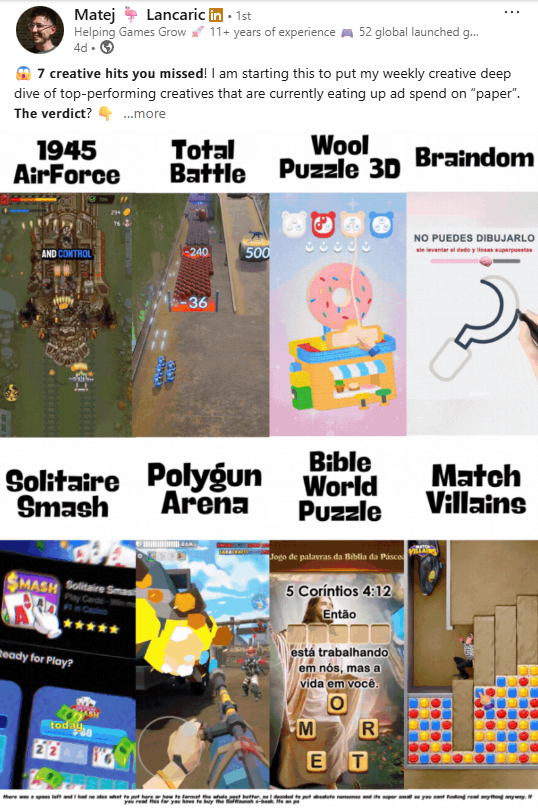
Performance marketing for mobile games has become lately a synonym for scam. There is not other world to describe the act of copying others’ creatives and produce massive quantity of low quality, repetitive content to try to catch the attention of people.

Marketing expert Matej Lancaric is happy to show off every week the disaster that mobile marketing as become

The good news is that marketing cannot be like that.

Marketing is the generous act of showing up with a true story that helps people get to where they’d like to go.

Seth Godin

Game design can seriously help to find the true story to tell to the people. The issue stands in the business model of free-to-play, of course. In a model where 5% (at best) of people pays something, and that something is variable and potentially very high, you need a massive volume of installs.

But maybe mobile gaming could be different and not just free-to-play. The point is to convince founders and CEOs to believe in this.

Roblox: unprofitably unsafe

The CEO of Roblox gave an interview to one of the most popular NYTimes podcasts and the industry didn’t reacted well. I found it insightful and I tend not to judge people, especially salesmen, when they are selling something.

The issue with Roblox stands in its business model. Everybody knows that when a service is for free, the product is you. And in Roblox, the product are the kids. If they would really fix the issue with kids safety, they should start from there. They should put on a subscription model, where 100% of kids (or better, their parents) will pay a fixed amount just to play. In that way, things would change a lot.

And maybe, who knows, Roblox would also become a profitable business. Because since day 1, it has never been profitable. Roblox relies on investors who believe that, at some point, all those users will eventually generate profits. But for now, it’s a leaking bucket.

A clockmaker’s craft

Many confuse casual games with simple games. Casual games permit the satisfaction of instinctual needs in small (2–5 minute) play sessions. However, many hardcore players of these casual games can play them for hours. In fact, they are the players who actually maintain the business.

I’ve worked on a bunch of them, and I feel like a clockmaker. They may feel simple, but they are deep: you move one gear and you must check all the others connected to it. You need patience to achieve the sweet spot (the perfect balance).

To properly study your competitors, you need to analyze them in immense detail. You may even need to record a session and review it frame-by-frame to fully understand the game’s circuit and how it works.

Be honest, be indie

I believe the single most important quality for indie developers is honesty. This is their secret weapon. It is nearly impossible for a Top 10 company to achieve full honesty because of their size and stakeholder structure. Honesty, however, allows you to consistently put out your authentic voice.

Recently, while consuming content in the indie space (podcasts and video), I’ve noticed a significant increase in marketing awareness. This often translates into the typical marketing discourse: “how to make trending things faster and avoid struggling too much.”

But that, in my humble opinion, misses the entire point of being an indie. Independence requires you to embrace the struggle and invest genuine effort—not just hours, but intense thought and creative energy. If you end up simply chasing trends, you risk falling into the trap of industrialization, product managerization, and creating derivative work.

I am not arguing against trend awareness or chasing money; of course, we work for money. But I am asserting that if you want to truly succeed in the indie space, you must prioritize honest self-expression. Put your authentic voice out there for real—even if your true call is to make a niche friends-to-lovers sim or a niche horror game.