Skip to content

Tag: ideas

How to build the next Supercell

I have a secret to build the next Supercell. Really, I have it! Have I ever built a company like Supercell? Of course not, but I mean: we live in the age of suggestions, advices, best practices, influence, likes, follows… So why shouldn’t I write some wise article about how to do things, right?

As any secret, this one is very easy to understand too: stop treating people like children. Easy, right? Let’s see three common ways in which you are treating your people like babies, including before they join your company.

Technical tests and assessments

In some case those are necessary, especially for junior talent or for talent that is switching radically the sector. For instance, passing from free-to-play to AAA. Anyway, if you are hiring a person in his forties please: give me a break!

Our curriculum, carreer and our ex colleagues speak from themselves. We have nothing to demonstrate anymore and we are completely capable of doing the job at a technical level. Do I really need to show you how I structure an economy in a spreadsheet? Do i really need to demonstrate my presentation skills? Do you want me to create a flow and a wireframe? Or worst, a single GDD bible? Please, I do this since probably before you joined that company. Again: give me a break!

Do this instead:

  • Interview for cultural fit
  • Review in detail past experiences
  • Ask for referrals of ex colleagues and employers

When I see a test proposal I just think: “ok, you are not capable of evaluating my kind of profile. Next.”

Show me the next things to do with no context

I remember when I was a little dude asking to my father: “Why should I do that?”.

“Because I say so”, was his answer.

35 years later, history repeats. And I am very tired of that. You give a task and a deadline, with no perspective. I will do that for you the best I can. I swear. But I will never understand anything like this. Why is this important for the project? And how will we demonstrate that in fact it was? When we shoud have some learning? What about the past iteration? How did it go?

Maybe you are too busy to explain well the vision behind any choice. That means that you are not doing the job you should, to me. Because if you are my manager, you should be focused on manage my team and myself. Not the game. Not the code. Not the art.

Put your hands on my work

This is tipically something that you do to game designers. And tipically something that occurs in small-mid sized companies. We spent weeks designing something, researching, getting the problem right, sync with all the people involved. And then you decide to change everything because you have your own idea in mind. You are the founder or the leader of the project and you have the last word.

I could be wrong and you right, of course. Still, you are stealing my opportunity to learn more about the audience and the kind of product we are doing together. I just feel that my solution will never be tested on the field. Your solution maybe can be successful. And probably you will be happy and still will recognize my work. But you stole my opportunity of seeing a design I made going out there.

Stop play with my toys, those are mine!
Push your boundaries

I see a lot of professionals getting a name in the industry working on successful projects. Then they decide to go indie. And they do the exactly same thing they were doing at the mother company, but with less resources. After a while, they return back to some corp. Classic.

One of the things I always suggest to the people I mentor is this: do not remake things you already did before. I am not sure it is the right way of thinking, honestly. It is just mine.

To me, remaking stuff is always a mistake. Maybe the thing you want to remake is an old experiment that failed for some reason. Learn from it and do something else, don’t try to take shortcuts or you will repeat other errors you did for that same experiments that were eclypsed by the major errors.

If a project was successful, instead, it probably was for a bunch of reasons. It wasn’t just your work and effort, but also the timing and the context of that time. If you decide to invest your time and effort for a new project, try always to push your boundaries instead. It is usually a better choice.

Being loyal

Year ago I was running a very promising free-to-play project in a local incubator. It was very promising, it was the future. My lead artist said: you are inventing the devil. Of course, it was just in my head. The project had no chance to go forward, because I wasn’t being loyal to my will of creating a new company around it.

Being loyal with ourselves is not just to maintain the promises we make. It’s not to respect the compromise. Is also to make well our numbers. If you want to build anything and we consider ourselves game designers it is necessary to stop and think well to all costs and scopes of the things we want to build. And then add a 20% of error to all of that. Otherwise we will most probably fail.

My project failed at many levels, but the main one is that you cannot start a free-to-play ambitious project without great professionals and lot of money behind. The art of giving games for free is very expensive, needs a good monetization strategy and the acquisition of new Players requires huge efforts.

I am glad that I didn’t invented any devil, and I am glad to be here happy telling you those stories.

Your indie can become the Metaverse

I am actively looking for a new job, while preparing my next step which will be a course on game writing and also a deep study of the Unreal Engine. I am arrived at a point where I consider myself pretty good at free to play, but I am constantly playing indie and AAA games. Why not try do some small indie experiment?

So that I fell in this paradox lately. I see a lot of huge investments and acquisitions towards companies and projects which are basically clones of existing success cases. I see also a bunch of independent people with really good ideas struggling to pay the bills at the end of the month. What the heck is going on? Why those people cannot manage to get investments?

So that the next guess is that maybe they don’t even try to sell something. Every game studio needs something who knows how to sell the idea behind. And suddendly some very old concept, like 3d lowpoly characters in a 3d World becomes the Metaverse. And some people buys that idea.

Show your impact

When you get an interview you can demonstrate your skills in three ways:

  1. Taking a test
  2. Showing a portfolio
  3. Demonstrate the impact of your work

Often, you are required to do more than one thing at the same time. In fact, many companies ask you to take a test. Before, they review your portfolio and later they ask you about the impactful initiatives you lead in your previous jobs.

Impact is, by far, the most interesting thing. Still it’s not really easy to understand the specific impact of your designs. Many times (too many times) your designs are strongly influenced by the context. It may be some specific software constraint or also the green light process at which every initiative is submitted.

Still it is very important to learn how to estimate the right impact of your work. In data driven contexts, like f2p for example, you should also accompain your reasonings with concrete KPIs increment (in % to not break any secrecy).

Lore and freedom

I am playing Horizon Forbidden West and everytime I meet a new character, the game invites me to hear minutes of dialogues. The story is intriguing and well written, but I cannot just walk away such as in Skyrim for instance, leaving the NPC speaking alone. Different design pillars, different approach to narrative.

Still, a great game. This forceful dialog creates somehow a connection with the lore of the game. So that a new intellectual property is reinforced.

I am also playing the classic Gothic. A game that says you NOTHING about what to do. A game from the past. You have to really strive to understand what to do, where to go and so on. I killed a man, today. I found him hidden in a mountain. I spoke with him and then I killed him. Why? The game gave me 40XP. There will be no consequences to my character.

And that fits into the game’s narrative of brutal freedom and high insecurity. So that I was the big fish eating the small fish, today. It fits. Gothic still has fans all over the World.

Humbleness and feedback

When someone asks me for a feedback for their game, I try to never give my opinion. In fact, I believe that working in games makes us liable of huge biases that come from experiences which are subjective.

I try to make them questions, instead. Try to understand really what’s behind their choices. Then I tell them what I would ask to playtesters to challenge their assumptions.

I believe that is the best way of giving feedback. From the other hand, the tendency is to say what one would do instead. And the worst is that then someone may follow blindly your advice. Applying that advice in their understanding, not what you said them in first place.

That is why it’s important be humble, somehow. Being humble is being completely honest. In order to be that, the right start is always a certain amount of questions.

Smiling Suns

I was talking on the phone with my mom, and she said: “your brother sent me yesterday photos from the beach. He was happy, he also put a Sun that smiles in the message.”

The “Sun that smiles” is her interpretation of the smiling emoji. I grew up typing ASCII symbols to create smileys. Then with MSN, those symbols were automatically translated to a smiley. In our interpretation, a smiley is a face, not a Sun. My mother, instead, had nothing to do with all of that. First time she saw a smiley was in WhatsApp. Her interpretation is a Sun, not a face. And she is right, is a yellow round circle with eyes and mouth. It is not a face, definitely! It is more a Sun.

Her meaning is more poetic than mine, too. A Sun that smiles, a Sun that cries. That is not the face that my brother wanted to show. There was a third entity in their conversation. It was an happy day at the beach, and the Sun smiles. I love it!

Sometimes the same happens to our games. The shapes we present to the Players have a meaning for us, developers. And then the game is out, everyone in the World will play it. Some of them will see a face smiling. Some other will see a Sun, instead. And that’s very powerful.

A VIP idea from Delta Airlines

Design games for the free-to-play mobile business is whale hunting. Unless you are a genious, like Bit Life developers, you will probably do the math. And doing the math, you will notice that you need high spenders to sustain your business.

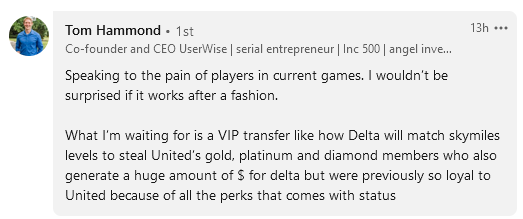
Yesterday I saw this comment on a LinkedIn post:

Shoutout to Tom Hammond for this great idea.

I checked out the original Delta program and now I cannot understand why nobody is doing that.

Scenario

Ana, a Slotomania player, is a Black Diamond level VIP client. She gets an ad from your Mobile Casino Game that promises her VIP level can be matched with a challenge.

  • Installs the game, logs in
  • A pop-up asks her if she already has VIP status in other games, she answers that she does and details that she is a Black Diamond in Slotomania
  • Within 12 hours, a person from Customer Support contacts Ana, asking for more information
  • Ana’s VIP level is matched with the game’s VIP level.

Why?

If someone has a high VIP level in another game, it is most likely a whale. It could be a whales acquisition strategy.

Try sell this idea

A lot of skilled entrepreneurs (skilled entrepreneur = very talented seller) are convincing investors with promises of huge returns on investments coming from concepts that, on the contrary, are demonstrating to be not so appealing to the people. I am talking about metaverse, web3, play-to-earn, gamified economies and so on.

The dream of creating the perfect mousetrap where people come from all over the World to watch ads and spend many hours per day will remain a dream. It comes, in my opinion, from a huge misunderstanding of how games as a service work.

The reality is that is becoming harder and harder to create the right experience for the people. Usually it comes with a great gameplay, usually is multiplatform and usually has no barrier to start. But, I mean, there are a lot of concepts to try out that may actually work. And nothing so fancy, something very simple.

Think in Among Us and its big success during the pandemic. Think in Bit Life, a game made just with text that breaks all the best practices of f2p.

Games like those cannot be proposed to investors, because one has to be honest. One should admit that we know very little things about the future of our industry. The things we know for sure are:

  • We need to create more value for the Players
  • We need to think in a vast geographies, not just rich countries
  • We need more talent to join the industry

Is it possible to really sell this idea to an investor? Is it really possible in an environment where too often we hear words like “growth” before of even write the first line of code?