Skip to content

Tag: AI

In the blacksmith’s house, a wooden skewer

The recent stock market fluctuations following the arrival of AI tech that promises to generate interactive worlds from simple prompts speak volumes about the current lack of video game literacy.

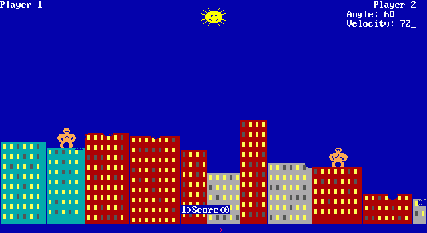
Almost every veteran I know—myself included—started by modding, not just “creating.” My journey began with Q-Basic to tweak Gorillas, then modifying voices in Worms, creating custom avatars for Baldur’s Gate, and hacking Diablo hash codes.

https://en.wikipedia.org/wiki/Gorillas_(video_game)

The best designers were often protagonists of the modding scene, diving into forums to figure out how to add value to the games they loved.

We’ve seen this cycle before. Tech giants often launch “revolutionary” gaming projects to fuel corporate career leaps, only to abandon them when the next trend arrives. But the real issue is the demand for shortcuts. Some entrepreneurs will try to use Genie3 to chase quick profits with flashy trailers, and some might even succeed in the short term.

Long-term success belongs to those who actually expand the horizons of gaming.

Reaching new audiences and solving the distribution puzzle requires more than a “genie.” It requires deep knowledge. While technocrats push “prompting and scrolling,” the smartest players are busy mastering history, philosophy, and art.

My advice? If you want to break into the market, stop looking for shortcuts. Work hard to engage your audience and start by modding what already exists. Read history books, and myths. Rack your brains, expose your work, and take risks.

You are far more likely to find success through craftsmanship than by playing a “word slot machine” and hoping for a believable game.

AI is not just a tool

I’m not convinced by this “AI is just a tool.” We’re wired for stories and narratives, in the sense that our perception is very attentive to them and our memory contains narrative sequences. A tool capable of creating a narrative structure ceases to be a simple tool for me.

It’s a bit like saying “movies are just a tool,” or “video games are just a tool.” Well, it’s certainly possible to use movies and video games as tools. How many times in school were we shown a movie to explain a story? Some teachers use role-playing games or even computer games to explain concepts.

However, these artifacts aren’t just tools. And AI isn’t one for me either. It can heavily influence the way we implement an idea, given that it’s capable of arguing (often bullshit) very well and could catch us at a stressful moment when it’s easy to give in to the temptation to trust. And this inevitably leads to missed opportunities.

Of course, you can cut off your finger with a knife. With Photoshop, you can gather a series of images and make a collage. But that’s a direct use during which you’re aware of the error, either before or just after.

AI isn’t just a tool; it can only be used as a tool, that’s true. But it’s designed, like many things these days, to capture our attention (so we pay the monthly subscription) in exchange for the feeling of being more productive.

And that’s not the case.

Ubisoft and the “Efficiency Trap”: Why Algorithmic Logic Can’t Save a Lost Vision

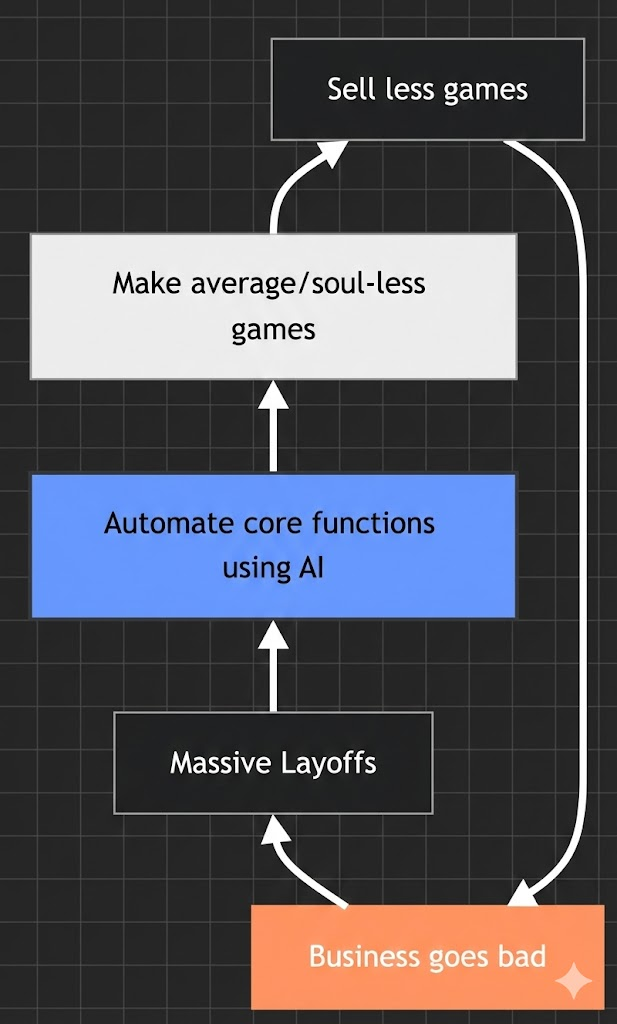
The recent news regarding Ubisoft isn’t just another headline about industry layoffs; it’s a “leading indicator” of a systemic crash. When the numbers don’t add up, the corporate playbook is predictably uninspired: cut the talent, automate the core, and pray the spreadsheet balances itself out.

But creativity isn’t an assembly line, Ubisoft might be the “canary in the coal mine” for an industry chasing its own tail. This isn’t just a trend; it’s a form of “drowning.” When inefficiency (ROI) drops too low, leadership grabs whatever is in reach—AI, NFT initiatives, or massive restructuring—often without even knowing what questions to ask their experts. They are borrowing against a future they don’t understand, hoping that money alone can catch the wind.

The “Glass Ceiling” of the French Elite

A company is only as brave as its leadership, and here we find a significant bottleneck. Ubisoft’s executive team is roughly 90% French, educated at the same elite business schools (ESSEC, ISG), with tenures spanning 30 years.

While these credentials are impressive on paper, they’ve created a cultural monoculture. This “upper-middle-class business elite” is now tasked with innovating for a global, diverse audience they are increasingly disconnected from. When leadership hasn’t seen the inside of another studio in three decades, they stop leading and start rehashing.

The AI Gamble: Partner or “Slop” Generator?

The debate around AI in development is often polarized. Someone argues that AAA gaming is “dead” without AI to reduce the staggering $200m+ budgets. I don’t disagree that budgets are exploding, but I disagree that AI is the silver bullet for quality.

AI isn’t the root of the problem, but it’s a risky “solution”. Relying on a technology that hasn’t yet delivered on its creative promises to save your strategy is a bet, not a plan. If you use AI to generate “slop,” you might save on costs, but you’ll lose the player.

From Rational Design to Brand Decay

Ubisoft once had a superpower: Rational Game Design. It was a method that allowed them to optimize the creation of epic adventures while maintaining a clear vision. But as they chased whales, “Games as a Service,” and unsustainable growth, they lost the creative DNA that made them special.

A software (and AI is just that) cannot solve a brand crisis. AI can’t fix the fact that Ubisoft has distanced itself from player fantasies and instinct—things that aren’t taught in prestigious business schools.

The Opportunity in the Chaos

The failure of long-term vision in these managers is an opening. The collapse of the old guard creates space for those who actually understand imagination and positioning.

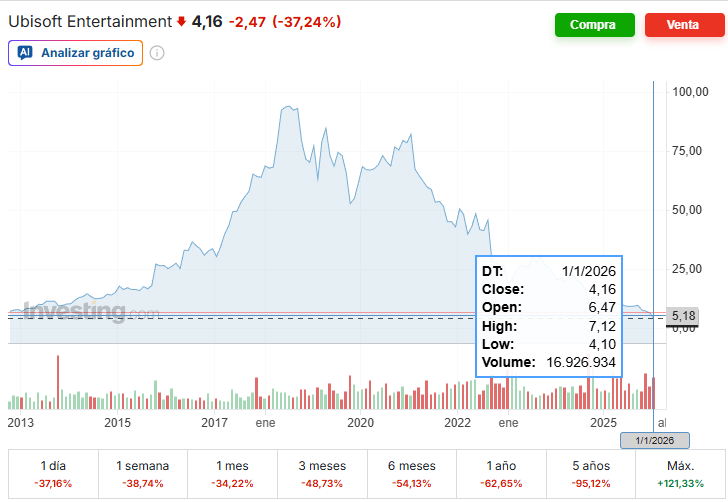
Ubisoft’s stock may be back to 1998 levels, but the talent is still out there. The question is: will they be allowed to lead, or will they be replaced by an algorithm until there’s nothing left to automate?

The AI Counter Wave

Our relationship with AI is still very much in development, like our relationship with other technologies, it will be shaped by time and usage. Take our smart phones, we seemingly can’t live without it, but school and parents seem to try and keep our kids away from them – at least for a while. AI is a different beast all together, but pros and cons are discussed daily everywhere. It seems that the technology is fundamental and it already affects many peoples lives.

It seems there’s a double standard that many are not aware of they possess. For instance, I noticed how recruiters and managers seem to praise AI in their work. Summarizing batches of resumes, auto filtering great from good candidates and offloading batches of work to optimize their workflow. AI is great! But when candidates use AI to write the perfect cover letter, create position based resumes and extraordinary motivations, recruiters and managers seem to hate and automatically deny the application. This is a double standard where the technology seems to be both great and very bad at the same time and in many cases this double standard isn’t felt by the person who possesses it.

But I think this double standard provides a clue to what the counter wave of AI will be. I believe all things come in pairs of opposites. Light and darkness exist only in relation to each other, like noise and silence, like chaos and order. AI will create a zest for CounterAI, the deeply personal, the things that exist because of effort and human suffering. The recruiter and managers that make their work impersonal and soulless by using AI to sift through their candidates demand heartfelt personal motivational letters and carefully crafted resumes with a clear human touch. AI will expose the need for humans to grow through hardship, suffering, commitment and purpose. Like microwave meals make you hungry for your mother’s favorite dish, so to will AI make you hungry for the purpose full and human.

Surrender

Whenever you’re struggling with a creative problem, there’s a specific moment when you feel you desperately need help. Today, it’s very easy to find software that supposedly assists with just that. You prompt your need in a chat, and the software mimics a human expert and gives you advice.

Thou shalt not make a machine to counterfeit a human mind.

Frank Herbert, Dune

In that very moment, however, you have already lost the battle for creativity. You will have surrendered your uniqueness to a probabilistic algorithm that will spit out something random, and more importantly, something common and average. In this Age of Average we’re all living in, you’ll probably feel like you’ve solved your problems.

But you’ve lost because you gave up.

A good use case for Claude.ai

I just paid for the premium subscription to Claude AI. Writing certain design documents took me 3-4 days. With Claude, 1-2.

Like every AI, it freaks out a lot. But this help me get started on tasks. I tell it to write me certain spec, it writes me something full of errors and that helps me think. It’s like teaching to a dumb student.

Then, when I have my document with wireframes, I pass it to it and first I tell it to act as a programmer. Again, it hallucinates but it helps me understand the “edge cases” the empty cases that I hadn’t thought of.

Finally, after a second iteration on the document, I send it again and ask to act as a quality assurance professional, to generate a test plan for me. This helps me think carefully about closing all the loose ends.

This is valuable. Indeed.

I like to write and design all by myself

I am noticing a trend against LLM platforms, coming from people that enjoy writing, like me. On the other side, enthusiasts explain how the performance improved thanks to these services.

It seems to me a case of beauty and intuition versus rationality and data. And this is something deeper than one can think at a first glance. Over the last decades the discourse around productivity and success got a huge boost. AI fits in this because it helps people build a storytelling that may feel credible with a quick read. And if you are not a creative person, this is a wonder.

There are consequences, on multiple levels. Internet today is a different place than 5 years ago, and I believe this is not right or wrong. It is what it is. I watch or listen anything and first thought is “let me check this has not been auto-generated”. Sometimes I fall in the trap, too.

Will AI boost “productivity”? Well, does it really matter at this point?

Can I be more productive with AI?

I own my way of doing things. With time, I got to believe in the power of patience for creative work. Ideas have to rest, somehow. Decisions must have taken at their own pace. Often, you take many micro-decisions in a couple of hours. Other times you need a week, or two, to get that “eureka” moment.

If you leave this part to anyone, or anything, you are missing the chance of connect things yourself. If you skip the writing of a huge, complete GDD with all your notes, you risk to get lost along the way.

You need to be a strategic thinker, and for that you need to have very clear the system.

“so, it’s a no?”

It’s a “it depends”. I started using Claude AI only on my personal project, the indie action sandbox Pawtners Case. I am developing it outsourcing Unreal Engine development, Art and first level design. And I am doing this in my way, I have no boss, no publisher, nobody supporting economically the project apart from me.

A couple of months ago, I wrote a project proposal that I still have to share with the team. Big docs are not meant to be shared with programmers and “hey, have a read”. Nobody will, it doesn’t matter if you’re a great entertainer or a poor writer. Still, they are very important for ourselves!

(with “big” I mean “more than 5 pages”)

Now that I got a couple of features and prototypes ready, I feel the need to share it. That is because now I see that they are involved. They need to know more. Before they were just following the lead of their client. Now they are part of this, for real.

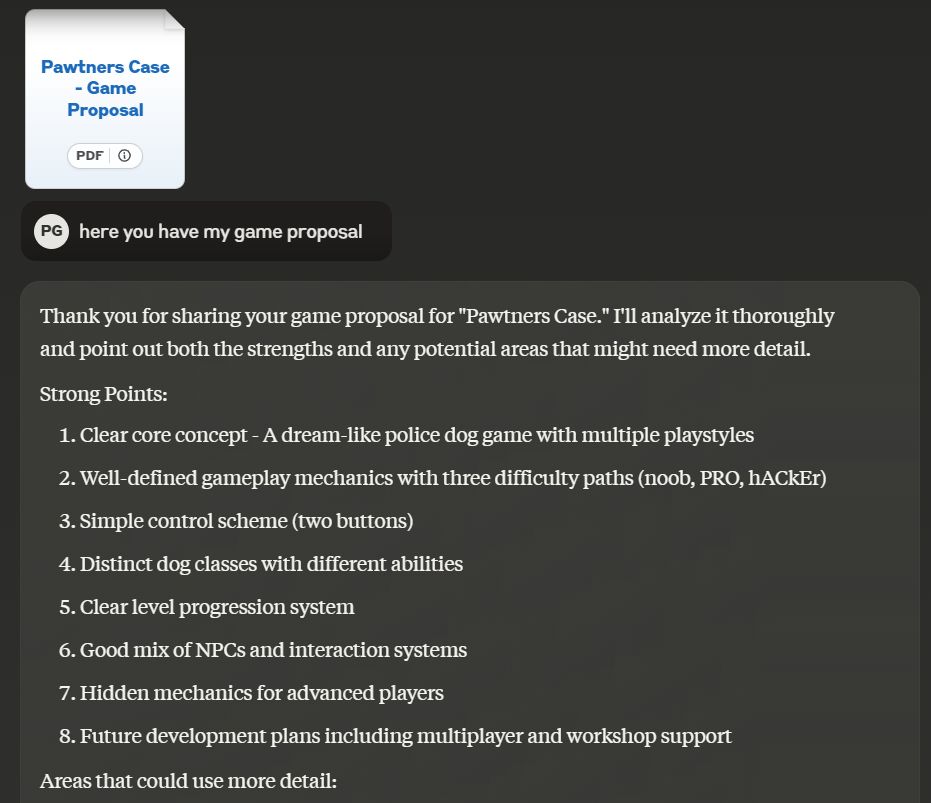
So I asked Claude AI to review my document and find me possible areas that could need more detail. And I have to say that I am pretty happy with the result. The software is aware to be a software and it provided me a concise list of things. Many of them are not meant to be in a game proposal to me, so I discarded them. There are two of twenty points, though, that made me thing of small edits here and there.

I could have hired a freelancer to make the same work, but it’s hard to find the right person. I can clearly see the value here. Maybe those 2 points would have been reasons of discussions with the team. And that is valuable too.

I did the job first, and this software helped me with its editing. I am in control of the thing, I am not spinning a wheel and see what it spits out. I am the person in charge all the time. I see value in that.

They earned my silence

Maybe it’s because I started on a new project. Maybe it’s because a company that canceled the position when I was the last candidate republished the position again. Maybe it’s because I am tired of influencers. Or maybe it’s because they use content to train shitty algorithms to produce empty content faster.

Maybe it’s because I don’t want to constantly check out likes and notifications there. Or maybe it’s just because I got bored.

I decided to commit to (at least) a period of silence on LinkedIn. I will continue to write here and on my Substack, though.

Creativity and patience

For me, there is a direct relationship between creativity and patience. Ideas need to rest before being properly evaluated. Teams need to have the space to make their own journey and thoughts to make a game happen.

Most games never get published. This is due to many factors. But, a good pre-production phase helps mitigate the risk of not seeing the light.

I’ve read many articles explaining how AI tools help speed up the pre-production stage of a game. Some say that companies can also create content faster. I am very skeptical on this point.

In the pre-production phase, a team measures its potential toward a concrete challenge. The AI tools promise to give us concept art of a pretty high standard in minutes. We can also create stories and document templates. We can get quick code snippets.

But then we’ll find ourselves having to edit here and there. This editing process is different from the process that created successful games.

Since when did we decide that faster is better?

A good dish takes time to cook. A good vertical slice or demo, too. People need time to make meaningful connections, the sparks that ignite the engines. If we entrust this process to machines, then we end up working for the machine.

I enter my prompt and await the results. I review and analyze them. I iterate with these results by introducing more prompts. I review everything and make my changes. Instead of me acting and creating, it’s like I’m making corrections to an assistant. And it’s one of the worst assistants because it doesn’t actually think!

Fail faster is good advice, but it doesn’t mean we have to rush things. If something not created by us fails, it will be more difficult to grow. We will have no memory or connections that will make us understand which steps need to improve.

When did we decide that jumbled datasets are better than looking for references?

People need the process of searching for references to achieve creative goals. While the result of a prompt may appear to have excellent quality, it is still a mindless mixing of elements.

Our urge to have “the thing” now causes us to end up feeding a machine that will create something average. It makes us disperse in a mass.

The process that created the hit games that are on everyone’s lips works differently. There are two types of goals, project goals and personal goals. Every maker must have time to reflect. This time is invested in looking for references and organizing them. The same goes for an artist, a writer and a programmer. If this process is skipped in the name of speed, we will be acting like monkeys. Can we make something good? Just by chance.

Is it possible to use these tools in a healthy way?

The quick answer is no because datasets are a sophisticated intellectual property assault.

For the extended answer, imagine that there is no ethical/legal problem. Assume that the datasets are completely legitimate.

These tools can be used to unlock meaningful internal conversations for the team.

If I, a game designer, have to communicate some concepts to artists, these tools can facilitate my work. If a producer is briefing game writers, these tools can help estimate the number of words to use.

AI tools can help us learn to communicate with people belonging to other departments.

There is a direct correlation between the time a team works together and their odds of success. We should foster this necessary time with patience.

  • Instead of thinking about speeding up critical passages, let’s improve cross-department communication.
  • Instead of trying to get to the end faster, let’s improve our understanding of how everything contributes to it.