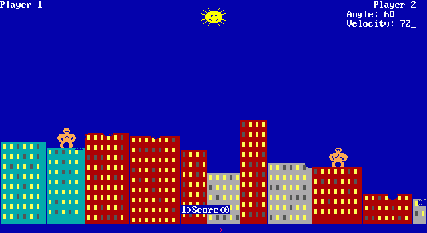
Almost every veteran I know—myself included—started by modding, not just “creating.” My journey began with Q-Basic to tweak Gorillas, then modifying voices in Worms, creating custom avatars for Baldur’s Gate, and hacking Diablo hash codes.
The best designers were often protagonists of the modding scene, diving into forums to figure out how to add value to the games they loved.
We’ve seen this cycle before. Tech giants often launch “revolutionary” gaming projects to fuel corporate career leaps, only to abandon them when the next trend arrives. But the real issue is the demand for shortcuts. Some entrepreneurs will try to use Genie3 to chase quick profits with flashy trailers, and some might even succeed in the short term.
Long-term success belongs to those who actually expand the horizons of gaming.
Reaching new audiences and solving the distribution puzzle requires more than a “genie.” It requires deep knowledge. While technocrats push “prompting and scrolling,” the smartest players are busy mastering history, philosophy, and art.
My advice? If you want to break into the market, stop looking for shortcuts. Work hard to engage your audience and start by modding what already exists. Read history books, and myths. Rack your brains, expose your work, and take risks.
You are far more likely to find success through craftsmanship than by playing a “word slot machine” and hoping for a believable game.
I was watching the last Deconstructor of Fun podcast, shooter monthly, on Highguard.
I downloaded the game days ago, completed the tutorial and played three matches. I am not really into hero shooters, but I have to admit that I also had the sensation, as these expert say, that the game was not properly play tested. Which is a common issue in the industry that leads to many games to fail miserably. You need to engage with your future clients, especially with service games. You cannot simply launch early access anymore, early access in current market is perceived as a full launch, especially if you game has been announced in “pompa magna” at The Game Awards by Jeff Keighley in person.
Regarding the market segmentation
The experts seem to agree (but not fully) on the fact that there are just two kind of profitable shooter genres: tactical and battle royale. I am not sure about that, I prefer this Owen Mahoney’s segmentation:
Owen Mahoney’s view of the industry
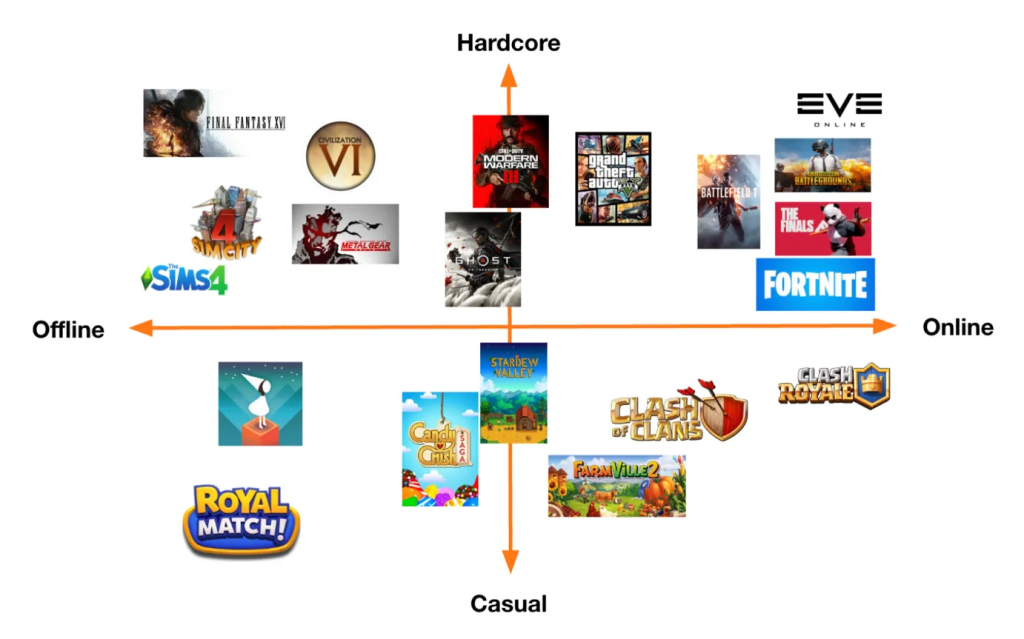
I believe that shooter as a genre fits in at least 2 quadrants: online and offline hardcore. Nicholas Lovell also has his view on the industry in general.
Nicholas Lovell’s view on the industry
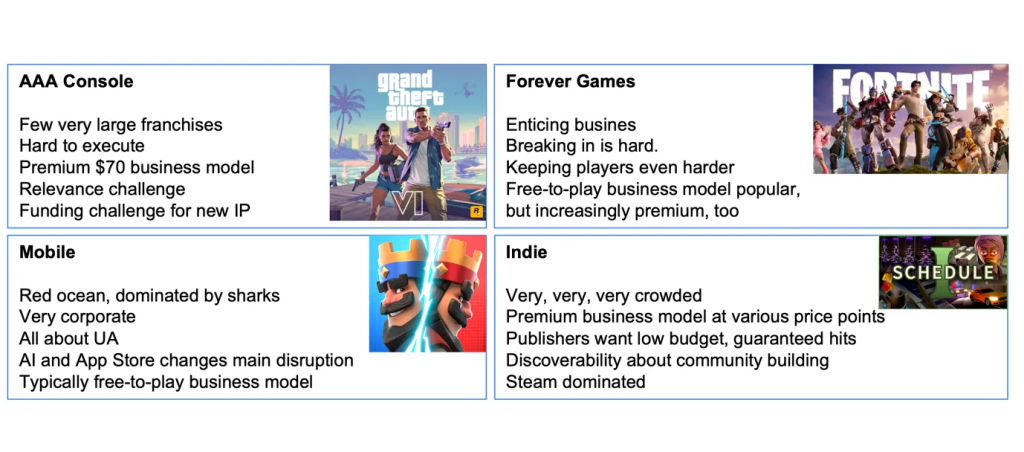
And we know there are AAA fps, forever fps like Fortninte, mobile FPS, and also indies who build on top of boomer shooters. Finally, there is Christopher Dring view of the industry:
Under this lens, I see games like STALKER being fps with stories. Fortnite and so on, are for socializing, but also competition/sport. COD and Battlefield as well. Boomer shooters are for passing the time, especially indies like this one.
I believe that the market is more complex and varied than the one pictured by Phillip Black in the DoF shooter monthly podcast.
What I do believe about the game modes
In the podcast, they insisted that the right number of people should be 5vs5 or 3vs3vs3, and I agree with them. But I believe that are also other problems with general game pacing:
Mining crystal is not the best during a shooter session, in my humble opinion. I know it’s a basic in Fortnite, but there you can then build things instantly. Here, instead, is to buy stuff from a vendor.
The vendor itself is slow and boring, can be put in another place
Upgrading/reparing walls is not so exciting, too.
First idea I would try to pitch and eventually design is to buy weapons and repair walls when you die. You die and while you wait, your “soul” can repair stuff. I know, maybe you prefer to watch what is happening, but that can be an extra cam or something while you fix things.
Another thing I noticed is that the most exciting part is when you raid or you need to defend from a raid. Still, I had the feeling that the attackers, the raiders, were stronger than the defenders. Maybe it’s just psychological, but I would like to try something asymmetrical, like 3vs5 (5 defenders).
Running on the horse while shooting is also cool, I remember that from RDR2, which lead designer works for Highguard. Maybe there can be the moment of earning crystals instead of mining.
3 ideas I would pitch:
Buy weapons and manage base on death
Asymmetrical raids
Earn crystals while killing people from the horse
Maybe these would create more exciting/unique moments for Highguard.
We use cookies on our website to give you the most relevant experience by remembering your preferences and repeat visits. By clicking “Accept”, you consent to the use of ALL the cookies.
This website uses cookies to improve your experience while you navigate through the website. Out of these, the cookies that are categorized as necessary are stored on your browser as they are essential for the working of basic functionalities of the website. We also use third-party cookies that help us analyze and understand how you use this website. These cookies will be stored in your browser only with your consent. You also have the option to opt-out of these cookies. But opting out of some of these cookies may affect your browsing experience.
Necessary cookies are absolutely essential for the website to function properly. These cookies ensure basic functionalities and security features of the website, anonymously.
Cookie
Duration
Description
cookielawinfo-checkbox-analytics
11 months
This cookie is set by GDPR Cookie Consent plugin. The cookie is used to store the user consent for the cookies in the category "Analytics".
cookielawinfo-checkbox-functional
11 months
The cookie is set by GDPR cookie consent to record the user consent for the cookies in the category "Functional".
cookielawinfo-checkbox-necessary
11 months
This cookie is set by GDPR Cookie Consent plugin. The cookies is used to store the user consent for the cookies in the category "Necessary".
cookielawinfo-checkbox-others
11 months
This cookie is set by GDPR Cookie Consent plugin. The cookie is used to store the user consent for the cookies in the category "Other.
cookielawinfo-checkbox-performance
11 months
This cookie is set by GDPR Cookie Consent plugin. The cookie is used to store the user consent for the cookies in the category "Performance".
viewed_cookie_policy
11 months
The cookie is set by the GDPR Cookie Consent plugin and is used to store whether or not user has consented to the use of cookies. It does not store any personal data.
Functional cookies help to perform certain functionalities like sharing the content of the website on social media platforms, collect feedbacks, and other third-party features.
Performance cookies are used to understand and analyze the key performance indexes of the website which helps in delivering a better user experience for the visitors.
Analytical cookies are used to understand how visitors interact with the website. These cookies help provide information on metrics the number of visitors, bounce rate, traffic source, etc.
Advertisement cookies are used to provide visitors with relevant ads and marketing campaigns. These cookies track visitors across websites and collect information to provide customized ads.