Skip to content

Month: November 2025

True stories

Performance marketing for mobile games has become lately a synonym for scam. There is not other world to describe the act of copying others’ creatives and produce massive quantity of low quality, repetitive content to try to catch the attention of people.
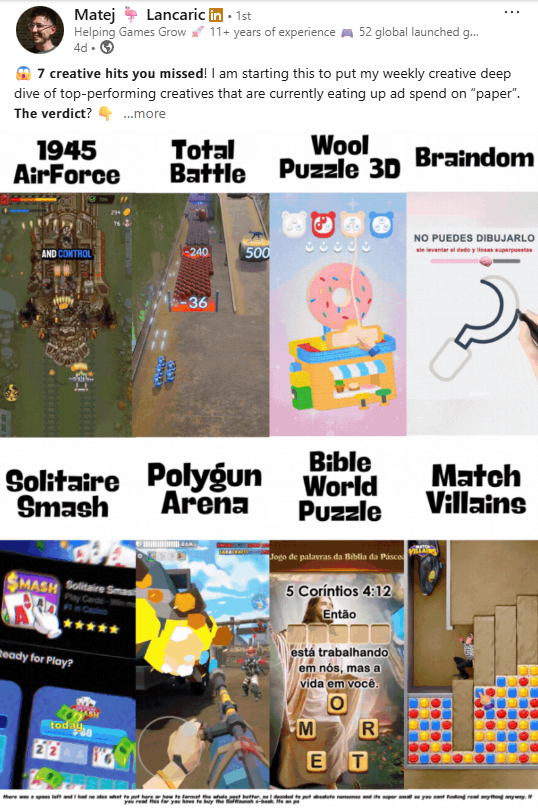
Marketing expert Matej Lancaric is happy to show off every week the disaster that mobile marketing as become

The good news is that marketing cannot be like that.

Marketing is the generous act of showing up with a true story that helps people get to where they’d like to go.

Seth Godin

Game design can seriously help to find the true story to tell to the people. The issue stands in the business model of free-to-play, of course. In a model where 5% (at best) of people pays something, and that something is variable and potentially very high, you need a massive volume of installs.

But maybe mobile gaming could be different and not just free-to-play. The point is to convince founders and CEOs to believe in this.
Start making memorable levels

If you are making levels professionally, you cannot just jump in the engine and placing shapes and mechanics here and there. You need a way of plan and communicate your design choices ahead. The big picture of the level and how it fits into the overall scheme of things is very much needed.

That’s why we use beat charts, a spreadsheet that puts everything in perspective. In my case, I have these fields:

  • Level ID: Unique name for the level, it should also correspond to the actual scene or map name inside of the engine.
  • Layout: a screenshot (or a link to a screenshot) of the level so that you and your teammates can directly recognize them when you have dozens levels.
  • Skill atom: the original unique thing the Player should learn or confirm during this level
  • Twist: if there is a special twist, describe it here. This can be filled later and just planned with a true/false text
  • List of mechanics: each column a single mechanic and a true/false if that mechanic is present inside of a level. Put the columns in order of appearance
  • Difficulty: the % of players who will not pass the level or die at least once.
  • Narrative: a short brief of what you are conveying to the Players (it can be a story, but also specific emotions)
  • Mood: useful to suggest your mood to environment art or in general artists. Try to put a mood board for them to understand. You can reuse the same mood boards over and over, of course. In this way you will also predict the weight of your design choices.
  • Music: similar to mood but put your musical references focusing on the feeling the Player should experiment during the level.

Roblox: unprofitably unsafe

The CEO of Roblox gave an interview to one of the most popular NYTimes podcasts and the industry didn’t reacted well. I found it insightful and I tend not to judge people, especially salesmen, when they are selling something.

The issue with Roblox stands in its business model. Everybody knows that when a service is for free, the product is you. And in Roblox, the product are the kids. If they would really fix the issue with kids safety, they should start from there. They should put on a subscription model, where 100% of kids (or better, their parents) will pay a fixed amount just to play. In that way, things would change a lot.

And maybe, who knows, Roblox would also become a profitable business. Because since day 1, it has never been profitable. Roblox relies on investors who believe that, at some point, all those users will eventually generate profits. But for now, it’s a leaking bucket.

I connect through game design

I work in games not as an individual creator, but to do it with others. Game design is a way to get in touch with others, teammates and potentially players. I am not a solodev, I struggle really hard when I do projects completely alone also if at times is necessary to push my boundaries.

That’s another reason why I do teach and I join online courses, as well. As a freelancer, I don’t always have clients. There are periods in which I dedicate to personal project, such as the book I am writing, and I feel very alone professionally speaking. Having the excuse to meet other people to teach them or to study with them fixes partially that problem. I am also on Discord channels, but I feel hard to follow discussions there because of the way Discord is designed.

A clockmaker’s craft

Many confuse casual games with simple games. Casual games permit the satisfaction of instinctual needs in small (2–5 minute) play sessions. However, many hardcore players of these casual games can play them for hours. In fact, they are the players who actually maintain the business.

I’ve worked on a bunch of them, and I feel like a clockmaker. They may feel simple, but they are deep: you move one gear and you must check all the others connected to it. You need patience to achieve the sweet spot (the perfect balance).

To properly study your competitors, you need to analyze them in immense detail. You may even need to record a session and review it frame-by-frame to fully understand the game’s circuit and how it works.

Vulnerable latitude

I have met plenty of professionals who don’t actually love working in games, including game designers. I’m sure this is not news to you, and I also believe that everyone has a right to work in an industry as big as gaming, even if only for a while.

Yesterday, I met one of these people, who told me, “Videogames are your beach!” (using a Brazilian, Rio de Janeiro slang phrase). And I agree; I genuinely love my profession.

I have proof of that because I often put myself in a vulnerable financial position just for the sake of engaging in game design. A client might offer me shares as part of my compensation. If I like the client or the project, I accept, even if I know I may never see any money from it. I know that my task will end, the client will close the collaboration, and I will lose all shares.

I know this, and I consciously make that choice because I love what I do.

But I deeply respect the professionals who don’t care too much—the ones who pass through the industry like tourists, earn some money, and move on. They will have the opportunity to explore different things, and their minds probably won’t be 110% focused on games all the time, unlike mine. I respect that attitude very much as well.

Be honest, be indie

I believe the single most important quality for indie developers is honesty. This is their secret weapon. It is nearly impossible for a Top 10 company to achieve full honesty because of their size and stakeholder structure. Honesty, however, allows you to consistently put out your authentic voice.

Recently, while consuming content in the indie space (podcasts and video), I’ve noticed a significant increase in marketing awareness. This often translates into the typical marketing discourse: “how to make trending things faster and avoid struggling too much.”

But that, in my humble opinion, misses the entire point of being an indie. Independence requires you to embrace the struggle and invest genuine effort—not just hours, but intense thought and creative energy. If you end up simply chasing trends, you risk falling into the trap of industrialization, product managerization, and creating derivative work.

I am not arguing against trend awareness or chasing money; of course, we work for money. But I am asserting that if you want to truly succeed in the indie space, you must prioritize honest self-expression. Put your authentic voice out there for real—even if your true call is to make a niche friends-to-lovers sim or a niche horror game.

Fast & Slow

Previous post I talked about being part of a high performance team and how we’re able to become so effective in term of our output. This post is about a personal observation in how I’m able to work in such an environment and keep up with the team.

I’ve noticed that my contribution is not consistent. It is fast one day and slow the other day. Ow how I used to hate the fact that I’m slow on certain days, or sometimes even extended periods of time, while seeing the fast periods as normal. But I’ve come to understand that these slower days have a purpose.

Sometimes, being slow means that you need to recover and reenergize from a previous high performance day.

At other times the slower days means that for that particular moment I should spend my time working on something else. When it comes to new ideas and design solutions they sometimes it just require me to be in a particular mood, a particular zone in order for ideas and solutions to come naturally and fast.

Sometimes, being slow means I do not have enough input, or just not spend enough time on finding the solution. Sometimes, it means that I just need to stare longer at the particular problem I want to solve.

In the end, I came to realize that being able to be fast and productive I have to accept that being slow at other times is just part of the process and one does not exist without the other. I’m becoming more mindful of my energy, my own flow, my own limitations and my own process. I’m more accepting of myself.

How to use KPIs

I insist a lot on the importance of entertainment when we design new games. I spoke on this blog regarding the satisfaction of core instincts, and I am aware that someone would need something more actionable and practical. The easy resource is KPIs, which often are seeing like targets to hit. They aren’t in my opinion: they are diagnostic tools for spotting flaws in your gameplay, indicators.

For every feature, we first define the specific utility it provides, and then we measure its impact on player behavior.

Player InstinctThe Utility ProvidedImpact (examples)
Acquisition (Urge to collect)Giving the player interesting things to collect that drive progression.Completion Rate (Quests, levels, and the final game).
Social Connection (Gregariousness)Maintaining engagement and fostering community.Stickiness and high D7 Retention. Track the specific flows to connect with others and also the number of social interactions.
Assertiveness & MasteryThe feeling of power and competence within a core system.Win Rate and Feature Usage.
CuriositySatisfying the urge to discover new things.High Session Length. Qualitatively, the best sign is playtesters who genuinely want more at the end of a prototype. Check also heuristics after a playtest

Prototypes are essential, especially when playtested and attached to heuristics. By leading with the projected impact on player behavior, we demonstrate business value. This is how we continue the pursuit of l’avenir, the radical, unexpected break from the past.